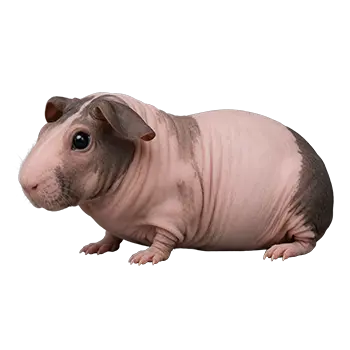

Origins & Development

The Baldwin guinea pig owes its existence to a spontaneous genetic mutation that first appeared in a litter of golden American Crested guinea pigs in the early 1990s in San Diego, California. A breeder named Carol Miller noticed that one particular pup began losing its fur gradually after birth, eventually becoming completely hairless by adulthood. Intrigued by this unusual trait, Miller selectively bred the offspring to isolate and stabilize the hairless gene, laying the groundwork for what would become a recognized breed.

Unlike the Skinny pig, which is born mostly hairless, the Baldwin is born with a full coat of fur that progressively sheds over the first several weeks of life. This distinctive developmental pattern is caused by a different recessive gene than the one responsible for hairlessness in Skinny pigs. The shedding process typically begins around five days of age, starting at the head and working backward until the guinea pig is entirely bald by approximately two months old.

The establishment of the Baldwin as a distinct breed required years of careful selective breeding to ensure healthy bloodlines. Early breeders worked to expand the gene pool while maintaining the hairless trait, outcrossing to standard-coated guinea pigs and then breeding back to preserve the Baldwin phenotype. This painstaking effort helped reduce the risks associated with a limited founder population and contributed to the breed's overall vigor.

By the early 2000s, the Baldwin had developed a dedicated following among cavy enthusiasts in the United States and was beginning to attract attention internationally. Breeders established informal networks to share knowledge about the breed's unique care requirements and genetic background, building the foundation for a supportive community that continues to grow.

Historical Roles

While guinea pigs as a species have a long history as both food animals and companion pets in South America, the Baldwin is an entirely modern creation with no deep historical lineage. Its primary role from the very beginning has been that of a companion animal and exhibition cavy. The breed's striking appearance and gentle temperament quickly made it a favorite among hobbyist breeders who valued novelty and were eager to work with a new genetic line.

The Baldwin has also played a notable role in scientific research, particularly in dermatological studies. Because its skin is fully exposed and structurally similar to human skin in many respects, the Baldwin has been used in research related to skin conditions, wound healing, and the effects of ultraviolet radiation. While this application has been controversial among pet owners, it has contributed to a broader scientific understanding of dermatological processes.

In the world of cavy shows, the Baldwin occupies an interesting niche. Some cavy organizations have created specific classes for hairless breeds, allowing Baldwins to compete alongside Skinny pigs. Others have been slower to grant formal recognition, viewing hairless varieties as novelties rather than established breeds. Regardless of official status, Baldwin owners have consistently brought their animals to shows and exhibitions, generating curiosity and conversation among attendees.

The breed has also served as an ambassador for guinea pig ownership more broadly. Its unusual appearance draws attention at pet expos, educational events, and social media platforms, sparking interest in guinea pigs among people who might not otherwise consider them as pets. This ambassadorial role has been an informal but meaningful part of the Baldwin's history.

Cultural Symbolism

Hairless animals have long occupied a special place in human culture, often symbolizing vulnerability, uniqueness, and unconventional beauty. The Baldwin guinea pig fits squarely into this tradition. For many owners, the choice to keep a Baldwin is a deliberate statement that beauty is not defined by conventional standards, and the breed has become something of an icon within communities that celebrate individuality and acceptance.

Within the guinea pig hobby, the Baldwin represents the spirit of genetic exploration and the willingness to embrace the unexpected. Its origin story, rooted in a chance mutation that a curious breeder chose to nurture rather than discard, resonates with enthusiasts who see selective breeding as both an art and a science. The Baldwin reminds the cavy community that new possibilities can emerge from the most unlikely beginnings.

The breed's appearance has also made it a subject of humor and affection online, where photos of Baldwins are often shared with playful captions comparing them to tiny hippos, potatoes, or wrinkly babies. This lighthearted cultural presence has helped destigmatize hairless animals and challenged the assumption that pets must be fluffy to be lovable. Far from being put off by the Baldwin's appearance, many people find themselves charmed by its expressive skin folds and warm, velvety texture.

In some circles, the Baldwin has taken on a countercultural significance, embraced by owners who identify with nonconformity and who see their pet as a reflection of their own values. This symbolic dimension adds richness to the breed's cultural footprint, elevating it beyond a simple companion animal to a small but meaningful cultural marker.

Breed Clubs & Standards

The Baldwin guinea pig has achieved varying degrees of formal recognition depending on the cavy organization in question. In the United States, the American Cavy Breeders Association has historically been conservative in granting recognition to newer breeds, and the Baldwin's journey toward full acceptance has been a gradual one. Breeders have submitted proposals and worked to develop a consistent breed standard that addresses the Baldwin's unique characteristics, including skin texture, body conformation, and the acceptable presence or absence of residual hair.

A working breed standard for the Baldwin typically describes a robust, well-muscled animal with smooth, elastic skin that is free of excessive wrinkling except around the head, shoulders, and legs. The skin should feel warm and slightly rubbery to the touch. Minor fuzz on the feet and muzzle is generally permissible, but significant hair growth elsewhere is considered a fault. Body type follows the general guinea pig ideal of a broad, rounded profile with a strong, level back.

Outside the United States, recognition varies considerably. Some European cavy clubs have embraced hairless breeds more readily, creating dedicated show categories and developing their own standards. In the United Kingdom, Scandinavian countries, and parts of continental Europe, Baldwin enthusiasts have formed breed-specific clubs or subgroups within larger cavy organizations to advocate for recognition and promote responsible breeding.

Online communities and social media groups have become important venues for Baldwin breed clubs, particularly in regions where the breed population is still small. These virtual organizations facilitate knowledge sharing, coordinate breeding programs, and organize informal shows and meetups. They play a crucial role in maintaining genetic diversity and promoting best practices for Baldwin care and husbandry.

The Breed Today

Today the Baldwin guinea pig enjoys a stable and growing following worldwide, though it remains a relatively uncommon breed compared to popular coated varieties like the American or Abyssinian. Dedicated breeders in the United States, Canada, Europe, and Australia continue to refine the breed, focusing on improving body type, skin quality, and overall health. The Baldwin community, while small, is notably passionate and well-organized.

Advances in husbandry knowledge have significantly improved the quality of life for Baldwin guinea pigs. Owners now have access to detailed care guides addressing the breed's special needs, including skin care routines, temperature management, sun protection, and dietary considerations that support healthy skin. This wealth of information, much of it developed and shared through online communities, has made Baldwin ownership more accessible to newcomers.

The Baldwin's popularity on social media platforms continues to grow, with dedicated accounts on various platforms attracting substantial followings. These accounts showcase the breed's personality and charm, helping to dispel misconceptions about hairless animals and introducing the Baldwin to audiences around the world. The breed's photogenic quality, particularly the expressive wrinkles and range of skin colors, makes it a natural fit for visual platforms.

Breeding programs today place a strong emphasis on genetic diversity and health. Responsible Baldwin breeders maintain detailed pedigree records, screen for hereditary conditions, and practice strategic outcrossing to coated guinea pigs to maintain vigor. The breed's future looks promising, with steady interest from new enthusiasts and a committed core community working to ensure the Baldwin's continued health and development.

Notable Individuals

While the Baldwin guinea pig world does not have the same tradition of celebrity individuals as the dog world, certain animals and breeders have achieved recognition within the cavy community. Carol Miller, the San Diego breeder who first identified and developed the Baldwin breed from a spontaneous mutation in her American Crested line, is widely regarded as the breed's founder. Her decision to pursue the hairless trait rather than dismissing it as an anomaly was the pivotal moment in the Baldwin's history.

Several Baldwin guinea pigs have achieved internet fame through social media, becoming beloved figures with dedicated followings. These animals, often photographed in elaborate setups or wearing tiny accessories, have served as ambassadors for the breed and for guinea pig ownership in general. Their popularity has introduced the Baldwin to millions of people who might never have encountered the breed otherwise.

Within the show world, certain Baldwin specimens have earned distinction for their exceptional conformation and skin quality, setting benchmarks that breeders continue to reference. While these animals may not be household names outside the cavy fancy, their contributions to the breed's development through their genetics and the standards they represent are significant and enduring.

Breeder-educators who have published care guides, produced instructional videos, and mentored new Baldwin owners also deserve recognition as notable figures in the breed's history. Their efforts to disseminate accurate information about Baldwin care have raised the standard of husbandry across the community and helped ensure that new owners are well-prepared for the unique responsibilities of keeping a hairless guinea pig.

Always consult a qualified professional before making any health-related decisions. This content is provided for informational reference only and should not replace professional guidance specific to your animal.