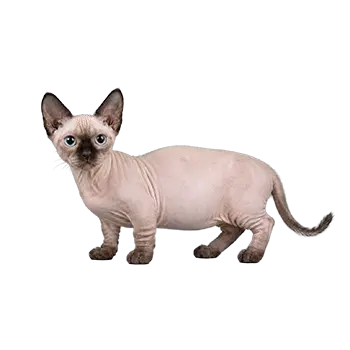

Film & Television

As a rare and recently developed breed, the Minskin has had little direct presence in film and television, where hairless cats on screen are far more often Sphynxes. When productions want the striking look of a bare-skinned cat — typically to signal villainy, wealth, or eccentricity — they have historically reached for the better-established breed.

The Minskin's combination of short legs and a partial coat is subtle on camera and easily mistaken for other cats, which further limits its on-screen identification. Viewers who spot an unusual small hairless cat in media are usually seeing a Sphynx or a generic "hairless cat" rather than a confirmed Minskin.

This low profile is consistent with the breed's overall rarity; screen appearances tend to follow population size and public recognition, both of which remain modest for the Minskin.

Literature & Art

In literature and visual art, hairless cats appear as symbols of the strange and the striking far more often than any specific breed is named. The Minskin, being both new and uncommon, has not yet established a distinct literary or artistic identity of its own.

Contemporary pet photography and illustration have embraced hairless and unusual cats for their sculptural, expressive forms, and Minskins occasionally feature in this work. Their wrinkled skin, large ears, and compact bodies lend themselves to portraiture that emphasizes texture and personality.

As the breed becomes more recognizable it may develop a stronger presence in art and writing, but for now its cultural footprint in these areas is small and largely folded into the broader category of hairless cats.

Internet & Social Media

Social media is where the Minskin is most visible. Platforms built around images and short video have proven ideal for a breed whose appeal is strongly visual, and individual Minskins maintain followings that far exceed what the breed's small population might suggest.

The breed's photogenic mix of bare skin, fur points, and short legs performs well in the "unusual pet" content that circulates widely online. This visibility has helped drive interest and introduced many people to the breed's existence for the first time.

That online prominence carries a familiar caution: viral appeal can fuel impulse demand for rare breeds without a matching understanding of their care needs. Responsible breeders and owners often use the same platforms to share accurate information about the breed's grooming, warmth, and skin-care requirements.

Advertising & Branding

Hairless cats are a recurring choice in advertising and branding when a campaign wants to convey novelty, luxury, or playful strangeness. As with film, however, that role is dominated by the more numerous and recognizable Sphynx rather than the Minskin specifically.

The Minskin's smaller stature and partial coat make it less immediately legible as "the hairless cat" that advertisers typically seek, so deliberate use of the breed in commercial imagery is uncommon.

Where unusual cats do appear in branding, they tend to be chosen for their attention-grabbing silhouette rather than for any breed-specific association, meaning the Minskin rarely receives distinct billing.

The Popularity Effect

Rising online visibility for unusual cat breeds creates a recognizable cycle: striking images drive demand, demand draws new breeders, and rapid expansion can outpace responsible breeding practice. For a small breed like the Minskin, this dynamic carries real risk.

Because the breed combines two traits that are themselves the subject of welfare debate, surges in popularity can incentivize careless breeding that prioritizes appearance over health. Prospective owners are encouraged to seek breeders who screen for genetic and structural problems rather than those simply meeting demand.

The healthiest version of popularity for the Minskin is informed interest — admiration paired with a realistic understanding of the breed's needs and of the ethical questions surrounding its foundation traits.

Always consult a qualified professional before making any health-related decisions. This content is provided for informational reference only and should not replace professional guidance specific to your animal.