
Origins & Development

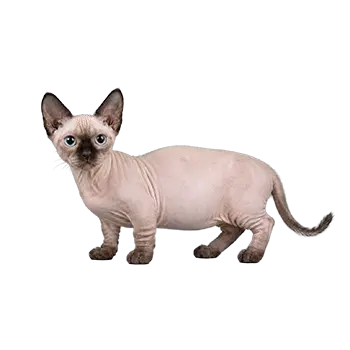
The Minskin is one of the cat fancy's more recent creations, developed in Boston, Massachusetts by breeder Paul McSorley beginning in 1998. McSorley set out to design a small cat that combined the short legs of the Munchkin with the sparse, suede-like coat associated with the Sphynx, producing the distinctive "fur-pointed" appearance that defines the breed.

The first kitten matching McSorley's vision arrived in the summer of 2000, a cat he named TomCat. From that foundation the program expanded slowly and deliberately, and by the middle of the decade only a few dozen Minskins existed worldwide.

From the outset the breed was developed with careful outcrossing to maintain genetic diversity and health, drawing on several established breeds rather than a single source. This measured approach reflected lessons learned by earlier dwarf- and hairless-cat programs about the risks of a narrow gene pool.

The Foundation Breeds

The Minskin draws on four principal breeds. The Munchkin contributes its short-legged trait, caused by a naturally occurring dominant gene that affects limb length. The Sphynx provides the hairlessness, the Devon Rex contributes coat texture and refinement around the points, and the Burmese is credited with the breed's rounded body type and warmly affectionate disposition.

The result is a cat described as having "fur points" — cashmere-like fuzz concentrated on the face, ears, legs, and tail, set against a largely bare, warm-to-the-touch torso. This patterning is the breed's signature and distinguishes it from fully hairless cats.

Because two of these foundation traits — short legs and hairlessness — are the subject of ongoing welfare discussion, responsible Minskin breeders place strong emphasis on health screening and on avoiding pairings that could compound physical strain.

Cultural Symbolism

Hairless and short-legged cats tend to provoke strong reactions, and the Minskin sits squarely within a broader cultural fascination with unusual feline forms. To admirers, the breed's bare skin and compact stature read as endearing and almost otherworldly; to skeptics, the same features raise questions about how far selective breeding should go.

Hairless cats have long carried an air of the exotic, sometimes linked in the popular imagination to the temple cats of antiquity, though such associations are romantic rather than historical. The Minskin, as a deliberately designed modern breed, instead symbolizes the contemporary cat fancy's appetite for novelty and for distinctive companions.

Its small size and dependent, people-oriented nature have also made it an emblem of the "lap cat" ideal — a companion bred less for any working purpose than for close human company.

Registry Recognition & Standards

The Minskin was accepted by The International Cat Association into its Preliminary New Breed program in 2008, an early developmental stage that allows registration and exhibition while a breed's population and consistency grow. Full championship recognition requires meeting population, genetic-diversity, and consistency benchmarks over time.

Major registries differ in how they treat dwarf and hairless breeds. Some, including the Cat Fanciers' Association, have historically declined to recognize short-legged breeds on welfare grounds, meaning recognition of the Minskin is far from universal across the cat fancy.

Breed standards describe a small cat with short, sturdy legs, a rounded head, large ears, and the characteristic fur-pointed coat. Because the breed remains in active development, these standards continue to be refined as breeders and registries gather data.

The Breed Today

The Minskin remains rare. Worldwide numbers are modest compared with established breeds, and dedicated breeders are concentrated in a relatively small number of catteries, primarily in North America with a scattering elsewhere.

Interest has grown alongside broader enthusiasm for hairless and unusual breeds, but reputable breeders typically maintain waiting lists and screen homes carefully. Prospective owners are encouraged to verify health testing and to understand the breed's particular care needs before committing.

The breed's future depends in part on the evolving welfare conversation around dwarf and hairless cats, which shapes registry policy, breeding practice, and regional legality. Responsible breeders increasingly frame the Minskin's development as an ongoing project in which health takes precedence over appearance.

Notable Individuals & Pioneers

The most significant individual in the breed's story is TomCat, the first kitten to embody Paul McSorley's intended type around the year 2000 and, in effect, the breed's founding cat. McSorley himself remains the figure most associated with the Minskin's creation and early direction.

Unlike older breeds with celebrated show champions or famous animal actors, the Minskin's rarity means it has produced few widely known individual cats. Such visibility as it has tends to come from social media, where individual pet Minskins have attracted followings.

The breed's pioneers are therefore best understood as a small community of breeders working to stabilize type and health, rather than a roster of famous show winners.

Always consult a qualified professional before making any health-related decisions. This content is provided for informational reference only and should not replace professional guidance specific to your animal.