
Origins & Development

The Khao Manee is one of Thailand's truly native cats, with a heritage that reaches back centuries into the region historically known as Siam. Its name comes from Thai and is usually translated as "White Gem" or "White Jewel," a reference both to the cat's flawless, snow-white coat and to its luminous, jewel-like eyes. Unlike many modern pedigree breeds that were deliberately engineered over a few generations, the Khao Manee developed as a naturally occurring landrace, valued and propagated by the people who lived alongside it.

Much of what is known about the breed's early existence comes from Thai cultural memory rather than formal stud records. The cat appears in the tradition of the Tamra Maew, the illustrated "Cat-Book Poems" that catalogued auspicious and inauspicious cats of old Siam. White cats held a special place in this tradition, prized for their purity of color and the belief that they carried good fortune to the households that kept them.

For much of its history the Khao Manee remained largely confined to Thailand, kept within families and, by tradition, within royal and aristocratic circles. This relative isolation helped preserve the breed's distinctive look, but it also meant the cat was virtually unknown to the wider world until comparatively recent decades, when breeders outside Thailand began working to document and establish it formally.

Historical Roles

Within Thai society the Khao Manee was prized less as a working animal and more as a living emblem of good fortune. White cats were associated with prosperity, longevity, and high status, and a pure-white cat with bright eyes was considered an especially desirable companion. Such cats were kept close to their owners as cherished pets rather than tasked with the rodent-control duties common to barn and street cats elsewhere.

Tradition strongly links the breed to royalty. Stories handed down in Thailand describe white cats being kept within palace walls and protected as treasures of the court, a status that reinforced their reputation and helped keep the bloodlines distinct. While precise historical documentation is limited, the cultural association between the Khao Manee and Thai nobility is durable and well attested in the breed's lore.

This role as an auspicious household companion shaped the cat that exists today. Generations of selection for temperament as well as appearance produced an animal that is sociable, people-oriented, and comfortable at the center of family life rather than aloof or solitary.

Cultural Symbolism

In Thai symbolism the color white carries connotations of purity, merit, and spiritual cleanliness, and the Khao Manee embodied those ideals in feline form. The breed's unbroken white coat and brilliant eyes made it a natural emblem of good luck, and owning one was thought to invite wealth and long life into the home.

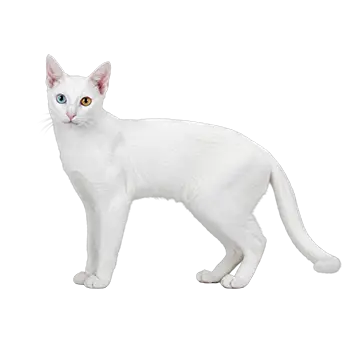
The cat's eyes are central to its symbolic appeal. Khao Manee may have blue eyes, gold or amber eyes, or strikingly mismatched "odd eyes," with one of each color. The odd-eyed cats in particular have earned the nickname "Diamond Eye," and this jewel imagery is woven directly into the breed's identity and name.

The Khao Manee also sits within a broader family of celebrated Thai cats, alongside the Wichienmaat (the ancestor of the modern Siamese) and the blue-gray Korat, known in Thailand as the Si-Sawat. Each of these cats carried its own auspicious associations, and together they formed a recognized tradition of treasured native breeds that distinguished Thailand's feline heritage.

Breed Clubs & Standards

Formal recognition of the Khao Manee outside Thailand is a relatively recent development. Dedicated breeding efforts in the West are generally traced to the late 1990s, when foundation cats were imported and breeders began establishing programs aimed at preserving the landrace while documenting it to modern registry standards.

The Khao Manee was accepted into the registration process of The International Cat Association (TICA) as a developing breed, advancing through preliminary stages before achieving full championship recognition in the mid-2010s. This progression gave the breed a formal standard against which cats could be evaluated and shown.

Breed standards describe the Khao Manee as a moderate, muscular shorthaired cat with a pure white, close-lying coat and no other coloration. The eyes are a defining feature, accepted in blue, gold, or odd-eyed combinations. Because the breed is still being established internationally, registries and preservation breeders place particular emphasis on maintaining genetic diversity and honoring the cat's natural Thai origins.

Dedicated breed clubs and preservation groups, both within Thailand and abroad, continue to coordinate breeding, share bloodline information, and promote responsible ownership as the breed becomes better known.

The Breed Today

The Khao Manee remains a rare breed by global standards. Although recognition has grown and small breeding programs now exist in several countries, the worldwide population is modest, and the cat is still far more common in its Thai homeland than anywhere else.

For breeders and enthusiasts, that rarity brings both pride and responsibility. With a limited founding population, careful attention to genetic diversity and health is essential to keep the breed sustainable. Preservation-minded breeders often emphasize sourcing from Thailand where possible to broaden the gene pool and maintain the cat's authentic character.

Prospective owners today are typically drawn to the breed's striking appearance and lively, affectionate personality. Waiting lists are common, and reputable breeders tend to screen homes carefully. The breed's growing visibility on the internet has introduced it to a far wider audience than ever before, gradually moving it from obscurity toward broader appreciation while keeping numbers comparatively small.

Notable Individuals

Because the Khao Manee is a rare and recently documented breed, it has not accumulated the long roster of individually famous animals associated with older, more populous breeds. Its fame rests more on its collective cultural identity than on any single celebrated cat.

The most historically significant individuals are the foundation cats that established Western breeding lines from the late 1990s onward. These imported Thai cats, and the early generations bred from them, are the reference points that pedigrees and preservation efforts trace back to, and they are remembered within the breed community much as foundation stock is honored in any developing breed.

Within Thailand, the breed's prestige is tied less to named cats than to its enduring royal and aristocratic associations. In the modern era, the most visible individual Khao Manee tend to be the ambassador cats kept by breeders and the standout show animals that have helped introduce the breed to international audiences and demonstrate the standard in person.

Always consult a qualified professional before making any health-related decisions. This content is provided for informational reference only and should not replace professional guidance specific to your animal.