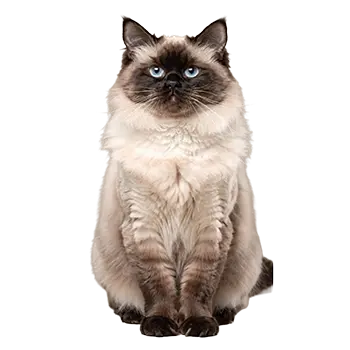

The Himalayan is not a breed shaped by centuries of natural selection or regional isolation. It is instead the product of deliberate, scientifically informed crossbreeding undertaken in the early twentieth century, making it one of the most meticulously engineered cat breeds in existence. The goal was straightforward in concept but demanding in execution: combine the luxurious coat and placid temperament of the Persian with the striking colorpoint pattern of the Siamese. Achieving that vision required decades of selective breeding and an understanding of recessive genetics that was still relatively new to the cat fancy.
The earliest documented efforts to produce a colorpoint longhaired cat began in the 1920s and 1930s. In Sweden, geneticist and cat breeder Dr. Tjebbes conducted crosses between Siamese and white Persians to study the inheritance of coat color. Around the same time, researchers at Harvard Medical School, notably Dr. Clyde Keeler and breeder Virginia Cobb, undertook a parallel program in the United States. Their 1936 paper described the successful production of a longhaired colorpoint kitten named Debutante, confirming that the Siamese point-restricted pigmentation pattern could be transferred to a Persian-type cat through controlled matings.
These early experiments were driven primarily by scientific curiosity rather than commercial breeding ambitions. The cats produced in these programs demonstrated that the colorpoint gene was recessive and could be carried invisibly through multiple generations before expressing itself. This insight was a significant contribution to the emerging field of feline genetics, but the cats themselves were not immediately developed into a recognized breed. The intervening years of World War II disrupted many breeding programs across Europe and North America, delaying the Himalayan's progress as a formal breed.
Following the war, breeders on both sides of the Atlantic resumed work in earnest. In Britain, breeders used the designation Colourpoint Longhair to describe their developing lines, while American breeders adopted the name Himalayan, inspired by the colorpoint pattern found in Himalayan rabbits rather than by any geographic connection to the Himalayan mountain range. By the early 1950s, dedicated breeding programs in the United States and the United Kingdom had produced cats that consistently displayed the desired combination of Persian body type with Siamese coloring.