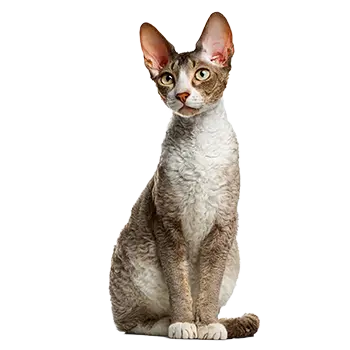

The Cornish Rex traces its origins to a single remarkable kitten born on July 21, 1950, on a farm in Bodmin Moor, Cornwall, England. Nina Ennismore, a farmer who also bred and exhibited curly-coated Rex rabbits, noticed that one kitten in a litter born to her tortoiseshell cat Serena was strikingly different from its siblings. The cream-colored male, which she named Kallibunker, had an unusually slender body and a coat of tight, Marcel-like waves rather than the typical straight fur seen in domestic cats.
Ennismore recognized the kitten's curly coat as resembling the Rex mutation she was already familiar with from her rabbit breeding program. On the advice of geneticist A.C. Jude, she backcrossed Kallibunker with his mother Serena, producing a litter that included two more curly-coated kittens. This confirmed that the Rex coat was the result of a recessive genetic mutation. One of those offspring, a male named Poldhu, went on to become a key foundation sire for the breed.
The genetic mutation responsible for the Cornish Rex coat affects only the undercoat, leaving these cats without the typical guard hairs and awn hairs found in most domestic felines. This results in their signature soft, rippling coat that feels like crushed velvet or silk to the touch. The mutation arose spontaneously and was unrelated to any previous curly-coated breeds, setting the Cornish Rex apart as a genetically unique variety from the very beginning.
In its earliest years the breed remained confined to a handful of dedicated breeders in England who worked to establish a viable population from the limited genetic base. Outcrossing to Siamese, Burmese, and British Shorthairs was employed to broaden the gene pool while preserving the distinctive Rex coat and refining the elegant body type that would become the breed's hallmark.