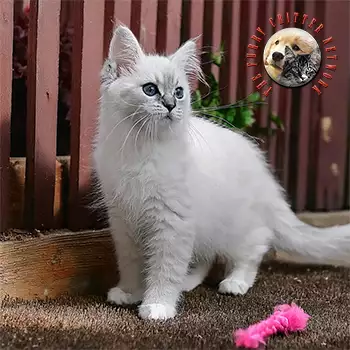

The Burmilla owes its existence to one of the most celebrated accidents in cat breeding history. In 1981, in the United Kingdom, a lilac Burmese female named Bambino Lilac Fabergé escaped from her room just before she was scheduled for a planned mating and encountered a Chinchilla Persian male named Jemari Doha Doha. The resulting litter of four female kittens displayed a striking shaded silver coat over a Burmese body type that immediately captured the attention of their owner, Baroness Miranda von Kirchberg.
The kittens were so remarkable in appearance that a deliberate breeding program was established to reproduce and refine these characteristics. Early breeders worked to combine the muscular, compact body of the Burmese with the shimmering, tipped coat of the Chinchilla Persian. The goal was not simply to replicate the original cross but to develop a breed that consistently expressed these traits across generations while maintaining sound health and temperament.
The breed's name is a portmanteau of its two parent breeds, combining "Burm" from Burmese and "illa" from Chinchilla. Initial breeding efforts focused heavily on outcrossing back to Burmese lines to preserve the breed's distinctive body type and sociable personality while retaining the silver-tipped coat. Over time, breeders refined the standard and reduced the reliance on outcrosses, creating a stable and predictable gene pool.
By the mid-1980s, the Burmilla had attracted a dedicated group of breeders across the United Kingdom and parts of Europe. A breed club was formed, and efforts began to gain formal recognition from major cat registries. The careful documentation of early pedigrees and the consistency of the breeding program laid a strong foundation for the breed's future development.