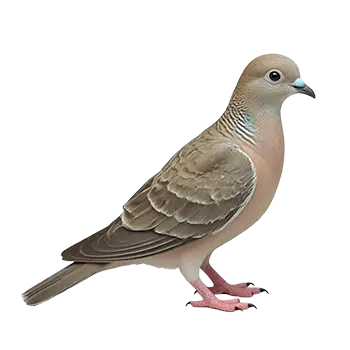

The Zebra Dove (Geopelia striata) is a small, ground-dwelling columbid native to the tropical and subtropical lowlands of Southeast Asia. Its historical range spans the Malay Peninsula, the Indonesian archipelago including Java, Sumatra, and Bali, and extends into parts of southern Thailand, Myanmar, and the Philippines. The species evolved to occupy open woodlands, scrublands, cultivated fields, and the margins of human settlements, a habitat preference that would prove instrumental in its long and intimate relationship with people across the region.
The bird's common name derives from the fine, dark barring that covers its breast and flanks, creating a pattern reminiscent of zebra striping. This delicate plumage, combined with its small stature and gentle demeanor, distinguishes the Zebra Dove from larger and more conspicuous members of the pigeon and dove family. Taxonomically, Geopelia striata sits within a small genus of Australasian ground doves, with its closest relatives being the Peaceful Dove of Australia and the Barred Dove of the Lesser Sunda Islands.
In its native habitats, the Zebra Dove is a bird of edges and clearings rather than dense forest interiors. It forages on the ground for grass seeds, small grains, and tiny invertebrates, often moving in loose pairs or small flocks along roadsides, garden paths, and the borders of rice paddies. This comfort with open, human-modified landscapes allowed the species to thrive alongside the expansion of agriculture and village life across Southeast Asia, creating the conditions for its eventual domestication and cultural elevation.
The species' adaptability to disturbed and semi-urban environments has also driven its establishment as an introduced population in numerous regions outside its native range. Zebra Doves have been successfully introduced to Hawaii, parts of coastal Australia, Madagascar, Mauritius, the Seychelles, and Tahiti, among other locations. In many of these places, feral populations descended from released or escaped captive birds now flourish, a testament to the species' ecological flexibility and its centuries-long association with human activity.