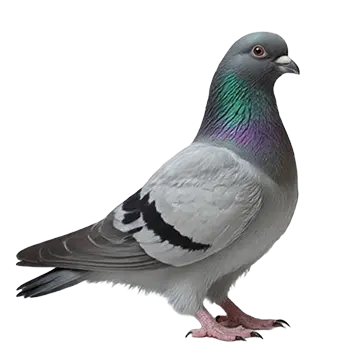

The Tumbler Pigeon's earliest and most consequential appearance in Western literature came through the work of Charles Darwin, whose books On the Origin of Species and The Variation of Animals and Plants Under Domestication gave the breed group a prominent place in one of the most influential scientific arguments ever published. Darwin was himself an avid pigeon keeper who maintained a loft at his home in Downe, Kent, and he devoted detailed passages to the Tumbler's distinctive behavior, skeletal modifications, and the extraordinary diversity that selective breeding had produced within the group. His descriptions of Short-faced Tumblers, in particular, were vivid enough to give Victorian-era readers a clear picture of how profoundly artificial selection could reshape an organism.
Beyond Darwin, the Tumbler Pigeon appears in numerous works of natural history and animal husbandry from the 17th century onward. John Moore's Columbarium, or, the Pigeon-House, published in 1735, is one of the earliest English-language texts to describe Tumbler varieties in systematic detail, offering insights into the breeding practices and competitive culture of Georgian-era London pigeon fanciers. Subsequent pigeon-keeping manuals throughout the 18th and 19th centuries devoted substantial chapters to the Tumbler group, establishing a body of specialized literature that continues to grow today.
In fiction, pigeons as a broader category have appeared in works ranging from children's stories to literary novels, though the Tumbler specifically is less commonly singled out by name. However, narratives about pigeon keeping and urban pigeon culture frequently draw on imagery and themes closely associated with the Tumbler tradition, including rooftop lofts, competitive flying, and the close bond between keeper and bird. The pigeon-flying subcultures of cities like New York, Istanbul, and Lahore have inspired novels, short stories, and creative nonfiction that, while not always identifying Tumbler Pigeons by breed name, clearly depict the competitive flying traditions in which Tumblers and Rollers play a central role.
Poetry from the Persian and Mughal traditions offers another literary dimension. Classical Persian poets used pigeons as symbols of devotion, beauty, and the flight of the soul, and while these references encompass pigeons generally, the pigeon-keeping culture in which the poets were immersed was one deeply invested in Tumbler and high-flying varieties. The imagery of pigeons wheeling and tumbling against an open sky appears in verses that have been recited for centuries, embedding the Tumbler's aerial display in a rich literary tradition.