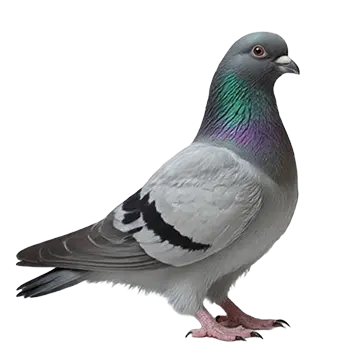

The Tumbler Pigeon belongs to one of the oldest recognized groups of domesticated pigeons, with roots that extend deep into the ancient civilizations of the Middle East, Persia, and the Indian subcontinent. All domestic pigeons descend from the wild rock dove (Columba livia), and the selective breeding that produced the tumbling trait is believed to have begun at least a thousand years ago, possibly much earlier. Ancient Persian and Mughal texts reference pigeons prized for their aerial acrobatics, and while the precise moment when the tumbling behavior was first isolated through selective breeding remains uncertain, the cultural record strongly suggests that fanciers in the region were cultivating rolling and tumbling bloodlines well before the medieval period.
The tumbling trait itself is a neurological behavior in which the pigeon performs backward somersaults during flight. This characteristic is heritable and appears to have arisen as a natural mutation within rock dove populations, one that early pigeon keepers found visually captivating and worth preserving. Over successive generations, breeders selected for birds that tumbled more frequently, more consistently, and with greater control, gradually establishing distinct strains that would become the ancestors of the many Tumbler varieties recognized today.
Persia, which encompassed much of modern-day Iran, was a particularly important center of early Tumbler development. Pigeon keeping in Persian culture was not a casual pastime but a deeply respected tradition intertwined with art, poetry, and social status. Wealthy households maintained elaborate pigeon lofts, and competitive flying was a well-organized activity with established rules and judging criteria. The birds that emerged from these Persian breeding programs were refined over centuries and eventually spread along trade routes to India, Turkey, and the broader Islamic world.
In India, the Tumbler Pigeon found equally fertile ground. The Mughal emperors were renowned patrons of pigeon keeping, and the courts of Akbar the Great and his successors supported extensive breeding programs that produced some of the most accomplished flying and tumbling strains in the world. Indian fanciers developed distinct regional varieties, each adapted to local preferences in tumbling style, body type, and plumage color. This parallel development in Persia and India established the two great historical traditions from which most modern Tumbler varieties ultimately descend.