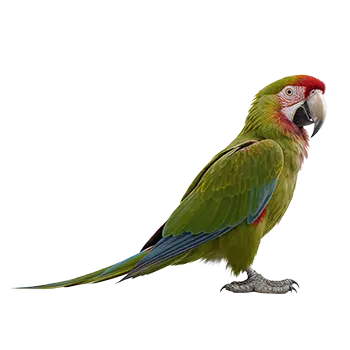

The Red-Fronted Macaw (Ara rubrogenys) is one of the most geographically restricted macaw species in the world, found exclusively in a narrow band of dry inter-Andean valleys in central Bolivia. Its range is confined to portions of the departments of Cochabamba, Chuquisaca, Santa Cruz, and Potosi, where steep-sided valleys carved by rivers such as the Rio Grande, Rio Mizque, and Rio Pilcomayo create a distinctive semi-arid landscape unlike the tropical lowland forests typically associated with macaws. This habitat, characterized by thorny scrub, cactus-studded hillsides, and scattered patches of deciduous woodland, sits at elevations ranging from approximately 1,100 to 2,500 meters above sea level.
The species evolved to exploit the particular resources of these Andean valleys. Red-Fronted Macaws feed on the seeds and fruits of native trees and shrubs, including species of Cnidoscolus, Jatropha, and Schinus, as well as cactus fruits and the pods of leguminous trees. During the agricultural season, the birds also forage on cultivated crops such as maize and peanuts, a behavior that has historically brought them into conflict with local farming communities. Their nesting sites are typically found in cliff faces and rocky outcroppings along river gorges, where natural cavities and eroded crevices provide sheltered locations for egg laying and chick rearing.
The dry valleys that constitute the Red-Fronted Macaw's habitat are ecologically fragile environments subject to seasonal extremes. The wet season brings sudden torrential rains that can cause flash flooding and landslides, while the dry season reduces available water and food sources to a minimum. The macaw's life cycle is closely synchronized with these seasonal patterns, with breeding timed to coincide with the period of greatest food abundance. This tight ecological coupling means that even modest changes in rainfall patterns or land use can have disproportionate effects on the population.
Unlike many macaw species whose ranges span multiple countries and diverse biomes, the Red-Fronted Macaw's extreme endemism makes it uniquely vulnerable. Its entire global population occupies an area estimated at roughly 6,000 square kilometers, a fraction of the range enjoyed by widespread relatives such as the Blue-and-Yellow Macaw or the Scarlet Macaw. This restricted distribution is not the result of recent habitat loss alone but reflects the species' deep evolutionary adaptation to a specific set of environmental conditions found nowhere else on Earth.