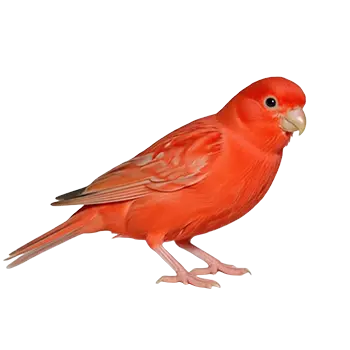

Origins & the Quest for Red

The domestic canary (Serinus canaria domestica) had been a fixture of European households for centuries before breeders turned their attention to a color that the species simply could not produce on its own: red. Canaries descended from the wild Atlantic Canary of the Canary Islands, Madeira, and the Azores naturally carry yellow and green pigments derived from carotenoids in their diet, processed through metabolic pathways that yield bright yellows, soft golds, and olive greens. True red, however, lay outside the species' genetic repertoire. No amount of selective breeding among domestic canaries could coax red plumage from a genome that lacked the enzymatic machinery to convert dietary carotenoids into red ketocarotenoids such as canthaxanthin and astaxanthin.

The idea of producing a red canary first gained serious traction in the early twentieth century, driven by the broader spirit of genetic experimentation that followed the rediscovery of Mendelian inheritance around 1900. European aviculturists, particularly in Germany, the Netherlands, and Belgium, had long been pushing the boundaries of canary breeding, developing new color mutations, feather types, and body conformations. The notion that a wild finch carrying red pigment genes could be crossed with the domestic canary to introduce that trait captured the imagination of breeders and scientists alike.

The wild bird identified as the most promising candidate for this cross was the Red Siskin (Spinus cucullatus), a small South American finch native to the coastal mountains and dry forests of northern Venezuela and adjacent Colombia. Males of the species display vivid red-orange plumage produced by ketocarotenoids, and their taxonomic proximity to canaries within the family Fringillidae suggested that hybridization, while difficult, might be biologically possible. Obtaining Red Siskins proved challenging, however, as the birds were neither common in the European trade nor easy to breed in captivity.

The quest for red was not merely an aesthetic exercise. It represented a test case for emerging theories of genetic inheritance, pigment biochemistry, and the practical limits of interspecies hybridization. The breeders who embarked on this project were working at the intersection of science and art, and their efforts would ultimately reshape the canary fancy in ways that extended far beyond a single color.

Early Hybridization Programs

The first documented crosses between domestic canaries and Red Siskins took place in the 1920s, with German breeder Hans Duncker and his collaborator Karl Reich among the earliest and most systematic experimenters. Duncker, a genetics professor in Bremen, approached the project with scientific rigor, carefully recording the outcomes of each cross and analyzing the inheritance patterns of plumage color in the resulting hybrids. His work demonstrated that the red pigment trait from the Red Siskin could indeed be transferred to hybrid offspring, though the first-generation birds were typically infertile males with muted, washed-out coloring rather than the vivid red that breeders envisioned.

Achieving fertile hybrids required patience and persistence. Female first-generation hybrids were sometimes fertile when backcrossed to domestic canary males, allowing breeders to begin the long process of introgressing the red factor gene into a canary genetic background. Each successive generation of backcrossing diluted the siskin genome while, ideally, retaining the critical genes responsible for ketocarotenoid metabolism. The process was slow, unpredictable, and marked by frequent setbacks, as desired color traits did not always segregate cleanly and many offspring reverted toward standard canary coloration.

By the 1930s and 1940s, breeders in Germany, England, and the Low Countries had established lines of birds that carried the red factor gene in a predominantly canary genetic background. These birds could be bred to one another to produce offspring that, when provided with appropriate dietary carotenoids, displayed plumage ranging from deep orange to a rich, saturated red. The color, however, was not entirely genetic; it depended on the bird's ability to metabolize ingested carotenoids, which in turn required specific dietary supplementation during the molt.

The early hybridization programs also had an unintended ecological consequence. Demand for Red Siskins surged as breeders sought fresh genetic stock, placing intense trapping pressure on wild populations in Venezuela. By mid-century, the Red Siskin had become one of the most endangered finches in South America, a status directly linked to its role in the creation of the Red Factor Canary. This uncomfortable legacy would later prompt conservation efforts aimed at restoring the species in its native range.

The Science of Color Feeding

One of the most distinctive aspects of the Red Factor Canary is that its red coloration is not solely determined by genetics. The bird must carry the inherited enzymatic pathway that converts yellow carotenoid precursors into red ketocarotenoids, but it must also receive a dietary supply of appropriate carotenoid compounds during the annual molt, when new feathers are being formed. Without this dietary supplementation, a genetically red-factor bird will grow feathers that are orange, peach, or even pale yellow, falling far short of the deep red that defines the variety at its best.

The practice of color feeding, as it came to be known, emerged alongside the breed itself. Early breeders experimented with a wide range of natural and synthetic carotenoid sources, including grated carrot, red pepper (both sweet and hot varieties), beet juice, and various commercially prepared supplements. Canthaxanthin, a ketocarotenoid found naturally in certain mushrooms, crustaceans, and algae, became the most widely used synthetic color-feeding agent by the mid-twentieth century. When administered in controlled doses during the pre-molt and molting periods, canthaxanthin is absorbed, circulated in the bloodstream, and deposited in the developing feather structure, producing the intense red hue that judges and hobbyists prize.

The science of color feeding required breeders to develop a nuanced understanding of avian physiology, molt timing, and nutritional biochemistry. Overfeeding carotenoids can produce an unnaturally saturated or uneven color, while underfeeding results in washed-out plumage. The timing of supplementation is critical: carotenoids deposited in a feather are locked in place once the feather sheath hardens, so any pigment consumed outside the molting window has no effect on plumage color. Breeders learned to monitor the onset of molt closely, adjusting diet formulations to achieve the most uniform and vivid results.

Color feeding also introduced a philosophical tension within the canary fancy. Some purists argued that a color requiring dietary supplementation was not a true genetic color and should be judged differently from naturally expressed pigments. Others countered that the genetic ability to metabolize and deposit ketocarotenoids was itself an inherited trait, no different in principle from the metabolic pathways that produce yellow or white plumage in other canary varieties. This debate persists in modified form today, though the practice of color feeding is now universally accepted within the Red Factor community and governed by detailed standards issued by national and international canary organizations.

Cultural Significance in the Canary Fancy

The Red Factor Canary occupies a singular position within the broader culture of canary keeping. While the canary fancy has historically been organized around three major branches, color, type, and song, the Red Factor sits squarely within the color breeding tradition and has arguably done more than any other single variety to elevate that branch to prominence. The introduction of red into the canary palette was not merely an incremental addition; it was a paradigm shift that demonstrated the power of planned hybridization and opened the door to an entirely new spectrum of color possibilities.

Canary shows and exhibitions have long served as the social backbone of the hobby, and the Red Factor classes routinely draw some of the most intense competition and spectator interest at these events. Judges evaluate birds on the depth, uniformity, and coverage of red pigmentation across the plumage, as well as on conformation, feather quality, and overall condition. The best specimens display a rich, even red from head to tail, with no patches of yellow, orange, or frosted feathering that would indicate incomplete color feeding or genetic dilution. Achieving this standard requires years of careful line breeding and meticulous dietary management.

Beyond the show bench, the Red Factor Canary has become a cultural ambassador for the canary hobby as a whole. Its vivid appearance makes it one of the most recognizable and photogenic of all canary varieties, and it is frequently featured in promotional materials, magazine covers, and educational displays produced by avicultural societies. For many people who are not otherwise involved in the canary fancy, the Red Factor is the variety they are most likely to encounter in a pet shop or on a breeder's website, serving as a gateway into a hobby with centuries of tradition behind it.

The variety has also fostered international collaboration among breeders. Because the genetics of red factor coloration are complex and influenced by multiple modifier genes, breeders benefit from exchanging stock and knowledge across national boundaries. International canary organizations such as the Confederation Ornithologique Mondiale (COM) have established standardized judging criteria for Red Factor birds, creating a shared framework that allows breeders in different countries to work toward the same ideal. This collaborative spirit has strengthened ties within the global avicultural community and helped maintain genetic diversity within the breed.

Conservation Connections

The history of the Red Factor Canary is inseparable from the conservation story of the Red Siskin, the wild finch whose genes made the red canary possible. As demand for Red Siskins grew in the mid-twentieth century, trapping for the avicultural trade devastated wild populations across Venezuela's northern cordillera. By the 1960s and 1970s, the Red Siskin had been extirpated from much of its former range, surviving in scattered, isolated populations that were themselves under continued pressure from habitat loss and illegal capture.

The species was listed under the Convention on International Trade in Endangered Species of Wild Fauna and Flora (CITES) in 1975, placed on Appendix I, which prohibits commercial international trade. Venezuela enacted domestic protections as well, but enforcement proved difficult in the remote mountainous regions where the remaining birds persisted. Conservation breeding programs were established at several institutions, including efforts coordinated by the Smithsonian Conservation Biology Institute in the United States, aimed at building a captive population that could eventually support reintroduction efforts.

The Red Factor Canary community has responded to the Red Siskin's plight with a mixture of guilt, awareness, and active support. Many canary clubs and individual breeders have contributed financially to Red Siskin conservation projects, recognizing that the breed they cherish exists because of a species now fighting for survival. Educational campaigns within the fancy have emphasized the ethical dimensions of the breed's origin, encouraging breeders to source stock responsibly and to support habitat restoration initiatives in Venezuela and Colombia.

In a remarkable twist, advances in canary genetics have begun to benefit Red Siskin conservation directly. Researchers studying the genomic basis of red pigmentation in canaries have generated detailed genetic maps that are also useful for understanding genetic diversity and population structure in wild Red Siskin populations. The same science that enabled the creation of the Red Factor Canary is now being applied to help preserve the wild species that made it possible, closing a circle that began nearly a century ago with the first experimental crosses in a German aviary.

The Breed Today

The Red Factor Canary in the twenty-first century is a refined and well-established variety supported by a global network of breeders, judges, and enthusiasts. Decades of selective breeding have produced birds with exceptional color depth and feather quality, and the genetic toolbox available to modern breeders includes a range of modifier genes that influence pigment intensity, distribution, and ground color. Varieties within the Red Factor umbrella now include intensive (non-frosted) and non-intensive (frosted) feather types, as well as mosaic patterns in which red pigmentation is concentrated in specific plumage zones such as the face, shoulders, and rump, with the remaining feathering appearing white or near-white.

Color-feeding science has advanced considerably since the early days of grated carrots and red pepper. Commercial carotenoid supplements are now precisely formulated, and breeders can choose from a range of products containing canthaxanthin, beta-carotene, or blends designed to target specific hues. Research into carotenoid metabolism continues, with studies exploring how gut microbiota, liver enzymes, and feather keratin structure influence the final deposited color. These advances have made it possible for even relatively inexperienced breeders to achieve good color results, though the highest show-quality birds still require expert management.

The Red Factor Canary remains one of the most popular color canary varieties worldwide, with strong followings in Europe, North and South America, and increasingly in Asia and the Middle East. Online forums, social media groups, and video channels have expanded access to breeding knowledge and connected hobbyists across geographic boundaries in ways that earlier generations of breeders could not have imagined. Virtual shows and photographic competitions have also emerged, supplementing the traditional exhibition circuit and allowing breeders in regions without established canary clubs to participate in the broader community.

Despite its popularity, the Red Factor Canary faces ongoing challenges. Maintaining genetic diversity within breeding lines requires careful management, particularly as the gene pool narrows through decades of selection for specific color traits. The breed's dependence on color feeding continues to generate debate about the nature of genetic versus dietary color expression, and welfare concerns about the use of synthetic carotenoids have prompted some organizations to review their guidelines. Nevertheless, the Red Factor Canary endures as a testament to the ingenuity, patience, and passion of the aviculturists who brought it into existence, and its vivid plumage continues to captivate newcomers and seasoned breeders alike.

Always consult a qualified professional before making any health-related decisions. This content is provided for informational reference only and should not replace professional guidance specific to your animal.