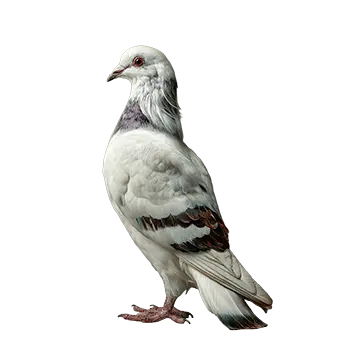

The Jacobin in Fine Art & Illustration

The Jacobin Pigeon has held a place in visual art for centuries, appearing in engravings, paintings, and natural history illustrations that sought to document the remarkable diversity of domestic pigeon breeds. During the 17th and 18th centuries, as European interest in exotic and ornamental animals reached its height, naturalist-illustrators produced detailed depictions of fancy pigeons for scientific treatises and lavishly illustrated folios. The Jacobin, with its unmistakable feathered hood, was among the breeds most frequently chosen for these publications, its dramatic silhouette lending itself to striking visual compositions.

The Victorian era brought a new wave of artistic attention to fancy pigeons, driven in part by the rise of competitive exhibition and the broader Victorian fascination with classification and collection. Breed books published during this period featured meticulous chromolithographs of Jacobins in various color varieties, rendered with a level of detail that reflected both scientific precision and genuine aesthetic admiration. These illustrations served as visual standards for breeders and remain valued collector's items, prized for their craftsmanship and their role in documenting the breed's development.

In the 20th and 21st centuries, the Jacobin has continued to inspire artists working in a range of media. Contemporary painters, printmakers, and digital illustrators have drawn on the breed's otherworldly appearance to create works that sit at the intersection of natural history and imaginative art. The bird's hood, which can give it a fantastical, almost mythical quality, has made it a favorite subject for artists interested in the boundary between the real and the surreal. Gallery exhibitions devoted to avian themes frequently include depictions of the Jacobin, and the breed has appeared in curated collections exploring the aesthetics of domestication and selective breeding.

The Jacobin's visual appeal has also made it a popular subject in decorative arts. The breed's image has appeared on ceramics, textiles, and ornamental objects, particularly in cultures with strong traditions of pigeon keeping. In parts of the Middle East and South Asia, stylized depictions of hooded pigeons can be found in architectural ornamentation, tile work, and handicrafts, reflecting the deep cultural significance of pigeon breeding in these regions.

Photography & the Exhibition Circuit

The Jacobin Pigeon is among the most photographed of all fancy pigeon breeds, and photography has played a central role in shaping the breed's public image and reputation. The development of modern photography in the late 19th and early 20th centuries coincided with the formalization of pigeon shows, and early show photographers quickly recognized the Jacobin as a subject of exceptional visual interest. Portraits of prize-winning Jacobins appeared in pigeon fancier magazines and breed club publications, establishing a photographic tradition that continues to this day.

Contemporary pigeon photography has elevated the Jacobin to a new level of visibility. Specialist avian photographers, armed with high-resolution cameras and controlled studio lighting, produce images of Jacobins that reveal the intricate structure of the hood in extraordinary detail. These photographs circulate widely in pigeon fancier publications, on breed club websites, and across social media platforms, where they routinely attract attention from audiences well beyond the pigeon keeping community. The visual impact of a well-photographed Jacobin, its hood fully displayed in crisp focus against a clean background, has made such images a gateway through which many people first encounter the world of fancy pigeons.

Pigeon shows themselves have become increasingly photogenic events, and the Jacobin is often a centerpiece of show coverage. Major exhibitions, from national championship shows in Europe and North America to international events in the Middle East, attract professional and amateur photographers who document the judging process, the winning birds, and the atmosphere of the show hall. Jacobin classes at these events are frequently highlighted in post-show reports and video recaps, and images of top specimens circulate as reference material among breeders worldwide.

The relationship between photography and breed development is more than incidental. High-quality photographs allow breeders to study and compare hood structure, body type, and color quality across birds from different programs and different countries. Before the era of ubiquitous photography, breeders relied on in-person observation and written descriptions to evaluate birds they had not seen firsthand. Today, photographic documentation is an integral part of the breeding process, enabling a level of international comparison and collaboration that was previously impossible.

Film, Television & Documentary Appearances

While the Jacobin Pigeon is not a staple of mainstream film or television, it has made notable appearances in documentary and educational programming devoted to the natural world, animal breeding, and the science of genetics. Nature documentaries exploring the diversity of domesticated animals have frequently featured the Jacobin as a vivid example of how selective breeding can reshape an organism's appearance. The breed's visual drama makes it an effective subject for screen storytelling, and filmmakers have used it to illustrate concepts ranging from artificial selection to the cultural history of human-animal relationships.

Several prominent documentary series and science programs have highlighted the Jacobin in segments about Charles Darwin and his use of pigeon variation to develop his theory of evolution. Because Darwin himself studied and wrote about the Jacobin, the breed occupies a natural place in any visual retelling of the Darwinian story. In these contexts, footage of living Jacobins is often paired with historical illustrations and expert commentary to demonstrate how the dramatic differences among domestic pigeon breeds all derive from a single wild ancestor, the rock pigeon.

Television programs focused on animal shows and competitions have also given the Jacobin screen time. Coverage of major pigeon exhibitions in the United Kingdom, the United States, and continental Europe has occasionally been picked up by mainstream broadcast and streaming outlets, introducing the breed to audiences unfamiliar with the pigeon fancy. These segments typically emphasize the dedication and skill required to breed a top-quality Jacobin, framing the hobby as a form of living artistry that combines biological knowledge with aesthetic judgment.

Independent and short-form filmmakers have also explored the Jacobin's visual potential. The breed has appeared in art films, student projects, and experimental video works that use its unusual appearance as a metaphor or visual motif. The contrast between the everyday associations of the word "pigeon" and the extraordinary reality of the Jacobin's appearance creates a narrative tension that filmmakers have found compelling, allowing them to challenge viewers' assumptions about familiar animals.

Social Media & Online Virality

The Jacobin Pigeon has experienced a significant surge in visibility through social media and online platforms, where its striking appearance regularly captures the attention of audiences far removed from the pigeon fancy. Photographs and short videos of Jacobins have gone viral on platforms including Instagram, TikTok, Reddit, and X, often accompanied by expressions of astonishment from viewers encountering the breed for the first time. The typical reaction cycle, disbelief that such a bird exists, followed by fascination with its feathered hood, has made the Jacobin a reliable source of engagement on accounts dedicated to unusual animals and natural curiosities.

Dedicated pigeon fancier accounts on social media have leveraged the Jacobin's visual appeal to grow followings that extend well beyond the traditional fancy pigeon audience. Breeders who share high-quality photographs and videos of their Jacobins regularly attract followers who have no personal involvement in pigeon keeping but are drawn to the beauty and novelty of the birds. This crossover appeal has helped raise the profile of the pigeon fancy as a whole, challenging the common perception of pigeons as unremarkable urban birds and revealing the extraordinary diversity that exists within the species.

The breed has also become a frequent subject in the genre of online content that highlights surprising or little-known aspects of the animal world. Listicles, video compilations, and educational posts about unusual animal breeds routinely include the Jacobin, often positioning it alongside other visually dramatic domestic varieties. This type of content serves as an informal introduction to the world of fancy pigeons for millions of viewers, and breed clubs have reported increased inquiries from prospective fanciers who first encountered the Jacobin through social media.

The online visibility of the Jacobin has not been without complications. The breed's viral appeal can create unrealistic expectations among people who are captivated by its appearance but unaware of the specialized husbandry it requires. Breeders and fancier organizations have responded by using their own social media presence to provide accurate information about the breed's care, temperament, and breeding challenges, aiming to ensure that the Jacobin's online fame translates into informed interest rather than impulsive acquisition.

Literature & Written References

The Jacobin Pigeon has appeared in written works spanning several centuries, from early natural history texts to modern breed manuals and popular science writing. Among the earliest significant references is John Moore's "Columbarium, or the Pigeon-House," published in 1735, which described the Jacobin among the established fancy pigeon breeds of the period. Moore's account provides a valuable snapshot of the breed's status in 18th-century England and documents the characteristics that breeders of the era valued, offering a baseline against which subsequent development can be measured.

Charles Darwin's treatment of the Jacobin in "The Variation of Animals and Plants Under Domestication" remains one of the most consequential written references to the breed. Darwin's detailed observations of the Jacobin's hood, his comparisons with other crested and maned breeds, and his use of the pigeon fancy as evidence for the power of selection have given the breed a permanent place in the literature of evolutionary biology. Subsequent popular science writers, from Stephen Jay Gould to modern science journalists, have drawn on Darwin's pigeon work and frequently mention the Jacobin by name when discussing artificial selection and domestication.

Breed-specific literature produced by pigeon fancier organizations constitutes another important body of written reference. Jacobin breed clubs in the United Kingdom, the United States, Germany, and other countries have published handbooks, newsletters, and judging guides that document the breed's standard, its history, and the practical aspects of breeding and exhibition. These publications, while aimed primarily at fanciers, serve as valuable primary sources for anyone seeking detailed information about the breed.

In more recent decades, the Jacobin has appeared in popular nonfiction books exploring the world of animal breeding and exhibition culture. Authors who have written about the subcultures of competitive animal showing have found the pigeon fancy, and the Jacobin in particular, to be rich material. These accounts often use the Jacobin as a lens through which to examine broader themes of obsession, craftsmanship, community, and the human desire to shape the natural world according to aesthetic ideals. The breed's combination of visual spectacle and cultural depth makes it a compelling subject for narrative nonfiction.

Cultural Impact & Public Perception

The Jacobin Pigeon's cultural impact rests on its ability to challenge and reshape public perceptions of pigeons as a species. For most people, the word "pigeon" conjures images of the familiar feral birds that inhabit cities worldwide, birds that are often regarded with indifference or even disdain. The Jacobin, with its elaborate hood and regal bearing, disrupts this default perception entirely, prompting reactions that range from wonder to incredulity. In this sense, the breed serves as an ambassador for the broader diversity of domestic pigeons and for the pigeon fancy as a cultural practice.

The breed's impact is particularly evident in the way it functions as a conversation starter about selective breeding and genetics. When images of Jacobins circulate in mainstream media or on social platforms, they inevitably generate questions about how such a bird came to exist, what its hood is made of, and whether it can see or fly normally. These questions open doors to discussions about domestication, artificial selection, and the ethical dimensions of breeding animals for extreme physical traits, topics that have broad relevance beyond the pigeon world.

Within the pigeon fancy itself, the Jacobin occupies a position of considerable prestige. It is widely regarded as one of the most challenging breeds to raise and exhibit at a high level, and success with Jacobins is considered a mark of genuine expertise. This reputation has made the breed a symbol of the fancier's art, representing the pinnacle of what can be achieved through patient, knowledgeable breeding over many generations. Jacobin specialists are often respected figures within their local and national pigeon communities, and their expertise is sought by fanciers working with other breeds as well.

The breed's cultural reach continues to expand as new audiences encounter it through digital media, exhibitions, and educational programming. Whether viewed as a living work of art, a testament to centuries of human ingenuity, or a subject of legitimate scientific interest, the Jacobin Pigeon commands a level of attention and respect that few other domestic pigeon breeds can match. Its ongoing presence in media and public consciousness ensures that the breed will continue to shape how people think about pigeons, breeding, and the remarkable plasticity of the domesticated animal form.

Always consult a qualified professional before making any health-related decisions. This content is provided for informational reference only and should not replace professional guidance specific to your animal.