
Origins & Ancestral Roots

The Jacobin Pigeon traces its ancestry to the Indian subcontinent, where domesticated pigeons have been bred for thousands of years in a tradition that rivals any other culture's relationship with Columba livia domestica. Historical accounts and ornithological scholarship generally place the breed's emergence within the broader context of Indian pigeon keeping, a practice deeply woven into the social, religious, and aesthetic life of the region. While the precise timeline of the Jacobin's development remains debated, the consensus among breed historians is that its defining characteristic, the elaborate feathered hood or mane, was already recognizable in birds kept by Indian fanciers well before European contact.

The Indian subcontinent's long tradition of pigeon breeding produced an extraordinary diversity of forms, colors, and behavioral traits. Pigeons held a place of honor in Mughal courts, where emperors maintained vast lofts and employed dedicated keepers to manage breeding programs. The Mughal emperor Akbar the Great, who reigned in the late 16th century, is recorded as having kept thousands of pigeons and having taken a personal interest in the refinement of various breeds. While it is impossible to say with certainty that the Jacobin as we know it today existed in Akbar's lofts, the culture of intensive selective breeding that flourished under Mughal patronage almost certainly contributed to the development of hooded and maned pigeon varieties.

The wild rock pigeon, the ancestor of all domestic pigeon breeds, possesses no natural hood or mane, which means that the Jacobin's signature feature is entirely a product of human selection over many generations. The reversed feathers that form the hood grow upward and forward from the back of the neck, eventually enveloping the head in a rosette of plumage that can obscure the bird's vision if left untrimmed. This dramatic trait would have required sustained, deliberate breeding effort, selecting for progressively longer and more reflexed neck feathers generation after generation.

The breed's name itself carries a European rather than an Indian origin, a reflection of the path by which the bird traveled westward. The designation "Jacobin" is widely believed to derive from the Order of Jacobin friars, a branch of the Dominican order whose members wore distinctive cowled hoods. When the hooded pigeons from India arrived in Europe, observers noted the resemblance between the bird's feathered cowl and the friars' garments, and the name took hold. This linguistic connection underscores how thoroughly the breed's identity became intertwined with European cultural references, even as its biological roots remained firmly in South Asia.

Arrival in Europe & Early Breeding

The Jacobin Pigeon reached European shores through the maritime trade routes that connected the Indian Ocean world with the Mediterranean and Atlantic during the 16th and 17th centuries. Portuguese, Dutch, and later British traders who established commercial outposts along the Indian coast encountered the rich pigeon-keeping traditions of the subcontinent and brought specimens of various fancy breeds back to Europe. The Jacobin, with its visually arresting hood, was among the breeds that attracted the most immediate attention from European fanciers.

By the early 17th century, references to hooded or maned pigeons began appearing in European natural history texts and avicultural writings. The breed was documented in several early treatises on domestic pigeons, and by the mid-1600s it had established a foothold in the lofts of English, Dutch, and French breeders. The European fancy pigeon community, already engaged in refining breeds like the Fantail, the Pouter, and the Tumbler, embraced the Jacobin as a compelling new subject for selective improvement. Breeders set to work intensifying the hood, refining the bird's body type, and establishing consistent color varieties.

Charles Darwin, whose work on pigeon variation contributed significantly to his theory of natural selection, included the Jacobin among the breeds he studied and discussed in "The Variation of Animals and Plants Under Domestication," published in 1868. Darwin noted the Jacobin's hood as a striking example of how human selection could produce morphological features far removed from those of the wild ancestor. He used the breed, alongside others, to illustrate the power of cumulative selection over many generations, drawing parallels between the breeder's art and the processes of natural evolution.

The Victorian era proved to be a golden age for the Jacobin in Britain and across much of Europe. The rise of competitive pigeon showing in the mid-19th century created formal standards against which birds could be judged, and the Jacobin's dramatic appearance made it a natural star of the exhibition circuit. Breed clubs dedicated specifically to the Jacobin were established, and breeders began keeping detailed pedigree records, applying principles of selective breeding with increasing rigor and sophistication.

During this period, the breed's hood was progressively refined and enlarged through careful pairing. Show standards began to specify not only the length and density of the mane feathers but also their texture, direction of growth, and the completeness of the rosette formed around the head. The result was a bird that looked markedly different from its Indian ancestors, though the fundamental trait of reversed neck feathering remained the same. This era of intensive refinement established the Jacobin's modern form and cemented its place among the elite exhibition pigeon breeds.

Cultural Symbolism & the Fancy Pigeon Tradition

The Jacobin Pigeon occupies a distinctive symbolic niche within the broader culture of fancy pigeon keeping. Its elaborate hood, which can give the bird an almost regal or ecclesiastical appearance, has made it a recurring emblem of the art and devotion involved in selective breeding. For fanciers, the Jacobin represents the idea that patient, multigenerational effort can produce something genuinely extraordinary from humble raw material, transforming the common rock pigeon into a creature of remarkable visual drama.

In Indian culture, the pigeon has long carried associations with peace, devotion, and spiritual aspiration. The keeping of pigeons in the Indian subcontinent was not merely a hobby but often a practice imbued with philosophical or spiritual meaning, particularly in Sufi and Hindu traditions where the release of birds held ritual significance. While the Jacobin itself was primarily valued as an ornamental breed, it emerged from a cultural context in which pigeons were regarded with genuine reverence, and echoes of that reverence persist in the seriousness with which many modern breeders approach their craft.

In Europe, the Jacobin became associated with aristocratic leisure and intellectual curiosity during the 17th and 18th centuries. Wealthy patrons who maintained elaborate aviaries often included Jacobins among their collections, and the breed appeared in the margins of broader conversations about natural philosophy, aesthetics, and the relationship between human ingenuity and nature. The bird's hood, reminiscent of monastic garments, also lent it a faintly mystical quality that distinguished it from more utilitarian pigeon breeds.

The modern fancy pigeon community treats the Jacobin with a respect that reflects this layered cultural heritage. At major exhibitions, Jacobin classes routinely draw significant entries and attract dedicated specialists whose breeding programs span decades. The breed is often cited by fanciers as one that rewards patience and penalizes shortcuts, since the quality of the hood depends on subtle genetic factors that cannot be rushed. This reputation for demanding excellence from its breeders has given the Jacobin an almost aspirational status within the hobby, representing a challenge that only the most committed fanciers undertake.

Development of the Modern Standard

The formal standardization of the Jacobin Pigeon began in earnest during the latter half of the 19th century, coinciding with the broader formalization of livestock and poultry judging across Europe and North America. Breed standards for the Jacobin were developed by national pigeon organizations and specialized breed clubs, and these standards have been refined continuously over the intervening decades. The core of the standard has always centered on the hood, but modern judging criteria evaluate the entire bird, including body shape, station, color, and overall balance.

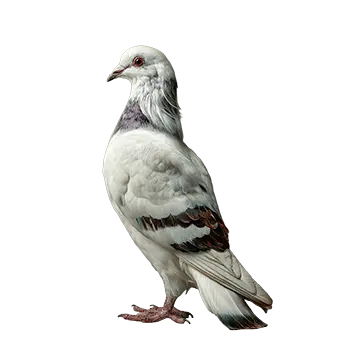
The ideal Jacobin hood, as described by contemporary standards, consists of a full rosette of feathers that rises from the back of the neck, sweeps forward over the crown, and extends down past the sides of the head to meet beneath the beak. The mane feathers should be long, dense, and uniformly textured, creating a smooth, unbroken cowl that frames the head without gaps or thin spots. The chain, a row of feathers running down the front of the breast, complements the hood and is judged for its length and fullness. Together, the hood, mane, and chain create the "furnishings" that define the breed's visual identity.

Body type has also been a significant focus of standardization. The modern Jacobin is expected to stand tall and upright, with a slender, elongated body that emphasizes the vertical display of the hood. This preference for a slim, erect carriage represents a departure from some historical types, which were stockier and more compact. The shift toward a taller, more refined silhouette has been driven by show ring aesthetics and reflects the broader trend in fancy pigeon breeding toward increasingly specialized and visually dramatic forms.

Color varieties in the Jacobin are numerous, including self colors such as black, white, red, and yellow, as well as patterned varieties. Standards specify the depth, evenness, and luster of color, and breeders work to maintain color quality alongside hood development, a dual challenge that adds complexity to breeding programs. White Jacobins have historically been among the most popular and widely exhibited, in part because the white plumage showcases the hood's structure without the visual distraction of color markings.

The evolution of the standard has not been without controversy. Some fanciers have expressed concern that the drive toward ever-larger hoods and ever-slimmer bodies has compromised the breed's vigor and functionality. Birds with extremely developed hoods may have restricted vision and can struggle with tasks as basic as feeding their young, sometimes requiring foster parents from other pigeon breeds to raise their squabs. This tension between aesthetic ambition and practical welfare is a recurring theme in Jacobin breeding and in the fancy pigeon world more broadly.

The Jacobin in the Global Fancy

Today the Jacobin Pigeon is bred and exhibited on every inhabited continent, with strong communities of fanciers active in Europe, North America, Australia, the Middle East, and South Asia. The breed's global reach reflects both the historic diffusion of European pigeon culture through colonialism and trade and the enduring appeal of the Jacobin's dramatic appearance. National and international pigeon shows regularly feature Jacobin classes, and dedicated breed clubs in countries from the United Kingdom to India promote the breed through exhibitions, publications, and mentoring of new fanciers.

In the United States, the Jacobin has a loyal following within the National Pigeon Association and its affiliated specialty clubs. American breeders have contributed to the refinement of several color varieties and have been active in international exchanges of breeding stock that have helped maintain genetic diversity within the breed. The annual Grand National Pigeon Show, one of the largest competitive pigeon events in North America, consistently draws strong Jacobin entries, and winners in the breed's classes are recognized as having achieved a significant accomplishment within the hobby.

The Middle East and South Asia have experienced a notable resurgence of interest in the Jacobin in recent decades, reconnecting in some respects with the breed's historical origins. In countries such as Pakistan, India, and the United Arab Emirates, pigeon keeping remains a vibrant cultural practice, and the Jacobin is valued both for its exhibition qualities and for its connection to the region's deep avicultural heritage. International competition has fostered cross-pollination between breeding traditions, with fanciers from different regions exchanging stock and ideas in pursuit of the ideal bird.

Online communities and social media have accelerated the globalization of Jacobin breeding. Breeders who once relied on local club meetings and printed newsletters for information exchange now participate in international forums, video channels, and social media groups where breeding results, show outcomes, and husbandry advice are shared in real time. This connectivity has raised the overall standard of the breed worldwide, as fanciers in any location can now study and compare birds from programs across the globe.

Despite this expansion, the Jacobin remains a breed that demands significant expertise and commitment. The complexity of breeding for a high-quality hood, combined with the challenges of rearing and maintaining birds whose ornamentation can interfere with normal behavior, means that the Jacobin is more often the province of experienced fanciers than of newcomers to the hobby. This selectivity has helped preserve the breed's reputation as one of the most prestigious and demanding of all fancy pigeon varieties.

Legacy & Continuing Influence

The Jacobin Pigeon's legacy extends well beyond the exhibition hall. As one of the most visually distinctive domestic pigeon breeds, the Jacobin has served as a powerful illustration of the principles of selective breeding and artificial selection. From Darwin's foundational use of pigeon variation in his evolutionary arguments to modern genetics research that has identified some of the molecular mechanisms behind crest and hood formation in birds, the Jacobin has contributed to scientific understanding in ways that few other domestic breeds can claim.

Recent genetic studies have shed light on the developmental pathways that produce the Jacobin's reversed feathering. Research published in leading scientific journals has identified specific genetic variants associated with head crest formation in pigeons, and the Jacobin, with its extreme expression of this trait, has been a key subject in these investigations. These findings have broader implications for understanding feather development and patterning across bird species, connecting the Jacobin to cutting-edge questions in evolutionary and developmental biology.

Within the pigeon fancy, the Jacobin's influence is felt in the standards of craftsmanship and dedication that the breed embodies. Many experienced fanciers regard the Jacobin as a benchmark breed, one whose demands test the full range of a breeder's skills, from genetic planning and pair selection to the hands-on management of birds whose ornamentation requires attentive husbandry. The breed's reputation for rewarding patience and punishing haste has made it a touchstone in discussions about what it means to be a serious pigeon breeder.

The Jacobin also occupies an important place in ongoing conversations about ethics and welfare in the fancy pigeon world. The tension between aesthetic refinement and the bird's ability to function normally, to see clearly, to feed its own young, to fly with agility, raises questions that are increasingly prominent in avicultural discourse. Responsible breeders navigate this tension by selecting for birds that combine quality ornamentation with robust health and vitality, and breed organizations have begun incorporating welfare considerations more explicitly into their standards and judging guidelines.

Looking forward, the Jacobin Pigeon's future is shaped by the same forces that have driven its history: the dedication of individual breeders, the social structures of the pigeon fancy, and the broader cultural currents that determine how societies relate to domesticated animals. As long as there are fanciers who find beauty and meaning in the patient art of selective breeding, the Jacobin is likely to remain one of the most admired and enduring products of that art.

Always consult a qualified professional before making any health-related decisions. This content is provided for informational reference only and should not replace professional guidance specific to your animal.