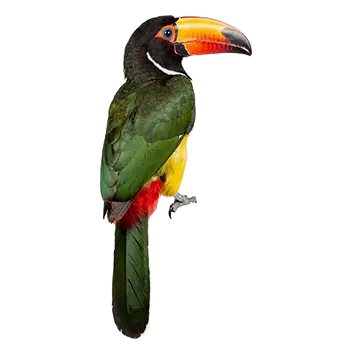

Origins & Natural Habitat

The Green Aracari (Pteroglossus viridis) is the smallest member of the toucan family Ramphastidae and is native to the lowland rainforests and forest edges of northern South America. Its range spans a sweeping arc across the Guiana Shield region, encompassing Venezuela, Guyana, Suriname, French Guiana, and the northern reaches of Brazil, particularly the states of Amazonas, Roraima, and Amapa. Within this territory, the species favors humid tropical forest below approximately 500 meters in elevation, though it has been recorded at slightly higher altitudes in certain transitional zones.

The bird occupies a distinctive ecological niche within the forest canopy and sub-canopy, where it feeds primarily on fruits, supplemented by insects, small vertebrates, and the eggs and nestlings of other bird species. Its relatively modest bill, compared to the larger toucans, is well adapted for extracting small fruits and probing into cavities. Green Aracaris are cavity nesters, typically utilizing abandoned woodpecker holes in standing deadwood, and they are among the few toucan species known to roost communally, with multiple adults and juveniles crowding into a single tree cavity at night in a behavior thought to conserve body heat and strengthen social bonds.

The forests that sustain the Green Aracari are among the most biodiverse ecosystems on the planet, and the species shares its habitat with a remarkable assemblage of other toucans, parrots, tanagers, and frugivorous birds. This ecological context has shaped the Green Aracari's behavior, diet, and social structure in ways that distinguish it from its larger relatives. Its smaller size and more agile foraging style allow it to exploit fruit resources that bigger toucans may overlook, reducing direct competition within the family.

Despite ongoing pressures from deforestation and habitat fragmentation in parts of its range, the Green Aracari benefits from the relative intactness of the Guiana Shield forests, which remain among the least disturbed tropical forest blocks in the Americas. The species is currently classified as Least Concern by the International Union for Conservation of Nature, though localized population declines have been noted in areas experiencing rapid land-use change. Its evolutionary history within the Ramphastidae places it among a radiation of Neotropical toucans that diversified during the Miocene and Pliocene epochs, adapting to a range of forest niches across Central and South America.

Early History with Humans

The Green Aracari's relationship with humans predates European contact by centuries, rooted in the daily lives and spiritual traditions of indigenous peoples throughout the Guiana Shield and the northern Amazon basin. For communities such as the Waiwai, Macushi, and Arawak, toucans as a group held practical and symbolic importance. The brightly colored feathers of various toucan species, including the Green Aracari, were incorporated into headdresses, ornamental garments, and ceremonial objects. The Green Aracari's compact size and vivid plumage made its feathers particularly valued for fine decorative work.

Indigenous hunters were intimately familiar with the Green Aracari's habits, knowing its preferred fruiting trees, its communal roosting behavior, and its seasonal movements through the forest. In some traditions, the bird's distinctive yelping call was associated with rain or changes in weather, and its presence near a village could carry augural significance. Oral histories from several Amazonian groups include stories featuring small toucans as characters embodying curiosity, cleverness, or mischief, reflecting the bird's inquisitive and social nature as observed in the wild.

European naturalists first encountered and described the Green Aracari during the age of colonial exploration in South America. The French naturalist Mathurin Jacques Brisson provided one of the earliest formal descriptions in the mid-18th century, and the species was subsequently classified by Carl Linnaeus in 1766 under the name Pteroglossus viridis. Early European accounts often marveled at the diversity and color of Neotropical toucans, and specimens were shipped back to European collections and menageries, though the Green Aracari's smaller size meant it attracted less immediate attention than its larger, more dramatically billed relatives such as the Toco Toucan.

During the 19th century, the expansion of scientific collecting expeditions into the interior of the Guianas and northern Brazil brought the Green Aracari into sharper focus for ornithologists. Collectors such as Henry Walter Bates and Alfred Russel Wallace documented the species during their legendary travels through Amazonia, noting its abundance in certain forest types and its distinctive social behavior. These accounts laid the groundwork for the modern scientific understanding of the species and contributed to the broader European fascination with tropical birdlife that would eventually fuel demand for live specimens in the avicultural trade.

Cultural Symbolism & Folklore

Among the indigenous peoples of the Guiana Shield and the northern Amazon basin, toucans occupy a prominent place in cosmology and oral tradition. The Green Aracari, as one of the most commonly encountered toucan species in the region, features in stories and beliefs that reflect the bird's conspicuous presence in the forest. In several Carib and Arawak-speaking cultures, toucans are associated with the spiritual realm, serving as messengers between the world of the living and the world of spirits. The Green Aracari's habit of roosting in groups inside tree cavities has been interpreted in some traditions as a metaphor for communal harmony and the importance of family bonds.

The bird's colorful plumage has also made it a symbol of beauty and vitality in indigenous art. Featherwork traditions across Amazonia are among the most sophisticated in the world, and the small, vivid feathers of aracaris have been used to adorn everything from ear ornaments to ritual fans. In some communities, the right to wear certain feather arrangements was linked to social status or spiritual authority, and the gathering and preparation of feathers followed strict protocols that reflected a deep respect for the birds and the forests they inhabited.

In broader South American folklore, toucans are often cast as characters in creation myths and moral tales. While the larger toucans tend to appear as bold, somewhat boastful figures, the smaller aracaris are frequently portrayed as quick-witted and resourceful. These narrative roles mirror the ecological differences between the species, with the Green Aracari's agility and sociability translated into cultural archetypes that emphasize cooperation, adaptability, and the cleverness needed to thrive in a complex environment.

In contemporary culture, the toucan family as a whole has become one of the most recognizable symbols of tropical biodiversity, and the Green Aracari shares in this broader symbolic resonance. Conservation organizations, ecotourism operators, and environmental educators frequently feature toucans in their outreach materials, and the Green Aracari's photogenic appearance has made it a popular subject for wildlife photographers and nature documentarians. This modern symbolism builds on centuries of indigenous tradition, extending the bird's cultural significance into new contexts while underscoring the ongoing importance of the forests it calls home.

Scientific Study & Recognition

The scientific study of the Green Aracari has evolved from early taxonomic descriptions to encompass a broad range of ecological, behavioral, and evolutionary research. Linnaeus's 1766 classification placed the species firmly within the genus Pteroglossus, a group of small to medium-sized toucans distinguished from the larger Ramphastos toucans by their more slender bills and smaller body size. Subsequent taxonomic work refined the understanding of relationships within the genus, and modern molecular phylogenetic studies have confirmed that the Green Aracari occupies a distinct lineage within the Pteroglossus radiation, most closely related to other aracaris of the Guiana Shield and eastern Amazonia.

Field research on the Green Aracari has revealed aspects of its biology that distinguish it from many other toucan species. Studies of its roosting behavior have documented groups of up to six or more individuals sharing a single tree cavity at night, a practice that is relatively uncommon among birds of similar size and that has implications for thermoregulation, predator avoidance, and social bonding. Researchers have also investigated the species' frugivorous diet in detail, finding that the Green Aracari plays a significant role as a seed disperser for a variety of tropical tree species, linking its ecology to broader patterns of forest regeneration and plant diversity.

The species' reproductive biology has been studied both in the wild and in captive settings. Green Aracaris are cooperative breeders to some degree, with non-breeding adults occasionally assisting in the care of nestlings. Clutch sizes typically range from two to four eggs, and both parents share incubation duties over a period of approximately 16 days. Nestlings fledge at around 40 to 45 days of age, remaining dependent on the adults for several weeks thereafter. These reproductive details have informed captive breeding protocols and contributed to the species' success in aviculture.

Conservation-oriented research has assessed the Green Aracari's population status across its range, generally finding that the species remains common in areas of intact forest but is sensitive to large-scale deforestation and habitat fragmentation. The bird's dependence on mature trees with suitable cavities for nesting and roosting makes it a useful indicator species for forest health, and its presence or absence in a given area can provide insights into the broader ecological condition of the landscape. This scientific recognition has helped to elevate the Green Aracari's profile in conservation planning for the Guiana Shield region.

The Species in Aviculture

The Green Aracari's entry into aviculture began in earnest during the latter half of the 20th century, when advances in husbandry knowledge and improvements in international transport made it feasible to keep softbill species that had previously been considered too delicate for captivity. Among the toucans, the Green Aracari was one of the first species to be bred consistently in captive settings, owing in part to its relatively manageable size, its adaptable diet, and its social temperament. By the 1980s and 1990s, a growing network of aviculturists in the United States and Europe had established breeding programs that reduced reliance on wild-caught birds and built a self-sustaining captive population.

The species' appeal as a companion bird differs markedly from that of parrots. Green Aracaris do not mimic human speech, but they compensate with a playful, curious personality and a striking visual presence that few other pet birds can match. Their social nature means they often bond strongly with their human caretakers, seeking physical contact and engaging in interactive play. Unlike many parrot species, they are not prone to loud, sustained vocalizations, making them somewhat more compatible with apartment or suburban living than their larger toucan relatives.

Feeding the Green Aracari in captivity requires attention to the species' specialized dietary needs. As frugivores, they require a diet centered on fresh fruits, supplemented with a high-quality low-iron softbill pellet. Iron storage disease, also known as hemochromatosis, is the most significant health concern in captive toucans and aracaris, and careful dietary management is essential to minimizing the risk. Aviculturists have refined feeding protocols over decades of experience, and the current best practices emphasize papaya, blueberries, grapes, and other low-iron fruits while strictly avoiding citrus and other foods that enhance iron absorption.

The avicultural community around the Green Aracari has grown to include dedicated breeders, hobbyist keepers, and institutional collections such as zoos and aviaries. Online forums, social media groups, and specialty organizations provide platforms for knowledge exchange and networking. The species' success in captivity has also raised awareness about toucan conservation more broadly, as keepers who develop a personal connection with their birds often become advocates for habitat preservation and responsible trade practices in the countries where Green Aracaris still fly wild.

Notable Individuals & Lasting Legacy

Unlike the African Grey Parrot or certain other companion bird species, the Green Aracari has not produced widely famous individual birds whose names are recognized by the general public. Its legacy is instead carried by a collective of animals whose charm and beauty have quietly influenced the trajectory of toucan aviculture and public interest in Neotropical birds. Zoos and aviaries around the world feature Green Aracaris in their tropical bird exhibits, and these institutional birds serve as ambassadors for the species and for the rainforest ecosystems they represent, introducing millions of visitors each year to a bird they might never otherwise encounter.

In the private aviculture world, certain breeding pairs and lineages have achieved recognition within the community for their contributions to the captive gene pool. Breeders who successfully maintained and propagated the species during the early decades of toucan aviculture played an outsized role in establishing the husbandry knowledge that subsequent generations of keepers have built upon. The development of reliable captive breeding techniques for the Green Aracari was a landmark achievement that demonstrated the viability of keeping softbill species long-term and paved the way for the captive propagation of rarer and more challenging toucan species.

The Green Aracari's influence extends into the realm of ecotourism, where it is one of the species most frequently sought by birdwatchers visiting the Guiana Shield and northern Amazonia. Guided birding tours in countries such as Guyana, Suriname, and French Guiana regularly feature the Green Aracari on their target lists, and sightings of these charismatic birds are among the highlights that draw international visitors to the region. This ecotourism interest generates economic value for local communities and provides a practical incentive for forest conservation.

The lasting legacy of the Green Aracari lies in its dual role as a wild species of ecological importance and a captive bird that has broadened human appreciation for the diversity and complexity of tropical avifauna. From its origins in the dense forests of the Guiana Shield to its presence in aviaries and living rooms around the world, the Green Aracari continues to demonstrate that even the smaller, less celebrated members of a charismatic bird family can leave a meaningful imprint on science, culture, and conservation.

Always consult a qualified professional before making any health-related decisions. This content is provided for informational reference only and should not replace professional guidance specific to your animal.