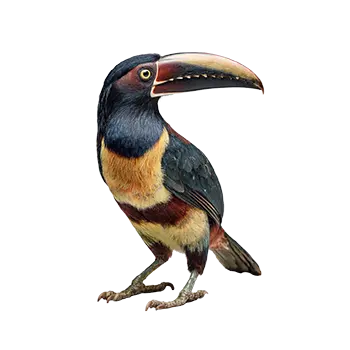

In Wildlife Documentaries & Film

The Collared Aracari has appeared in numerous wildlife documentaries that explore the biodiversity of Central and South American rainforests, though it typically shares screen time with its more immediately recognizable toucan relatives. Productions focusing on the forests of Costa Rica, Panama, and Belize frequently capture aracaris in their natural habitat, feeding at fruiting trees or engaged in the communal roosting behavior that makes them visually compelling subjects. The species' bold color patterns and active foraging behavior translate well to film, giving cinematographers dynamic footage that conveys the energy and richness of tropical ecosystems.

In broader natural history programming, the Collared Aracari often appears within segments dedicated to the Ramphastidae family, where it serves to illustrate the diversity of size and form within the toucan lineage. These segments typically contrast the diminutive aracaris with the larger Toco and Keel-billed Toucans, using the Collared Aracari as an example of how a single family can radiate into a range of ecological niches. The species' cooperative roosting and cavity-nesting behaviors have been highlighted in behavioral ecology series that examine the evolution of social strategies among birds.

Narrative and fictional film has engaged with the toucan family primarily through animated productions, where the bold silhouette and colorful plumage of toucans lend themselves to character design. While no major animated feature has centered specifically on a Collared Aracari character, the species' visual distinctiveness positions it as a natural candidate for future creative projects. Independent and short-form animated works have drawn on aracari imagery to represent the vibrancy and fragility of tropical forests, often in conservation-oriented storytelling.

The emergence of streaming platforms and long-form nature documentary series has expanded opportunities for lesser-known species to receive sustained on-screen attention. Multi-episode explorations of specific ecosystems or geographic regions allow producers to dedicate more time to species like the Collared Aracari that might receive only a fleeting appearance in a traditional 90-minute documentary. This shift in format has the potential to deepen public familiarity with the aracaris and their ecological roles in ways that earlier media could not easily accommodate.

In Print & Scientific Literature

The Collared Aracari has been a subject of ornithological literature since its formal description in the late 18th century, and it continues to appear in field guides, monographs, and scientific journals that document Neotropical avifauna. Major field guides covering the birds of Mexico, Central America, and northern South America invariably include the species, illustrated with detailed plates that highlight the plumage variations among recognized subspecies. These guides serve as essential references not only for professional ornithologists but also for the growing community of international birdwatchers who travel to the Neotropics in search of toucan-family species.

Popular natural history books focusing on toucans and their allies have given the Collared Aracari a more prominent role than it typically receives in general birding literature. Works such as comprehensive Ramphastid monographs examine the species' ecology, behavior, and taxonomic relationships in depth, providing detailed accounts of its diet, nesting habits, vocalizations, and social structure. These publications have played an important role in elevating the Collared Aracari from a footnote in broader toucan discussions to a species appreciated on its own terms.

Avicultural literature represents another significant print category for the Collared Aracari. Magazines and journals dedicated to exotic bird keeping have published numerous articles on the husbandry, breeding, and veterinary care of the species, reflecting its growing popularity among softbill aviculturists. These publications offer practical guidance on diet formulation, enclosure design, and health management, while also documenting breeding successes and discussing genetic management strategies for captive populations.

In the scientific journal literature, the Collared Aracari appears in studies spanning behavioral ecology, community ecology, phylogenetics, and conservation biology. Research papers examining frugivory and seed dispersal networks in tropical forests frequently include the species among the avian dispersers whose foraging patterns shape plant community composition. Studies of cavity-nesting bird communities in Neotropical forests have also featured the Collared Aracari, analyzing its competitive interactions with other cavity-dependent species and its role within the broader guild of secondary cavity nesters.

Photography & Visual Arts

The Collared Aracari is a prized subject among wildlife photographers, particularly those specializing in Neotropical avifauna. The species' vivid plumage, which combines deep blacks, bright yellows, warm reds, and a multicolored bill, creates compositions that are immediately striking in both print and digital formats. Photographers working at established lodges and feeding stations in Costa Rica, Panama, and Ecuador have produced portfolios of Collared Aracari images that circulate widely in birding publications, photo contest entries, and online galleries.

The rise of digital photography and accessible long-lens equipment has dramatically expanded the community of photographers documenting the Collared Aracari in the wild. Ecotourism destinations throughout the species' range now cater to photography-focused visitors, offering dedicated hides, controlled lighting setups, and fruit-baited platforms that allow for close-range images in natural settings. These setups have produced a growing library of high-quality Collared Aracari photographs that contribute to public awareness of the species and, by extension, the ecosystems it inhabits.

In the visual arts more broadly, the Collared Aracari benefits from the general appeal of the toucan form. Illustrators, painters, and digital artists have drawn on the species as a subject for works ranging from scientifically precise natural history illustration to stylized interpretive art. The bold graphic qualities of the Collared Aracari's appearance, particularly the interplay of warm and cool tones across its body, make it a compelling subject for artists exploring color theory, pattern, and the aesthetics of biological form.

Artisan and craft communities in the Collared Aracari's range countries have also incorporated the bird's imagery into handmade goods, including textiles, ceramics, and woodcarvings. In Costa Rica and Panama, toucan-themed crafts are staple offerings at markets and shops catering to both domestic and international buyers. While these items more often depict larger toucan species, the distinctive profile and coloring of the Collared Aracari appear with increasing frequency as artisans respond to demand for images that represent the full spectrum of local biodiversity.

Social Media & Online Communities

The Collared Aracari has developed a significant presence on social media platforms, driven by both aviculturists who share content of their companion birds and wildlife enthusiasts who post field observations and photographs. On platforms such as Instagram, TikTok, and YouTube, videos of captive Collared Aracaris eating fruit, playing with enrichment items, or interacting with their keepers routinely attract substantial engagement. The species' expressive body language, curious demeanor, and visually arresting appearance make it particularly well suited to short-form video content.

Dedicated online communities for toucan and aracari keepers have proliferated across social media and forum platforms. These groups serve as hubs for knowledge exchange, where experienced aviculturists share husbandry advice, discuss dietary protocols, troubleshoot health concerns, and celebrate breeding successes. The Collared Aracari features prominently in these spaces, often recommended as one of the more accessible toucan-family species for keepers transitioning from parrots or other more commonly kept companion birds.

The species' social media visibility has had measurable effects on public interest and demand. Search trends and breeder inquiries have shown correlations with viral content featuring Collared Aracaris, a pattern that has prompted both excitement and concern within the avicultural community. Experienced keepers and breed advocacy groups have responded by using the same platforms to disseminate educational content about the realities of aracari ownership, including the substantial dietary, veterinary, and housing requirements that may not be evident from a brief, charming video.

Birdwatching communities online have also embraced the Collared Aracari as a sought-after sighting for visiting birders. eBird checklists, birding trip reports, and location-specific forums document encounters with the species across its range, creating a valuable citizen science dataset that supplements formal survey efforts. Photographs and audio recordings shared through these platforms contribute to a growing public archive of Collared Aracari observations that informs both scientific research and conservation monitoring.

Tourism & Ecotourism Branding

The Collared Aracari plays a recognizable role in the ecotourism economies of several Central American countries, where its presence at lodges, reserves, and birding hotspots enhances the appeal of destinations marketed to nature-oriented travelers. Costa Rica, in particular, has leveraged its toucan species, including the Collared Aracari, as flagship attractions for a birding tourism sector that generates significant revenue and supports rural livelihoods. Tour operators, lodge owners, and destination marketers use images of toucans and aracaris in promotional materials that position their properties as gateways to tropical biodiversity.

Birding festivals and wildlife tourism events in the Neotropics frequently feature the Collared Aracari among their highlighted species, offering guided excursions to known roosting and feeding sites. These events draw participants from around the world and create economic incentives for local communities to protect the forest habitats on which the species depends. The connection between charismatic bird species and tourism revenue has been recognized by conservation organizations as a powerful argument for habitat preservation, and the Collared Aracari contributes to this dynamic alongside more widely celebrated species.

The species also appears in the branding and signage of nature reserves and national parks throughout its range. Interpretive panels at visitor centers and trailheads often feature the Collared Aracari as an example of the avian diversity protected within park boundaries, and guided walks led by local naturalists frequently highlight encounters with aracaris as memorable experiences for visitors. This integration of the species into the interpretive framework of protected areas reinforces its identity as a representative of healthy tropical forest ecosystems.

As ecotourism continues to grow in the Neotropics, the Collared Aracari's value as a tourism asset is increasingly recognized by policymakers, conservation planners, and community-based enterprises. Programs that train local guides in bird identification and natural history interpretation have expanded the workforce capable of delivering high-quality birding experiences, while revenue-sharing models ensure that the economic benefits of tourism reach the communities most directly involved in habitat stewardship. The Collared Aracari, as a reliably visible and visually rewarding species, occupies a meaningful place in this evolving landscape of conservation-linked tourism.

Representation in Education & Outreach

Zoos, aviaries, and nature centers around the world maintain Collared Aracaris as part of educational exhibits designed to introduce visitors to the diversity of tropical bird life. The species' manageable size, engaging behavior, and tolerance of controlled environments make it a practical choice for institutions seeking to represent the toucan family in live displays. Interpretive programming built around these exhibits typically addresses topics such as tropical forest ecology, frugivory and seed dispersal, the adaptations represented by the toucan bill, and the conservation challenges facing Neotropical bird species.

Educational outreach programs in the Collared Aracari's range countries have incorporated the species into curricula and materials aimed at building conservation awareness among young people. In Costa Rica and Belize, where environmental education has been integrated into national schooling frameworks, lessons about local wildlife frequently include toucans and aracaris as examples of species whose survival depends on habitat protection. These programs often pair classroom instruction with field trips to nearby forests or nature centers, creating direct encounters with the species that reinforce conservation messages.

In the global avicultural community, education about the Collared Aracari is delivered through workshops, webinars, and conference presentations organized by bird clubs, breed societies, and avian veterinary associations. These events address topics ranging from diet optimization and disease prevention to behavioral enrichment and breeding management, equipping current and prospective keepers with the knowledge needed to provide responsible care. The emphasis within these educational frameworks is on informed stewardship rather than casual ownership, reflecting a growing consensus that exotic bird keeping carries ethical obligations that must be taken seriously.

Publishing initiatives targeting general audiences have also contributed to the Collared Aracari's educational profile. Children's books, illustrated guides to tropical wildlife, and popular science articles have introduced the species to readers who may never visit its native range, planting seeds of awareness and appreciation that can influence attitudes toward tropical conservation. The Collared Aracari's charisma and visual appeal make it an effective ambassador in these contexts, capable of capturing attention and sparking curiosity in ways that drier conservation messaging sometimes cannot.

Always consult a qualified professional before making any health-related decisions. This content is provided for informational reference only and should not replace professional guidance specific to your animal.