
Origins & Natural Habitat

The Collared Aracari (Pteroglossus torquatus) belongs to the family Ramphastidae, the toucans and their allies, and occupies a geographic range that stretches from southern Mexico through Central America and into northwestern South America. Within this broad distribution, the species inhabits lowland and foothill tropical forests, typically below elevations of around 1,500 meters. It favors humid evergreen and semi-deciduous forests, forest edges, and second-growth woodland, where the canopy and mid-story provide both food resources and nesting opportunities in natural tree cavities.

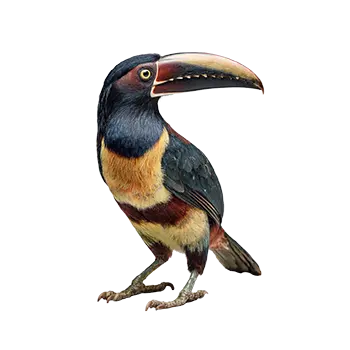
The Collared Aracari is one of approximately 14 recognized species within the genus Pteroglossus, a group commonly referred to as the aracaris. These smaller members of the toucan family are distinguished from their larger relatives by their more slender builds, relatively shorter bills, and pronounced social tendencies. The Collared Aracari itself is readily identified by its striking plumage pattern: a dark head and upper breast contrasted by vivid yellow underparts marked with a distinctive dark band across the belly, along with a multicolored bill that blends shades of ivory, black, and orange.

Ecologically, the species plays a meaningful role as a seed disperser within its forest habitat. Its diet consists primarily of fruits, supplemented by insects, small vertebrates, and the eggs and nestlings of other birds. By consuming fruits and depositing seeds across wide areas during daily foraging flights, the Collared Aracari contributes to the regeneration and genetic diversity of the tropical plant communities it depends upon. This ecological function connects the bird to the broader health of Neotropical forest ecosystems in ways that extend well beyond its own survival.

The evolutionary history of the Ramphastidae family traces back millions of years within the Americas, with molecular phylogenetics placing the divergence of the aracari lineage from other toucans in the late Miocene or early Pliocene. The diversification of Pteroglossus species across Central and South America reflects the complex geological and climatic history of the region, including the formation of the Isthmus of Panama, which created new corridors for dispersal and speciation. The Collared Aracari's modern range, spanning both sides of this land bridge, is itself a testament to that deep biogeographic history.

Early History with Humans

The indigenous peoples of Mesoamerica and northern South America have coexisted with the Collared Aracari and its toucan relatives for thousands of years. Archaeological and ethnographic evidence indicates that toucans held a recognized place in the cultural and material lives of pre-Columbian civilizations. The Maya, whose territory overlapped extensively with the Collared Aracari's range, depicted toucans in ceramic art, carved stonework, and codices. While the larger Keel-billed Toucan was more frequently represented, the smaller aracaris were part of the broader avian world that informed Mayan cosmology and daily life.

Toucan feathers, including those of aracari species, were valued trade items throughout Mesoamerica. The vibrant plumage of Ramphastid birds was used in headdresses, ceremonial garments, and ritual objects, often reserved for elites and religious figures. Among the Aztecs, the trade networks that supplied exotic feathers from the tropical lowlands to the highland capital of Tenochtitlan included toucans among the many bird species whose plumage was prized for the featherworking craft known as amantecayotl. Though the Collared Aracari was rarely singled out by name in surviving records, its habitat placed it squarely within the supply zones for these trade networks.

European contact in the 16th century brought the first written descriptions of toucans to audiences outside the Americas. Spanish and Portuguese naturalists and chroniclers, struck by the dramatic bills and colorful plumage of Ramphastid birds, included them in accounts of New World wildlife. The Collared Aracari, being smaller and less visually dramatic than the larger toucans, received less individual attention in these early reports, but it was nonetheless part of the avian tableau that astonished European observers and fueled the era's appetite for natural curiosities.

During the colonial period, live toucans were occasionally transported to Europe as novelties, though the logistical challenges of keeping frugivorous tropical birds alive during long sea voyages meant that most specimens arrived as skins or preserved study materials rather than living animals. It was not until advances in aviculture and international transport in the 19th and 20th centuries that the Collared Aracari began to establish a presence outside its native range as a kept bird, setting the stage for its eventual emergence in the modern exotic pet trade.

Cultural Symbolism & Folklore

Throughout the Neotropical region, toucans as a group carry rich symbolic weight, and the Collared Aracari shares in this broader cultural resonance even when it is not always individually distinguished from its larger relatives. In many indigenous cosmologies of Central America and the Amazon basin, toucans are associated with the spirit world, serving as messengers or intermediaries between the physical and supernatural realms. Their distinctive calls, which echo through the forest canopy at dawn and dusk, have been interpreted in various traditions as omens, announcements, or communications from ancestors.

Among several indigenous groups in Costa Rica, Panama, and Colombia, toucan imagery appears in traditional crafts, woven textiles, and carved implements. The Bribri and Cabecar peoples of Costa Rica, whose ancestral territories fall within the Collared Aracari's range, incorporate birds into origin stories and moral narratives that encode ecological knowledge alongside ethical instruction. These stories often emphasize the interdependence of forest creatures and the consequences of disrupting natural balance, themes that resonate with contemporary conservation perspectives.

In broader Latin American popular culture, the toucan silhouette has become an almost universal symbol of tropical biodiversity and the exuberance of rainforest ecosystems. While this iconography is most often associated with the Toco Toucan or the Keel-billed Toucan, the Collared Aracari benefits from the general affection and recognition that the toucan family commands. In countries like Costa Rica, Honduras, and Belize, toucans feature on currency, postage stamps, tourism branding, and national park signage, reinforcing their status as flagship species for Neotropical conservation.

The symbolism attached to toucans has also entered global consciousness through art, design, and commercial branding. The bold geometry of the toucan bill and the vivid color contrasts of the plumage lend themselves naturally to graphic representation, and toucan-inspired imagery appears in contexts ranging from high fashion to children's illustration. For the Collared Aracari, this broader cultural embrace has helped elevate the species from relative obscurity among non-specialists to a recognized and admired member of the tropical avian community.

Scientific Study & Classification

The Collared Aracari was formally described by the German naturalist Johann Friedrich Gmelin in 1788, based on earlier accounts and specimens collected from the species' range in Central America. Gmelin placed the bird within the genus Pteroglossus, where it remains today. The specific epithet torquatus derives from the Latin word for collar or necklace, referencing the dark band of feathers across the bird's breast that gives the species both its scientific and common names.

Taxonomic understanding of the Collared Aracari has been refined over subsequent centuries as ornithologists examined geographic variation across the species' extensive range. Several subspecies have been proposed, differentiated primarily by subtle variations in plumage coloration and bill patterning. The most commonly recognized subspecies include P. t. torquatus of southern Mexico and Guatemala, P. t. erythrozonus of Belize and Honduras, and forms from Costa Rica, Panama, and the northern reaches of South America. Molecular phylogenetic studies in the late 20th and early 21st centuries have helped clarify the relationships among these populations, though some taxonomic questions remain subjects of ongoing research.

Field studies of the Collared Aracari have contributed meaningfully to the scientific understanding of Ramphastid ecology and behavior. Research conducted at sites in Costa Rica, Panama, and Belize has documented the species' cooperative roosting behavior, in which groups of up to six or more adults and juveniles share a single tree cavity for overnight rest. This communal roosting habit, unusual among non-colonial bird species, has attracted interest from behavioral ecologists studying the evolution of sociality and the costs and benefits of group living in birds.

The species has also figured in studies of frugivory and seed dispersal, contributing data to broader investigations of how tropical bird communities shape forest composition and regeneration. Research into the Collared Aracari's foraging ecology has revealed that the species is more omnivorous than early accounts suggested, incorporating a wider range of animal prey into its diet than many other Ramphastid species. These findings have enriched scientific understanding of niche partitioning within the toucan family and highlighted the ecological versatility that has allowed the Collared Aracari to persist across a range of forest types and disturbance regimes.

The Species Today

In the early 21st century, the Collared Aracari occupies a somewhat paradoxical position. In the wild, the species is classified as Least Concern by the International Union for Conservation of Nature, reflecting its broad geographic range and relatively stable population levels compared to many other Neotropical birds. It remains a common sight in suitable habitat across much of Central America, and its tolerance for secondary forest and edge habitats has allowed it to persist in landscapes that have been moderately altered by human activity.

In aviculture, the Collared Aracari has become one of the most frequently kept members of the toucan family. Its relatively compact size compared to larger toucans, its social and engaging temperament, and its striking appearance have made it a favored species among experienced bird keepers seeking a toucan-family companion. Captive breeding programs, particularly in the United States and Europe, have established self-sustaining populations that reduce pressure on wild stocks, and the species is regularly available through specialized breeders and avicultural networks.

Ownership of a Collared Aracari, however, presents challenges that distinguish it from keeping more conventional companion birds. The species' frugivorous diet requires careful management to ensure adequate nutrition while avoiding iron storage disease, a condition to which toucans and aracaris are particularly susceptible. Housing requirements are also substantial, as these active and social birds need spacious flight enclosures and benefit from being kept in pairs or small groups rather than in isolation. Veterinary care for Ramphastid species remains a specialized field, and prospective keepers are advised to establish a relationship with an avian veterinarian experienced in softbill medicine before acquiring a bird.

The Collared Aracari's growing popularity as a companion animal has also raised questions within the avicultural community about responsible breeding practices, buyer education, and the long-term welfare of birds placed in private homes. Advocacy organizations and experienced breeders emphasize the importance of thorough research and realistic expectations, noting that the species' charm and beauty should not obscure the commitment required to provide appropriate lifelong care.

Conservation & Future Outlook

The Collared Aracari's conservation outlook is cautiously optimistic but not without concerns. While the species is not currently considered globally threatened, localized population declines have been documented in areas experiencing rapid deforestation, particularly in southern Mexico and parts of Central America where agricultural expansion and urban development continue to fragment forest habitats. The bird's dependence on tree cavities for nesting makes it vulnerable to the loss of large, mature trees, even in landscapes where overall forest cover remains relatively intact.

International trade in the Collared Aracari is regulated under the Convention on International Trade in Endangered Species of Wild Fauna and Flora, where it is listed under Appendix III by several range countries. This listing requires export permits and monitoring of trade volumes, providing a degree of oversight that helps prevent uncontrolled commercial exploitation. Domestic regulations within range countries vary, with some nations imposing strict protections on native wildlife capture and others maintaining less robust enforcement frameworks.

Captive breeding has emerged as an important component of the Collared Aracari's long-term conservation strategy. Well-managed avicultural programs not only supply the pet trade without drawing from wild populations but also maintain genetic diversity that could prove valuable in the event of future conservation breeding efforts. Zoos and aviaries in several countries maintain Collared Aracaris as part of educational exhibits that highlight the ecological roles and conservation needs of Neotropical birds, fostering public awareness and support for habitat protection initiatives.

The species' future will ultimately depend on the fate of the tropical forests it calls home. Conservation efforts that prioritize habitat connectivity, sustainable land use, and the protection of primary forest corridors will benefit the Collared Aracari along with the thousands of other species that share its ecosystem. As a charismatic and recognizable representative of the toucan family, the Collared Aracari has the potential to serve as a compelling ambassador for Neotropical forest conservation, provided that the human communities within and around its range are engaged as partners in stewardship rather than excluded from the conversation.

Always consult a qualified professional before making any health-related decisions. This content is provided for informational reference only and should not replace professional guidance specific to your animal.