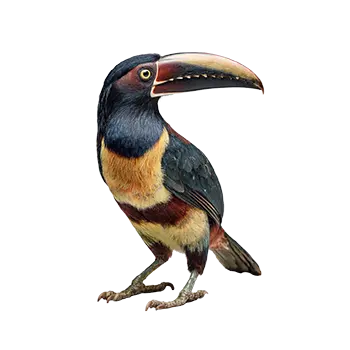

The Collared Aracari is subject to international trade regulation under the Convention on International Trade in Endangered Species of Wild Fauna and Flora. Several range countries have listed the species under CITES Appendix III, which requires that exporting nations issue permits certifying that specimens were legally obtained and that trade does not threaten wild populations. Unlike Appendix I or II listings, which impose more stringent controls, Appendix III listings are initiated by individual countries seeking assistance from the broader CITES framework to manage trade originating within their borders.
The practical effect of the CITES listing is that any international shipment of a Collared Aracari, whether live bird, skin, feather, or derivative product, must be accompanied by appropriate documentation from the exporting country's CITES Management Authority. Importing countries are responsible for verifying this documentation upon arrival, and shipments that lack proper permits are subject to seizure and potential criminal prosecution. For prospective owners in countries that import Collared Aracaris, this means that legally acquired birds should always come with a verifiable chain of documentation tracing their origin to a permitted source.
The CITES framework has been instrumental in reducing the volume of wild-caught Collared Aracaris entering international trade, shifting the legal market increasingly toward captive-bred specimens. However, enforcement capacity varies significantly among range countries, and illegal capture and smuggling remain concerns in some regions. Conservation and law enforcement agencies in countries such as Mexico, Guatemala, and Honduras have conducted operations targeting illegal wildlife trade networks that include Ramphastid species among their contraband.
Prospective owners should be aware that CITES regulations interact with and are supplemented by domestic laws in both exporting and importing countries. A transaction that complies with CITES at the international level may still violate national or subnational regulations in either the country of origin or the country of destination. Understanding the full legal framework requires attention to multiple overlapping layers of regulation, and buyers are strongly advised to work with reputable breeders or dealers who can demonstrate full legal compliance at every stage of the transaction.