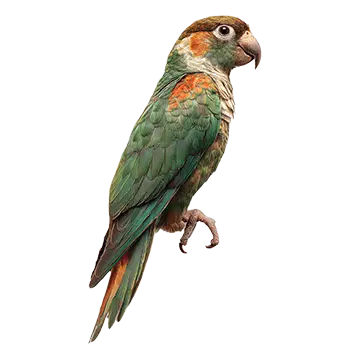

The Cape Parrot (Poicephalus robustus) is endemic to South Africa, inhabiting the remnant patches of Afromontane yellowwood forests found in the eastern regions of the country. The species was first described by European naturalists in the early nineteenth century, though indigenous peoples of southern Africa had long been familiar with the bird. Early collectors noted the parrot's preference for the fruits of the Podocarpus yellowwood tree, a relationship that would prove central to understanding the species' ecology and eventual decline.
For much of the twentieth century, the Cape Parrot was classified as a subspecies of the more widespread Brown-necked Parrot found across central and western Africa. Taxonomic debates persisted for decades, with ornithologists disagreeing on whether morphological and behavioral differences warranted full species status. Genetic studies conducted in the early 2000s finally confirmed that the Cape Parrot is a distinct species, separated from its continental relatives by millions of years of evolutionary divergence.
The formal recognition of the Cape Parrot as its own species had immediate conservation implications. What had appeared to be a widespread taxon was suddenly revealed to be a narrowly endemic bird with a dangerously small population. Estimates in the early twenty-first century placed the wild population at fewer than 1,600 individuals, making it one of the rarest parrots in Africa and galvanizing efforts to protect both the bird and its vanishing forest habitat.
The species' scientific name, robustus, references its stocky build relative to other Poicephalus parrots. Males and females are largely similar in plumage, with olive-green body feathers and a distinctive golden-brown head and neck, though males sometimes display a small patch of red-orange on the forehead and leading edge of the wing. This subtle sexual dimorphism was one of the early clues that prompted researchers to investigate the Cape Parrot's taxonomic independence.