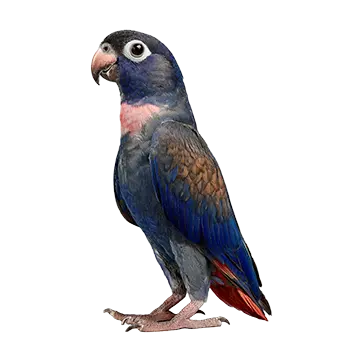

The Bronze-Winged Pionus is listed under Appendix II of the Convention on International Trade in Endangered Species of Wild Fauna and Flora, commonly known as CITES. Appendix II listing does not prohibit international trade outright but requires that any cross-border movement of the species, whether of live birds, eggs, or feathers, be accompanied by valid CITES export permits issued by the management authority of the country of origin. The listing reflects international recognition that unregulated trade could threaten wild populations, even though the species is not currently classified as endangered.
For prospective owners and breeders, the practical consequence of the CITES Appendix II listing is that any internationally sourced Bronze-Winged Pionus must be documented with paperwork verifying its legal origin and the legitimacy of its export. This requirement applies to both wild-caught and captive-bred specimens, though the documentation standards differ. Captive-bred birds may be traded under simplified procedures in some jurisdictions, provided the breeding facility is registered with the appropriate national CITES authority and can demonstrate that its breeding stock was legally acquired.
The CITES framework is implemented through national legislation in each of the convention's member states, which means that the specific procedures, fees, and timelines for obtaining permits vary considerably from one country to another. In the range states of Colombia, Ecuador, Venezuela, and Peru, national wildlife agencies administer CITES compliance alongside broader domestic wildlife protection laws. These agencies have the authority to set quotas on exports, inspect breeding facilities, and investigate suspected trafficking, though enforcement capacity varies widely across the region.
It is important for anyone involved in the international movement of Bronze-Winged Pionus parrots to understand that CITES compliance is a legal obligation with criminal penalties for violations. Attempting to import or export a specimen without the required permits can result in confiscation of the bird, substantial fines, and in serious cases, criminal prosecution. The CITES Secretariat maintains a trade database that tracks reported transactions, and discrepancies between exporting and importing country records can trigger investigations.