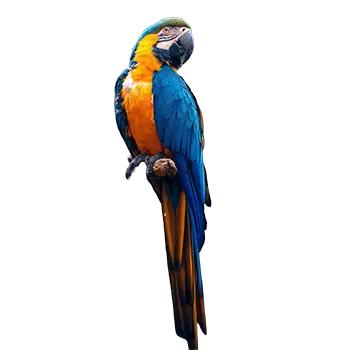

The Blue and Gold Macaw has been one of the most frequently featured parrot species in cinema, owing in large part to its photogenic plumage and trainable temperament. Hollywood productions set in tropical or pirate-themed settings have routinely cast Blue and Gold Macaws as on-screen companions, leveraging the bird's vivid coloring to add visual spectacle. The species' willingness to perch on handlers' shoulders, vocalize on cue, and tolerate the noise and activity of a film set has made it a preferred choice among animal wranglers working in the entertainment industry.
Animated films have drawn heavily on the Blue and Gold Macaw's appearance as a design template for fictional parrot characters. The species' distinctive color scheme, a cobalt blue back contrasting with a golden-yellow chest and a green forehead, provides animators with a palette that reads clearly on screen and translates well into merchandise. Several animated features set in South American environments have featured macaw characters whose designs are clearly inspired by or directly modeled on Ara ararauna, even when the fictional species is given a different name or hybridized with other macaw traits.
The representation of macaws in film has not been without controversy. Animal welfare organizations have periodically raised concerns about the conditions under which trained birds are kept and transported for film work, and some productions have drawn criticism for stimulating public demand for macaw ownership without adequately conveying the challenges involved. The phenomenon of audiences seeing a charismatic macaw on screen and impulsively seeking to acquire one has been documented in multiple countries, leading some avian welfare groups to advocate for disclaimers or educational messaging in media featuring pet parrots.
Despite these concerns, the Blue and Gold Macaw's cinematic legacy has also had positive effects. High-profile film appearances have brought public attention to macaw conservation, inspired donations to habitat protection programs, and introduced millions of viewers to the intelligence and personality of large parrots. When filmmakers have partnered with conservation organizations to promote responsible messaging alongside their releases, the results have demonstrated the potential for entertainment media to serve as a vehicle for environmental awareness.