
Origins & Natural Habitat

The Blue and Gold Macaw (Ara ararauna) is native to the tropical lowlands of Central and South America, ranging from eastern Panama through Colombia, Venezuela, Ecuador, Peru, Bolivia, Paraguay, and across much of Brazil. Its preferred habitats include gallery forests along rivers, seasonally flooded savannas, palm swamps, and the edges of dense tropical woodland. The species is closely associated with palm groves, particularly stands of Mauritia flexuosa, whose fruit constitutes a major component of its wild diet. This ecological relationship has shaped not only the macaw's distribution but also the indigenous human communities that share these landscapes.

In the wild, Blue and Gold Macaws are highly social birds that travel in pairs or small family groups and congregate in larger flocks at clay licks and communal roosting sites. These clay licks, known as collpas in Peru, attract dozens or even hundreds of macaws at a time and have become iconic spectacles of Neotropical wildlife. The birds' dependence on large tracts of mature forest and specific nesting sites, typically cavities in tall, dead palm trees, ties their population health directly to the integrity of their forest ecosystems.

The species' range historically encompassed a vast and continuous swath of lowland South America, though fragmentation has reduced connectivity between populations in some areas. In the southernmost portions of its range, particularly in Argentina and Paraguay, local populations have experienced sharp declines or extirpation. In contrast, populations in the Amazon Basin and the Pantanal wetlands remain relatively robust, supported by large areas of protected habitat and lower human population density.

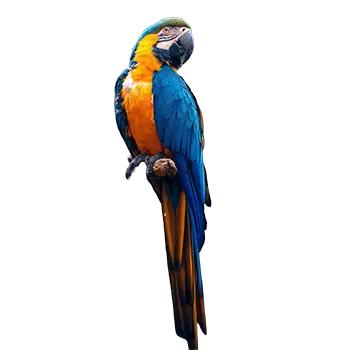
Paleontological and genetic evidence places the genus Ara within a broader radiation of Neotropical parrots that diversified millions of years ago. The Blue and Gold Macaw's vivid plumage, a striking contrast of cobalt blue dorsal feathers and rich golden-yellow underparts accented by a green forehead and black chin patch, likely evolved through a combination of sexual selection and ecological adaptation. These colors, so arresting to the human eye, would come to define the species' identity in both indigenous and colonial cultures.

Indigenous Cultures & Pre-Colonial Significance

Long before European contact, the Blue and Gold Macaw held profound significance for the indigenous peoples of South and Central America. Across the Amazon Basin, the Andes, and the lowland plains, macaw feathers were among the most prized natural materials available, valued for their brilliance, durability, and spiritual resonance. Elaborate feathered headdresses, capes, and ceremonial objects incorporating blue and gold macaw plumage have been documented among cultures including the Kayapo, Bororo, Munduruku, and numerous other Amazonian groups, where they played central roles in ritual, warfare, and social identity.

In many indigenous cosmologies, macaws were associated with the sun, fire, and celestial power. The golden-yellow breast of the Blue and Gold Macaw in particular linked the bird to solar imagery, and its raucous calls at dawn and dusk reinforced associations with the transitions between day and night. Some Amazonian creation myths describe macaws as messengers between the earthly and spiritual realms, carrying prayers skyward or bearing gifts from the gods. The Bororo people of central Brazil maintained a particularly elaborate symbolic relationship with macaws, incorporating them into clan structures and funerary rites.

The trade in macaw feathers was extensive and well-organized long before European arrival. Archaeological evidence from sites in the Andes, including the great Inca centers, reveals that macaw feathers, and sometimes live birds, were transported hundreds of miles from their lowland origins into the highlands. Inca nobility used macaw plumage in royal regalia, and the birds themselves were kept in palace aviaries. Similarly, Ancestral Puebloan sites in the American Southwest have yielded macaw remains dating back over a thousand years, indicating that long-distance trade networks carried Blue and Gold and Scarlet Macaws far beyond their natural range.

The keeping of live macaws by indigenous communities was both practical and symbolic. In some groups, captured chicks were raised by women and children, becoming semi-domesticated members of the household. These birds provided a renewable source of feathers, which could be plucked without killing the animal, and served as living symbols of the community's connection to the forest and its spiritual forces. This intimate, longstanding relationship between indigenous peoples and macaws established the cultural template upon which all later human interactions with the species would be built.

Colonial-Era Trade & European Fascination

The arrival of Spanish and Portuguese explorers in the Americas during the late 15th and early 16th centuries marked a turning point in the Blue and Gold Macaw's relationship with humans. European colonists were immediately captivated by the species' size, color, and vocal abilities. Chronicles from the earliest expeditions describe large parrots with brilliant plumage being kept by indigenous peoples and note the birds' capacity for learning words in European languages. Within decades, live macaws were being shipped across the Atlantic as exotic curiosities for European courts, aristocratic collections, and the menageries of wealthy merchants.

By the 17th century, the Blue and Gold Macaw had become an established fixture of European elite culture. The birds appeared in the collections of royals and nobles from Lisbon to Amsterdam, and their presence in a household signaled both wealth and cosmopolitan taste. Dutch and Flemish painters of the Golden Age occasionally included macaws in still life compositions and portraits, using the birds' vivid plumage to showcase their mastery of color and to symbolize the riches flowing from colonial commerce. The macaw became, in visual and literary culture, an emblem of the New World and its seemingly inexhaustible natural wonders.

The conditions under which macaws were captured and transported during this period were often brutal. Birds were taken from nests or caught with nets and snares, then confined in cramped wooden cages for ocean voyages lasting weeks or months. Mortality rates were high, and the survivors that reached European shores were frequently malnourished and stressed. Despite these hardships, the demand for macaws remained strong, sustained by their beauty, their entertaining vocal abilities, and the social status they conferred on their owners.

The colonial macaw trade also had lasting ecological consequences. While the Amazon's vast forests could absorb significant harvesting pressure, regional populations near colonial settlements and trade routes were depleted. The pattern of extraction established during the colonial era, capturing wild birds for distant markets with little regard for sustainability, would persist and intensify over the following centuries, setting the stage for the conservation challenges the species faces today.

Cultural Symbolism & Artistic Legacy

The Blue and Gold Macaw's visual impact has made it one of the most frequently depicted parrots in the history of art and design. From the featherwork of pre-Columbian civilizations to European oil paintings, and from Victorian natural history illustrations to contemporary graphic design, the species' bold color palette has served as a shorthand for tropical abundance and natural beauty. Edward Lear, the 19th-century artist and poet best known for his limericks, produced detailed lithographs of macaws that remain among the finest examples of ornithological illustration and helped popularize the image of the macaw in Victorian parlors.

In the nations of South America, the Blue and Gold Macaw carries additional layers of national and regional symbolism. Bolivia has recognized the species as emblematic of its tropical lowlands, and macaw imagery appears in the visual culture of Amazonian communities across Brazil, Peru, and Venezuela. Indigenous artisans continue to produce ceremonial objects incorporating macaw feathers or stylized macaw motifs, maintaining a cultural thread that stretches back centuries. In some regions, the macaw's image has been adopted by ecotourism initiatives and conservation organizations as a charismatic symbol of rainforest biodiversity.

The species has also exerted influence in the realm of language and metaphor. In Portuguese and Spanish, references to macaws appear in idiomatic expressions, place names, and literary works. The macaw's loud, carrying call has made it a symbol of expressiveness and vitality in popular culture, while its pair-bonding behavior has lent it romantic associations in folklore and poetry. These symbolic dimensions, spanning the visual, linguistic, and emotional, reflect the depth of the species' integration into human culture across its native range and beyond.

In the modern decorative arts, the Blue and Gold Macaw remains a perennial motif. Its plumage colors appear in textiles, ceramics, jewelry, and interior design, often evoking a sense of tropical luxury. While these commercial uses sometimes flatten the bird's cultural richness into mere decoration, they also ensure that the Blue and Gold Macaw remains one of the most widely recognized avian species on Earth, its image circulating far beyond the forests where it evolved.

Scientific Study & Avicultural Development

The scientific classification of the Blue and Gold Macaw dates to 1758, when Carl Linnaeus formally described the species as Psittacus ararauna in the tenth edition of Systema Naturae. The species was later reclassified into the genus Ara, where it remains today as Ara ararauna. Ornithological research over the following centuries refined understanding of the species' taxonomy, distribution, and ecology, though much of the detailed behavioral and physiological study has come only in recent decades, driven in part by the growth of aviculture and conservation biology.

Captive breeding of Blue and Gold Macaws gained momentum in the second half of the 20th century, as aviculturists developed techniques for incubation, hand-rearing, and dietary management that dramatically improved survival rates. By the 1980s and 1990s, captive-bred Blue and Gold Macaws were widely available in the pet trade in North America and Europe, reducing some of the demand that had historically driven wild capture. Breeders also began to document the species' reproductive biology in detail, contributing to a body of practical knowledge that has informed both private aviculture and institutional breeding programs.

Research into Blue and Gold Macaw cognition, while less extensive than the celebrated studies on African Grey Parrots, has nonetheless revealed impressive intellectual capabilities. Studies have demonstrated problem-solving skills, social learning, tool manipulation, and the capacity for vocal learning that extends beyond simple mimicry. These findings have reinforced the understanding that large macaws, like other psittacines, possess cognitive complexity that demands correspondingly rich social and environmental conditions in captivity.

The species' prominence in aviculture has also contributed to advances in avian veterinary medicine. Blue and Gold Macaws are among the most commonly presented psittacine patients in veterinary practice, and clinical experience with the species has improved understanding of macaw-specific health concerns, including proventricular dilatation disease, aspergillosis, and nutritional disorders. This accumulated clinical knowledge benefits not only captive macaws but also wild populations that may receive veterinary intervention as part of conservation programs.

The Species Today

The Blue and Gold Macaw occupies a distinctive position in contemporary aviculture and conservation. It remains one of the most popular large parrots in the pet trade worldwide, prized for its striking appearance, sociable temperament, and capacity for speech and interaction. Captive breeding has made the species broadly accessible, and well-established breeding populations exist in North America, Europe, Asia, and Australia. Bird clubs, online communities, and avian expos provide networks of support and education for keepers, and the species is a frequent subject of behavioral and husbandry guidance from avian veterinarians and behavioral consultants.

Ownership of a Blue and Gold Macaw, however, entails commitments that many prospective keepers underestimate. These are large, long-lived, and intensely social birds that require substantial space, a varied and nutritionally complete diet, daily interaction, and environmental enrichment to thrive. Without adequate stimulation and companionship, captive macaws can develop feather-destructive behavior, excessive vocalization, and other stress-related conditions. The species' potential lifespan of 50 years or more means that acquiring a macaw is a multi-decade commitment that may require provisions for the bird's care in the owner's will or estate plan.

In the wild, the Blue and Gold Macaw is currently classified as Least Concern by the International Union for Conservation of Nature, reflecting the species' broad range and relatively stable overall population. However, this global assessment masks significant regional variation. Populations in Trinidad, parts of Central America, and the southern fringes of the species' range have been severely reduced or lost entirely, while illegal trapping continues in some areas despite legal protections. Habitat loss from deforestation, agricultural expansion, and infrastructure development remains the most pervasive long-term threat.

Conservation initiatives targeting the Blue and Gold Macaw include habitat protection, anti-poaching enforcement, community-based ecotourism centered on clay licks and nesting sites, and reintroduction programs in areas where the species has been extirpated. In Trinidad, efforts to reestablish the Blue and Gold Macaw after decades of absence have drawn international attention and demonstrated the potential for restoring lost populations through carefully managed releases of captive-bred birds. These programs reflect a growing recognition that the species' future depends on sustaining both wild habitats and the cultural appreciation that has defined its relationship with humans for millennia.

Always consult a qualified professional before making any health-related decisions. This content is provided for informational reference only and should not replace professional guidance specific to your animal.