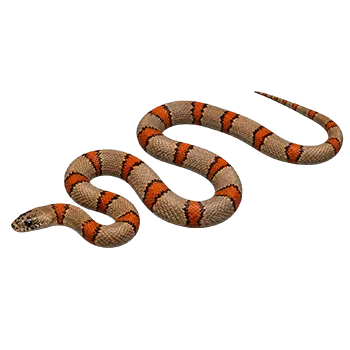

The Gray-Banded Kingsnake is a modestly sized, highly secretive colubrid that thrives in enclosures designed to prioritize security, thermal gradient quality, and ample hiding opportunities over sheer volume. In the wild, Lampropeltis alterna inhabits the rocky limestone canyons, desert scrublands, and montane slopes of the Chihuahuan Desert region, spending the vast majority of its time wedged into rock crevices, beneath flat stones, and inside rodent burrows. An enclosure that replicates this preference for tight, concealed spaces produces a more confident, less stressed animal than one that emphasizes open floor area.
For a single adult Gray-Banded Kingsnake in the three-to-four-foot range, a thirty-to-forty-gallon enclosure provides adequate space. In practical dimensions, this translates to approximately thirty-six inches long by eighteen inches deep by eighteen inches tall, though enclosures offering slightly more depth or length are welcomed by the snake. Glass terrariums with front-opening doors are a popular choice because they allow access without reaching over the snake from above — a movement that can startle secretive species into defensive behavior. PVC and molded plastic enclosures offer superior insulation and hold temperature gradients more effectively than glass, making them an excellent alternative in rooms with fluctuating ambient temperatures.
Hatchling and juvenile Gray-Banded Kingsnakes should not be housed in adult-sized enclosures. A small snake in an oversized space often feels exposed and insecure, leading to chronic stress, feeding refusal, and excessive hiding. Neonates do best in small plastic enclosures or shoebox-sized tubs with secure ventilation and tight-fitting lids, typically in the range of six to twelve quarts. As the snake grows, it can be moved through progressively larger enclosures, reaching its adult-sized habitat at roughly eighteen to twenty-four months of age. Each enclosure transition should include a settling-in period of one to two weeks before feeding is attempted.
Escape prevention is a non-negotiable priority with kingsnakes. Gray-Banded Kingsnakes, like all members of the genus Lampropeltis, are persistent and surprisingly strong escape artists. They will systematically probe every seam, hinge, and ventilation opening in their enclosure, and any gap wide enough to admit the snake's head is wide enough for the entire body to follow. Sliding screen tops secured with screen clips are minimally adequate, but front-opening enclosures with key locks or latch mechanisms provide far superior security. Any cage modification — drilled ventilation holes, cord pass-throughs for heating equipment, or gaps around bulkhead fittings — must be inspected carefully to confirm the opening is too small for the snake to exploit.