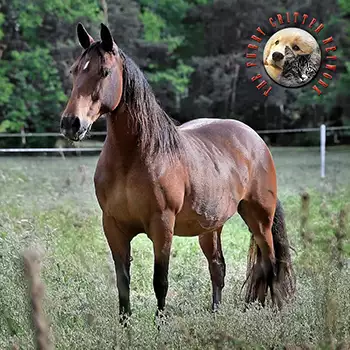

Play Style & Mental Drive

Morgans are among the more intelligent and curious horse breeds, which makes enrichment both particularly important and particularly rewarding. A bored Morgan does not simply stand quietly; this breed tends to channel unoccupied mental energy into undesirable behaviors such as cribbing, weaving, stall walking, or destructive chewing. Understanding that these behaviors are often symptoms of insufficient stimulation rather than personality flaws is the first step toward choosing the right enrichment products.

The Morgan's natural curiosity means they tend to investigate novel objects rather than shy away from them, which makes them excellent candidates for puzzle feeders, manipulable toys, and environmental enrichment that other breeds might ignore entirely. Their willingness to engage with new stimuli also means they can become bored with the same toy relatively quickly, so rotating enrichment items on a regular cycle keeps things interesting.

Social interaction is itself a form of enrichment for this people-oriented breed. Morgans that are housed in visual and physical contact with other horses tend to exhibit fewer stress behaviors than those kept in isolation. When evaluating enrichment products, consider that toys and puzzles are supplements to, not replacements for, the social contact and turnout time that form the foundation of equine mental health.

Matching enrichment intensity to the individual horse's energy level and workload prevents frustration on one end and disinterest on the other. A Morgan in regular work may need only moderate stall enrichment to stay content between rides, while a horse on stall rest due to injury requires a much more thoughtful and varied enrichment program to prevent behavioral deterioration.

Puzzle Feeders & Foraging Toys

Puzzle feeders are the most consistently effective enrichment category for horses because they tap into the animal's strongest natural drive: the motivation to eat. These products require the horse to manipulate an object in order to access a food reward, slowing consumption and providing mental engagement simultaneously. For easy-keeping Morgans, puzzle feeders offer the additional benefit of extending eating time without increasing caloric intake.

Ground-based treat balls and rolling dispensers are popular entry-level puzzle feeders. The horse pushes the ball with its nose or hooves, and small treats or feed pellets dispense through adjustable openings. These work well in stalls and paddocks, though they should be sized appropriately so the horse cannot pick them up and throw them, which some clever Morgans will figure out quickly as an alternative solution to the puzzle.

Hanging treat dispensers and lick-based enrichment products provide stimulation at head height, which encourages a more natural grazing posture than ground-level toys. Products that require the horse to manipulate flaps, slide panels, or rotate components to access food represent a higher difficulty level that suits the Morgan's intelligence. Start with easier configurations and increase complexity as the horse masters each stage.

Slow-feed hay nets and hay balls serve double duty as both feeding management tools and enrichment devices. Small-opening nets force the horse to pull hay through restricted openings, which mimics the natural browsing behavior of tearing forage from varied sources. Multi-opening hay balls that the horse must roll or manipulate add a physical puzzle component to basic forage consumption. These products are among the best value propositions in equine enrichment because they provide hours of engagement daily.

Stall Toys & Manipulable Objects

Stall toys that can be pushed, pulled, bitten, or batted provide physical outlets for horses confined to their stalls. Hanging toys attached to stall walls or ceilings via snap hooks or bungee cords allow the horse to grab, swing, and release objects without the toy disappearing under bedding or into a corner. Look for products made from horse-safe materials such as food-grade rubber, dense polyethylene, or natural untreated wood.

Textured toys with varied surfaces appeal to the Morgan's tactile curiosity. Products that combine ridges, bumps, and smooth areas give the horse different sensations to explore with lips and teeth, which is how horses investigate their environment. Some stall toys incorporate flavor infusions or scent elements that increase initial interest, though the novelty of these features tends to fade faster than mechanical complexity.

Mirrors have gained popularity as stall enrichment tools, particularly for horses that are housed without visual contact with other horses. The reflection provides a sense of companionship that can reduce stress behaviors in socially isolated individuals. Mirrors designed for equine use are made from shatter-proof acrylic or polished stainless steel rather than glass, and they should be mounted securely at the horse's head height on a flat, stable surface.

Durability is a primary purchasing consideration for any stall toy. Morgans can be vigorous with objects they enjoy, and products made from thin plastic or soft rubber may be destroyed quickly, creating both a waste of money and a potential ingestion hazard. Investing in heavy-duty, horse-specific products rather than repurposing items from other animal categories reduces the risk of breakage and the swallowing of small fragments.

Outdoor & Paddock Enrichment

Paddock enrichment takes advantage of the larger space available during turnout and can include objects that would be impractical inside a stall. Large rubber balls designed for equine use, typically 25 to 40 inches in diameter, encourage horses to push, chase, and interact with an object that moves unpredictably across the ground. These balls should be constructed from thick, puncture-resistant material that can withstand being stepped on without bursting.

Environmental variety within turnout areas contributes to mental stimulation without requiring purchased products. Varied terrain, including gentle hills, different ground surfaces, and natural obstacles like logs or rock piles, encourages the horse to navigate and problem-solve as it moves through its space. Safe, sturdy objects such as platform mounts or ground poles placed in paddocks give curious Morgans something to investigate and interact with.

Trail-style obstacles set up in a paddock or designated play area offer enrichment that doubles as training. Cavaletti poles, ground tarps, bridges, and curtain obstacles all provide sensory challenges that engage the Morgan's natural problem-solving ability. These setups can be rotated or rearranged regularly to maintain novelty, and they build confidence that transfers directly to trail riding and driving situations.

Water features, where climate and infrastructure permit, are surprisingly engaging for many horses. Shallow water troughs or splash pads placed in paddocks during warm weather give horses an opportunity to paw, splash, and play. Not every horse enjoys water play, but Morgans that do will spend significant time engaged with even simple water features, providing both enrichment and cooling benefit during hot months.

Comfort & Companion Items

Comfort items serve a different purpose than active toys: they provide a sense of security and companionship that reduces anxiety in horses experiencing stressful situations. Stable companions, such as goats, donkeys, or even poultry, are the original comfort enrichment and remain highly effective for horses that are housed alone or separated from their herd during stall rest or medical treatment.

For situations where a live companion is not feasible, products that provide visual, auditory, or tactile companionship can help. Stall-safe mirrors, as mentioned earlier, offer visual companionship. Radio or music systems playing low-volume classical, country, or ambient music have been studied in equine welfare research and shown to reduce heart rate and stress indicators in stabled horses. The key is consistent, calm audio rather than stations with sudden loud commercials or talk segments.

Scent-based enrichment is an underutilized category that can provide comfort and stimulation simultaneously. Horses have an extremely acute sense of smell, and introducing novel scents such as lavender, peppermint, or chamomile into the stall environment via diffusers or scented toys can provide low-intensity mental stimulation. Some research suggests that lavender in particular may have a mild calming effect on horses, though results vary between individuals.

Scratch pads and grooming stations mounted in stalls or paddocks allow horses to self-groom, which is a natural comfort behavior. These products, typically constructed from stiff bristle pads or textured rubber panels mounted at withers height, give the horse an outlet for the mutual grooming behavior they would normally share with a herd mate. Morgans tend to use these enthusiastically, and the products also help manage itching from shedding coats or insect bites.

DIY & Budget Options

Effective equine enrichment does not require expensive commercial products. Many of the most engaging enrichment strategies can be assembled from materials already available around a barn. A large plastic traffic cone placed in a stall or paddock becomes a batting and pushing toy. A clean, sturdy plastic jug with a few holes cut in the sides and a handful of feed pellets inside functions as a basic puzzle feeder at near-zero cost.

Frozen treat blocks made by freezing a bucket of water with pieces of carrot and apple embedded inside create a licking and pawing activity that lasts for hours during warm weather. The ice block can be placed in a large rubber feed tub to contain meltwater and prevent the horse from moving it around too aggressively. This is one of the simplest and most effective warm-weather enrichment activities for any horse.

Cardboard boxes filled with hay and a few hidden treats create a destructible foraging challenge that most horses find immensely satisfying. The horse tears apart the box to access the food inside, exercising problem-solving skills and physical coordination. Use only plain cardboard without tape, staples, printing ink, or plastic coatings, and remove all fragments once the horse has finished to prevent ingestion of non-food material.

Rotation is the most powerful and entirely free enrichment strategy available. Even the best commercial toy loses its appeal after constant exposure. Keeping three or four different enrichment items and cycling a new one into the stall every few days maintains novelty without requiring ongoing purchases. Pairing this rotation with occasional rearrangement of the stall environment, such as moving the hay net to a different corner or placing a ground pole in a new position, keeps the Morgan's curious mind engaged with minimal effort and cost.

Always consult a qualified professional before making any health-related decisions. This content is provided for informational reference only and should not replace professional guidance specific to your animal.