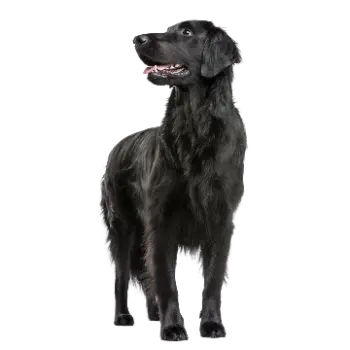

Play Style & Drive

Flat-Coated Retrievers are among the most playful sporting breeds, retaining a puppy-like enthusiasm for games well into adulthood and even old age. Their play style is shaped by strong retrieving instincts, a love of water, and an eagerness to interact with people. Understanding these drives is key to selecting toys that genuinely engage them rather than collecting dust in a corner.

The retrieve drive is the defining feature of this breed's play personality. Flat-Coats are hardwired to chase, pick up, carry, and return objects. This means fetch-oriented toys get the most use, and any toy that can be thrown a satisfying distance will hold their interest longer than a stationary puzzle. They also tend to carry toys around the house — greeting visitors with a shoe, stuffed animal, or whatever they can find — which reflects their desire to hold something in their mouths at all times.

Their intelligence and problem-solving ability mean they also benefit from mental challenges. A Flat-Coat that only gets physical exercise without mental stimulation can become restless and creative in unwanted ways — rearranging furniture, opening cabinets, or finding inventive paths to countertop food. Enrichment toys that combine physical interaction with cognitive challenge provide the most complete engagement for this breed.

Social play is another important dimension. Flat-Coated Retrievers thrive in interactive play with their owners and are naturally inclined toward cooperative games like tug and retrieve. They are less interested in solitary play than some independent breeds, which means the best toy investment is often one that facilitates shared activity between dog and human.

Interactive & Puzzle Toys

Puzzle toys that dispense treats or kibble in exchange for problem-solving effort are excellent tools for occupying a Flat-Coated Retriever's active mind. Start with simpler puzzles that reward basic pawing or nosing, then progress to multi-step designs as your dog builds confidence and skill. Most Flat-Coats catch on quickly, so having a rotation of puzzles at varying difficulty levels prevents boredom.

Treat-dispensing balls and wobble toys that release food as the dog rolls or nudges them work particularly well for this breed. They combine physical movement with the food motivation that Flat-Coats possess in abundance. Using these toys to deliver a portion of the daily kibble ration turns mealtime into an enrichment session without adding extra calories.

Snuffle mats and lick mats offer lower-energy enrichment for times when you need your dog to settle. Scattering kibble across a snuffle mat engages the dog's powerful nose and encourages calm, focused foraging behavior. Lick mats spread with a thin layer of plain yogurt, pumpkin puree, or wet food provide a soothing activity that can help anxious dogs decompress after stimulating events.

Interactive toys that require cooperation between dog and owner — such as tug ropes with treat compartments or toys designed for two-player engagement — align perfectly with the Flat-Coat's social nature. These toys strengthen the bond between dog and handler while providing both mental and physical exercise. The breed's gentle mouth and willingness to follow game rules make them ideal partners for structured interactive play.

Chew Toys & Durability

Flat-Coated Retrievers are moderate to heavy chewers with strong jaws that can dismantle flimsy toys in minutes. Investing in durable chew toys designed for large, powerful breeds saves money in the long run and — more importantly — reduces the risk of your dog ingesting fragments of destroyed toys. Look for products rated for aggressive chewers, made from solid rubber, heavy-duty nylon, or reinforced natural materials.

Rubber chew toys with some give to them are generally safer than rock-hard options that can crack teeth. The ideal chew toy has enough resistance to satisfy the urge to gnaw but yields slightly under jaw pressure, reducing the risk of dental fractures. Many quality rubber toys can be stuffed with treats or frozen with peanut butter to extend engagement time and add a food-reward dimension to chewing.

Natural chew options like bully sticks, tendons, and dried fish skins provide satisfying textures and flavors without synthetic ingredients. These are consumable products that should be offered under supervision, as any chew can become a choking hazard once whittled down to a small piece. Remove nubs and fragments before they reach a swallowable size, and match the chew's toughness to your individual dog's chewing intensity.

Avoid toys with small parts, squeakers that can be extracted, button eyes, or ribbon decorations. Flat-Coated Retrievers are dexterous enough to locate and remove these components, and any small part that comes loose is a potential foreign body. If you offer stuffed toys — and many Flat-Coats enjoy carrying them — choose those designed for large dogs with reinforced stitching and embedded rather than attached features.

Fetch & Outdoor Toys

Fetch is the signature game for most Flat-Coated Retrievers, and the right throwing toys make it more enjoyable for both dog and handler. Standard tennis balls work but wear down tooth enamel over time due to their abrasive felt covering. Rubber balls designed specifically for dogs offer similar bounce and visibility without the dental wear, and many come in high-visibility colors that are easier to track in tall grass or dim lighting.

Ball launchers that extend throwing distance dramatically increase the workout your dog gets per throw, which matters with a breed that has seemingly limitless endurance. These tools also reduce shoulder strain for owners who throw hundreds of balls over a dog's lifetime. Start with moderate distances and build up, particularly with puppies and adolescents whose joints are still developing.

Water-retrieving toys are essential equipment for a breed that lives to swim. Floating bumpers, buoyant rubber toys, and water-safe fetch sticks let you take the retrieve game into lakes, rivers, and pools. Choose brightly colored options that are easy to spot on the water's surface. Some floating toys are designed with rope handles that make them easier for the dog to grab and carry, which is a thoughtful feature for extended water sessions.

Flying discs made from soft, flexible rubber are another excellent outdoor option. Unlike rigid plastic discs, soft versions are gentler on the dog's mouth and less likely to cause dental injury during enthusiastic catches. Flat-Coated Retrievers often become skilled disc dogs with practice, and the unpredictable flight path of a well-thrown disc adds a mental component to the physical chase.

Comfort & Companion Toys

Despite their athletic reputation, Flat-Coated Retrievers have a deeply affectionate side that often manifests in attachment to comfort objects. Many Flat-Coats adopt a favorite stuffed toy that they carry around the house, present to visitors, and sleep with. Providing a durable plush toy that can serve this role satisfies an instinctive need to hold and carry without sacrificing your household items to the cause.

Comfort toys are especially valuable during transitional periods — bringing a new puppy home, adjusting to a new living situation, or recovering from surgery. A soft toy with a familiar scent can provide genuine emotional support for a breed that bonds deeply with its environment and routine. Some puppy-specific comfort toys include a warmable insert and heartbeat simulator that mimics the feeling of sleeping alongside littermates.

For dogs that experience mild separation anxiety — a not-uncommon trait in this people-oriented breed — a comfort toy combined with a treat-dispensing element can ease the stress of being left alone. Freezing a stuffable toy with a high-value filling gives the dog something positive to focus on during the critical first twenty minutes after the owner's departure, which is typically when anxiety peaks.

Rotating comfort toys periodically helps maintain their novelty, but be mindful that some dogs form genuine attachments to specific toys. If your Flat-Coat has a clear favorite, let them keep it while rotating the supporting cast. Washing comfort toys regularly maintains hygiene without disrupting the bond — most dogs recognize their toy by shape and texture rather than scent alone.

DIY & Budget Options

Not every enrichment activity requires a purchased product. Flat-Coated Retrievers are enthusiastic participants in homemade games that cost little or nothing. A muffin tin with tennis balls covering kibble-filled cups creates an instant puzzle feeder. A cardboard box filled with crumpled paper and hidden treats becomes a foraging station. An old towel with kibble rolled inside provides a simple unwrapping challenge.

Frozen enrichment is one of the most cost-effective ways to keep a Flat-Coat occupied. Freeze a mixture of low-sodium broth and small treats in a bowl or container for a long-lasting licking and chewing activity. Ice blocks with toys frozen inside provide warm-weather entertainment that also helps with cooling. These cost pennies to make and can occupy an active dog for thirty minutes or more.

Backyard obstacle courses assembled from household items offer physical and mental stimulation without commercial equipment. A broomstick balanced on two buckets becomes a jump. A line of chairs with a blanket draped over them creates a tunnel. A hula hoop held upright serves as a jumping ring. Flat-Coated Retrievers respond enthusiastically to these improvised agility setups, especially when treats mark each station.

Scent games tap into the Flat-Coat's powerful nose and cost nothing at all. Hide treats around the house or yard in progressively more challenging locations, then release your dog to find them. Start with obvious placements and increase difficulty as the dog's search skills develop. This activity provides intense mental exercise with minimal physical demand, making it ideal for rainy days, recovery periods, or senior dogs with reduced mobility.

Always consult a qualified professional before making any health-related decisions. This content is provided for informational reference only and should not replace professional guidance specific to your animal.