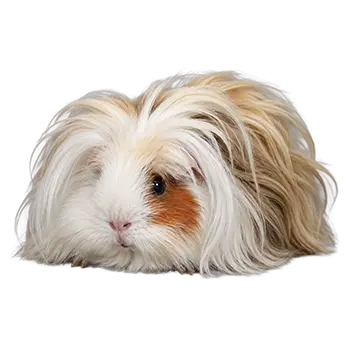

Guinea pigs need far more space than most commercially marketed cages provide, and this is especially true for Texels, whose long coats pick up bedding debris and moisture more readily in cramped quarters. The widely accepted minimum for a single guinea pig is 7.5 square feet of floor space, but because guinea pigs are social animals that should be kept in pairs or small groups, most owners should plan for at least 10.5 square feet. Larger enclosures pay dividends in cleanliness, enrichment, and overall health.
Floor space matters more than vertical height for guinea pigs. Unlike rats or chinchillas, cavies are ground-dwelling animals that do not climb, and multi-level cages with ramps are generally less useful than a single spacious floor area. Ramps can also pose a hazard for Texels, whose long curls can catch on wire ramp surfaces or become tangled in ramp edges. A wide, single-level enclosure is almost always the better choice.
The shape of the enclosure also influences usability. Rectangular enclosures encourage running and popcorning — the joyful leaping behavior that signals a happy guinea pig — far more effectively than square or circular designs. A long, relatively narrow layout gives your Texel room for short sprints and zoomies, which are important for cardiovascular health and weight management.
Placement within the home deserves careful thought. Guinea pigs are sensitive to drafts, direct sunlight, and temperature extremes. The enclosure should be positioned in a room with stable temperatures between 65 and 75 degrees Fahrenheit, away from heating vents, air conditioning units, and windows that receive prolonged direct sun. A living area or family room where the guinea pig can observe household activity without being overwhelmed by noise is ideal for socialization.