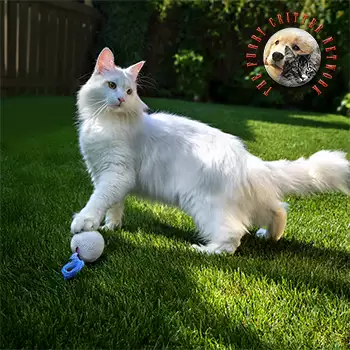

Play Style & Drive

Turkish Angoras are among the most playful and intellectually engaged cat breeds, maintaining kitten-like play energy well into adulthood and often into their senior years. Their play style tends to be fast, acrobatic, and inventive — these are cats that leap, twist mid-air, and chase with genuine athletic commitment. Understanding this play profile is essential for selecting toys that will hold their interest rather than collecting dust after a single session.

This breed has a strong prey drive oriented toward small, fast-moving targets. Toys that mimic the erratic movement of birds, insects, or small rodents trigger the most intense engagement. The Turkish Angora's hunting sequence — stalk, chase, pounce, capture — is well-developed and deeply satisfying to the cat when allowed to play out completely. Ending play sessions with a "catch" followed by a small treat reinforces the natural hunting cycle and leaves the cat feeling fulfilled.

Intelligence is a defining trait of the Turkish Angora, which means they bore quickly with toys that offer no challenge. A toy that was captivating on day one may be completely ignored by day three if it behaves predictably. Rotating toys on a weekly basis and introducing novelty through different textures, movements, and sounds keeps the enrichment fresh. Having a larger collection of toys and cycling through them is more effective than presenting everything at once.

Social play is important for this breed. Turkish Angoras are people-oriented cats that genuinely prefer interactive play with their owners over solo entertainment. While self-directed toys have their place, nothing replaces a dedicated daily play session where the owner actively engages with a wand toy or laser pointer. These sessions strengthen the human-cat bond and provide the level of stimulation that passive toys simply cannot match.

Interactive & Puzzle Toys

Puzzle feeders are among the most effective enrichment tools for a Turkish Angora. These devices require the cat to manipulate compartments, slides, or obstacles to access food or treats, engaging problem-solving skills that this intelligent breed thrives on. Start with simpler puzzles and increase difficulty as the cat masters each level — a puzzle that is too easy offers no engagement, while one that is too difficult causes frustration and abandonment.

Multi-stage puzzle boxes with adjustable difficulty settings offer the best long-term value because they grow with the cat's skills. Some designs feature removable inserts or configurable chambers that allow the owner to change the puzzle layout, essentially creating a new challenge from the same toy. For a breed as clever as the Turkish Angora, this adaptability is essential for sustained interest.

Interactive toys that respond to the cat's actions — motion-activated rollers, touch-sensitive sound toys, and app-controlled devices — provide stimulation when the owner is unavailable. These should supplement, not replace, human-driven play, but they can fill gaps during work hours or busy evenings. Look for products with variable speed or randomized movement patterns, as predictable toys lose their appeal quickly with this breed.

Treat-dispensing balls and wobble toys combine physical activity with food motivation. The cat must bat, roll, or manipulate the toy to release kibble or treats, turning snack time into an activity. These are particularly useful for Turkish Angoras who tend to eat too quickly, as the dispensing mechanism naturally slows consumption and adds a mental component to mealtime.

Wand Toys & Aerial Play

Wand toys are the gold standard for interactive play with a Turkish Angora. The combination of owner control and unpredictable movement creates the closest approximation to live prey that any toy can offer. The best wand toys feature long, flexible rods with attachments that flutter, dart, and change direction convincingly. Feathered attachments trigger the strongest response in most cats, though some Turkish Angoras prefer fabric streamers or small plush lures.

Technique matters as much as the toy itself. Dragging a wand toy slowly along the ground with occasional pauses — mimicking injured prey — produces far more engagement than waving it erratically in the air. Allow the cat to stalk, build anticipation, and then make its move. Occasionally letting the cat catch the toy and "kill" it completes the predatory cycle and prevents frustration from endless unsuccessful chasing.

The Turkish Angora's aerial abilities make overhead wand play especially rewarding. These cats are capable of impressive vertical leaps, and dangling a wand toy above them triggers spectacular acrobatic displays. Ensure the play area is free of fragile objects and has enough ceiling clearance for safe jumping. A dedicated play session of 15 to 20 minutes twice daily is sufficient for most adults, though younger cats may want more.

Wand toy safety requires attention. The string, ribbon, or elastic cord connecting the attachment to the rod is a serious ingestion hazard if the cat chews through it. Never leave wand toys accessible when unsupervised — store them in a closed drawer or cabinet after each session. Inspect attachments regularly for loose feathers, fraying string, or small parts that could be swallowed, and replace worn components promptly.

Solo & Automated Toys

Automated laser toys project a moving dot in randomized patterns, providing self-directed chase stimulation for times when the owner cannot play. Turkish Angoras typically respond enthusiastically to laser movement, and automated units with adjustable speed and pattern settings prevent the predictability that leads to disengagement. However, laser play should always be supplemented with tangible prey toys, as the inability to ever "catch" the dot can cause frustration in some cats.

Battery-operated floor toys that scuttle, vibrate, or roll unpredictably along the ground simulate small prey movement and can captivate a Turkish Angora for extended periods. The most effective designs change direction upon hitting obstacles, creating genuinely unpredictable paths. Models with fur or feather coverings add tactile interest that plain plastic bodies lack. Check battery compartments for secure closure, as a determined cat will investigate every opening.

Track toys with balls that move within enclosed channels provide low-intensity entertainment that suits quieter moments. While they rarely produce the intense engagement of a wand session, they offer consistent background stimulation and are completely safe for unsupervised use. Multi-level track designs with intersecting paths tend to hold interest longer than simple circular tracks.

Catnip and silvervine toys offer chemical enrichment that affects roughly two-thirds of cats. If your Turkish Angora is responsive to catnip, stuffed toys with refillable catnip pouches provide renewable stimulation. Silvervine produces a response in many cats who are indifferent to catnip, so it is worth testing as an alternative. Valerian root is a third option that some cats find equally compelling. Rotating between these different attractants prevents habituation.

Scratching & Physical Enrichment

Scratching is not a behavioral problem — it is a biological necessity. Cats scratch to maintain claw health, stretch their muscles, and mark territory through both visual marks and scent glands in their paws. Providing ample scratching surfaces is essential, and for a Turkish Angora, variety in both orientation and material produces the best results. Vertical scratching posts, horizontal pads, and angled ramps each serve slightly different muscle groups and scratching preferences.

Sisal rope and sisal fabric are the most universally preferred scratching materials among cats. Corrugated cardboard scratchers are also popular and have the advantage of being inexpensive and replaceable. Carpet-covered scratching posts are less ideal because they teach the cat that carpet texture is appropriate for scratching — a lesson that may extend to your actual carpet. Whatever material you choose, the scratcher must be stable enough that it does not wobble or tip when the cat uses it with full force.

Placement of scratching surfaces should be strategic. Cats often scratch immediately after waking, so placing a scratcher near the primary sleeping area catches this impulse. Scratchers near doorways and along common travel paths within the home address territorial marking instincts. If the cat has begun scratching furniture, placing an appropriate scratcher directly adjacent to the targeted piece and gradually moving it to a preferred location is more effective than simply removing the cat from the area.

Cat exercise wheels have become increasingly popular for high-energy breeds, and the Turkish Angora is an ideal candidate. These large, hamster-wheel-style devices allow the cat to run at full speed indoors, providing cardiovascular exercise that is difficult to replicate with standard toys. Training a cat to use an exercise wheel requires patience and positive reinforcement, but once adopted, many cats use them voluntarily and with obvious enjoyment.

DIY & Budget Options

Some of the most effective cat toys cost nothing. A crumpled ball of paper tossed across a hard floor produces unpredictable bouncing and skidding that triggers the Turkish Angora's chase instinct. Cardboard boxes — especially when multiple boxes are connected with cut-out openings to create tunnels — provide hours of exploration, ambush play, and hiding. Rotate boxes weekly to maintain novelty.

Paper bags with the handles removed make excellent crinkle toys that also serve as hiding spots. The sound of crinkling paper is inherently interesting to most cats, and the enclosed space satisfies the desire to hide and ambush. Never use plastic bags, as they present both suffocation and ingestion risks. Brown grocery bags are ideal — they are sturdy, produce satisfying sounds, and are endlessly replaceable.

DIY puzzle feeders can be constructed from common household items. An empty egg carton with treats placed in the cups becomes a simple puzzle. A muffin tin with tennis balls covering the treat-filled cups requires the cat to remove each ball to access the reward. Toilet paper tubes with the ends folded shut and a few holes cut in the sides create treat-dispensing rollers. These homemade solutions are often just as effective as commercial alternatives and allow for infinite customization.

A length of string dragged across the floor under a sheet of newspaper or a blanket creates invisible prey movement that most cats find irresistible. Ice cubes on a tile or hardwood floor skitter unpredictably and add a temperature novelty. Ping pong balls in a dry bathtub create a contained play environment where the ball cannot escape under furniture. The most important enrichment ingredient is not the toy itself but the owner's willingness to engage — even five minutes of dedicated interactive play each day makes a meaningful difference in a Turkish Angora's quality of life.

Always consult a qualified professional before making any health-related decisions. This content is provided for informational reference only and should not replace professional guidance specific to your animal.