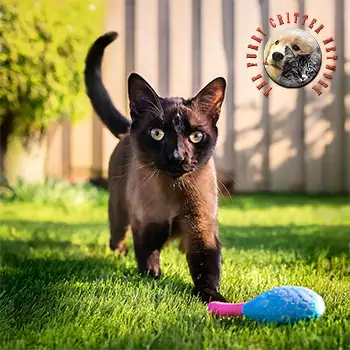

Play Style & Drive

Tonkinese cats are among the most play-driven breeds in the domestic cat world. Their Siamese and Burmese heritage gives them a combination of intelligence, athleticism, and social engagement that demands more interactive play than the average house cat. A Tonkinese that does not receive adequate play stimulation will find ways to entertain itself — and those ways usually involve your belongings, your curtains, or your patience.

This breed retains kitten-like playfulness well into adulthood and even into their senior years. They are fetch players, ambush specialists, and aerial acrobats. Their play style tends to be fast, intense, and social — they want you involved, not just watching. A toy left on the floor will get a few minutes of solo attention, but a toy animated by a human hand will captivate a Tonkinese for extended sessions.

Understanding your individual cat's prey preferences will help you select the most effective toys. Some Tonkinese cats are bird-chasers, responding strongly to feathered toys and objects that move through the air. Others are ground-hunters, preferring toys that skitter across the floor like mice or insects. Observe which movements trigger the most intense stalking and pouncing behavior, and build your toy collection around those preferences.

Scheduled play sessions are essential — at least two fifteen-to-twenty-minute sessions per day for an adult Tonkinese. These sessions should mimic the hunt cycle: stalk, chase, catch, and then a cool-down period followed by a small meal or treat. This sequence satisfies the cat's predatory instincts and provides a natural transition from high energy to rest.

Interactive & Puzzle Toys

Interactive toys that require the cat to solve a problem to access a reward are particularly well-suited to the Tonkinese temperament. This breed is intelligent enough to figure out sliding panels, rotating discs, and hidden compartments, and they find genuine satisfaction in the process. Start with beginner-level puzzles and increase complexity as your cat masters each one — a puzzle that is too easy will be abandoned, and one that is too difficult will be ignored.

Treat-dispensing balls and wobble toys provide mental stimulation when you are not available for interactive play. These toys release small amounts of kibble or treats as the cat bats them around, turning feeding time into an enrichment activity. For Tonkinese cats that tend to eat too quickly, puzzle feeders serve the dual purpose of slowing down consumption and providing cognitive engagement.

Electronic interactive toys — motion-activated laser dots, automated feather wands, and rolling ball tracks — can supplement human-led play but should not replace it. Tonkinese cats crave social interaction, and an electronic toy that moves on its own lacks the responsiveness and unpredictability that makes play with a human partner so rewarding. Use automated toys as a bridge between interactive sessions, not as a substitute.

Rotate puzzle toys on a weekly basis to maintain novelty. Even the most engaging puzzle loses its appeal once the cat has memorized the solution. Keeping three or four puzzles in rotation and swapping them out regularly ensures that each one feels fresh when it returns to the lineup.

Wand Toys & Chasers

Wand toys are the gold standard for interactive play with a Tonkinese cat. A well-made wand toy with a feathered, furred, or ribbon attachment allows you to simulate the erratic movement of prey — darting, pausing, fluttering, and hiding behind furniture. The key is unpredictability. Move the toy in ways that mimic real prey behavior rather than simply dragging it in circles.

Quality varies enormously in wand toys. Look for a flexible rod that can absorb the impact of a leaping cat without snapping, a secure attachment point that will not detach during vigorous play, and replaceable lure ends so you can swap out worn attachments without replacing the entire toy. Wire-core wands should be avoided or used only under supervision, as a determined chewer can expose the wire and create an injury risk.

Laser pointers are popular but should be used with caution. The Tonkinese hunting instinct is deeply satisfying when it ends in a catch, and a laser dot can never be caught. Extended laser play without a tangible payoff can lead to frustration and obsessive behavior in some cats. If you use a laser pointer, always end the session by directing the dot onto a physical toy or treat that the cat can catch and "kill" to complete the hunt cycle.

Kickable prey toys — elongated plush toys filled with catnip or silvervine that the cat can grab with its front paws and kick with its hind legs — satisfy the grappling and bunny-kicking instinct. Tonkinese cats often enjoy wrestling with these toys, and they provide a physical outlet for energy that wand play does not fully address.

Scratching & Climbing Toys

Scratching is a non-negotiable behavior for all cats, and providing appropriate outlets is a matter of environmental design, not training. Tonkinese cats scratch to maintain claw health, mark territory, and stretch their muscles. If you do not provide scratching surfaces they find appealing, they will select their own — typically your couch, carpet, or door frames.

Offer a variety of scratching surfaces in different orientations. Vertical scratching posts should be tall enough for the cat to fully extend its body — at least 30 to 32 inches for an adult Tonkinese. Horizontal and angled scratchers provide alternatives, and most cats have a preference for one orientation or another. Sisal rope, sisal fabric, corrugated cardboard, and natural wood are all viable surface materials, but sisal tends to be the most universally preferred and the most durable.

Combination pieces that integrate scratching surfaces with climbing platforms and perching spots are ideal for Tonkinese cats. These all-in-one structures serve multiple needs in a single footprint, which is especially valuable in smaller living spaces. A tall scratching post with a platform on top becomes a scratching station, a climbing challenge, and a lookout point — three functions in one piece of furniture.

Place scratching surfaces near sleeping areas, room entrances, and any furniture the cat has previously targeted. Cats often scratch upon waking and when entering a new space, so positioning scratchers in these locations channels the behavior to appropriate surfaces. If your cat is already scratching furniture, place a scratcher directly next to or in front of the damaged area and gradually move it to a preferred location once the cat has redirected its habit.

Comfort & Companion Toys

While Tonkinese cats are not typically anxious by nature, they are deeply attached to their people and can experience stress during absences. Comfort toys — soft plush toys that provide a physical presence to curl up with — can help ease the transition when the household is empty. Some cats bond strongly with a particular plush toy and will carry it, groom it, and sleep with it consistently.

Catnip and silvervine toys provide a neurological stimulation that many cats find pleasurable and relaxing. Approximately 60 to 70 percent of cats respond to catnip, and those that do not often respond to silvervine or valerian root as alternatives. Tonkinese cats tend to be responsive to these attractants, and a catnip session can serve as a useful wind-down activity after an intense play period.

Kicker toys filled with catnip or crinkle material serve as both comfort objects and solo play companions. A Tonkinese cat home alone during the workday may cycle between resting with a kicker toy and wrestling with it, providing intermittent physical activity throughout the day. Choose kicker toys with reinforced seams, as this breed plays hard and can destroy a poorly constructed toy in a single session.

Avoid toys with small, detachable parts — button eyes, ribbon decorations, tiny bells, or glued-on accessories. Tonkinese cats are persistent chewers when engaged, and small parts that separate from a toy become choking hazards. Opt for toys with embroidered features rather than attached components, and inspect all toys regularly for wear that could expose stuffing or internal mechanisms.

DIY & Budget Options

You do not need an expensive toy collection to keep a Tonkinese cat entertained. Some of the most engaging play objects are household items repurposed as cat toys. A crumpled ball of paper, a ping-pong ball bouncing across a hard floor, or a cardboard box with holes cut in the sides can provide extended entertainment at zero cost. Tonkinese cats are attracted to novelty, and a new cardboard box is genuinely exciting to them.

Paper bags with the handles removed make excellent rustling, hiding, and pouncing toys. Never use plastic bags, which pose a suffocation risk. Toilet paper and paper towel tubes can be cut into rings, partially folded, and filled with a few pieces of kibble to create a simple puzzle toy. These disposable toys can be rotated frequently without any financial investment.

A DIY fishing rod toy can be made from a wooden dowel, a length of string, and a fabric or feather attachment tied securely to the end. Supervise all string play — unsupervised access to string, yarn, ribbon, or thread is one of the most common causes of intestinal obstruction in cats. When the play session ends, put the string toy away in a drawer or closet.

Rotation is the simplest and most effective enrichment strategy available, and it costs nothing. Divide your cat's toy collection into three or four groups and put out only one group at a time, swapping every three to five days. Toys that have been out of sight for a week feel new again when they reappear, and this approach keeps the environment stimulating without requiring a constant supply of new purchases.

Always consult a qualified professional before making any health-related decisions. This content is provided for informational reference only and should not replace professional guidance specific to your animal.