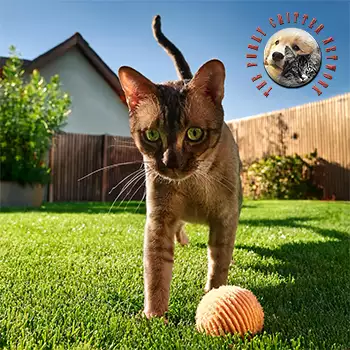

Play Style & Drive

The Sokoke retains a stronger prey drive than most domesticated breeds, a direct inheritance from their semi-wild ancestors in the Arabuko-Sokoke Forest. This translates into play sessions that are intense, fast, and heavily oriented around stalking, chasing, and pouncing sequences. Understanding this instinctive play pattern is essential to choosing toys that will actually hold their attention rather than being batted once and forgotten under the couch.

These cats are ambush predators at heart. They prefer toys that mimic the erratic movement of small prey — darting, pausing, changing direction — rather than toys that simply sit still or move in predictable patterns. A Sokoke will often crouch motionless for several seconds before exploding into action, and toys that reward this stalk-and-strike behavior create the most satisfying play experience for the cat.

Social play is equally important for this breed. Sokokes bond closely with their owners and often prefer interactive play sessions over solitary amusement. A toy that requires human participation — like a wand toy or a laser pointer session — strengthens the relationship while providing the physical and mental workout the cat needs. Expect to dedicate at least two focused play sessions of fifteen to twenty minutes each day to keep a Sokoke content.

Boredom is the enemy of a happy Sokoke. Without adequate mental and physical stimulation, these intelligent cats will create their own entertainment, often at the expense of household objects, curtains, or other pets. Investing in a rotation of engaging toys is not an indulgence — it is a practical strategy for preserving your home and your sanity.

Interactive & Puzzle Toys

Puzzle feeders and treat-dispensing toys are among the most effective enrichment tools for the Sokoke. These toys tap into the cat's natural foraging instincts by requiring them to manipulate objects, solve simple mechanical challenges, or work through obstacles to access a food reward. The mental engagement these toys provide is just as tiring as physical exercise, making them an excellent complement to active play sessions.

Start with simpler puzzle designs and gradually increase the difficulty as your Sokoke masters each level. Many puzzle feeders come with adjustable difficulty settings that allow you to close off certain openings or add barriers as the cat becomes more proficient. A Sokoke that solves a puzzle too easily will lose interest quickly, so maintaining an appropriate challenge level is key to sustained engagement.

Interactive electronic toys that produce unpredictable movements can captivate a Sokoke for extended periods. Toys that hide under fabric and move erratically, or that feature randomly rotating elements, appeal to the cat's prey drive by creating the illusion of a living target. Battery life and noise level are practical considerations — choose toys with rechargeable batteries and motors that are not so loud they startle the cat or annoy the household.

Rotation is critical with all interactive toys. Even the most engaging puzzle or electronic toy will lose its appeal if it is available constantly. Keep three or four options in active rotation and swap them out every few days. The reintroduction of a previously shelved toy often reignites interest as though the cat is encountering it for the first time.

Wand Toys & Chasers

Wand toys are the gold standard for interactive play with a Sokoke. A flexible rod with a feathered, furred, or ribbon attachment at the end allows you to simulate the movement of birds, insects, or small rodents with remarkable realism. The key to an engaging wand session is in the technique — move the toy away from the cat rather than toward it, incorporate sudden pauses and directional changes, and occasionally let the cat catch and "kill" the target to complete the predatory sequence.

Durability matters significantly with this breed. A Sokoke in full prey mode will hit a wand attachment with considerable force, and cheap feathered lures tend to disintegrate within minutes. Look for wand toys with reinforced attachment points and lures made from tougher materials. Having spare attachments on hand ensures you can replace a destroyed lure without interrupting the play rotation.

Chaser toys — battery-operated devices that send a small object racing along a track or across the floor — provide a different type of pursuit experience. These can be useful for those times when you cannot personally engage in a play session but want to give the cat an outlet for chase energy. However, they should supplement rather than replace hands-on interactive play, as the Sokoke's social nature means they derive significantly more satisfaction from playing with their human than from any automated device.

Always end wand play sessions with a cooldown period. Allow the Sokoke a final catch followed by a small food reward, mimicking the natural hunt-catch-eat sequence. This brings the play session to a satisfying conclusion and helps prevent the frustrated, hyperactive behavior that can result from abrupt endings to high-energy play.

Climbing & Exploration Toys

Given the Sokoke's exceptional climbing ability, toys and structures that encourage vertical exploration provide some of the best enrichment available. Tunnel systems, both horizontal and angled, appeal to the cat's desire to stalk through enclosed spaces and ambush targets at the other end. Collapsible tunnels with crinkly interiors add an auditory dimension that many Sokokes find irresistible.

Cat wheels — essentially oversized hamster wheels designed for cats — are a significant investment but can be transformative for a high-energy Sokoke. These devices allow the cat to sprint at full speed indoors, which is especially valuable in smaller living spaces or during seasons when outdoor enclosure use is limited. Not every cat takes to a wheel immediately, and some training with treat rewards may be required, but Sokokes are among the breeds most likely to adopt wheel running enthusiastically.

Hanging toys mounted in doorways or on cat tree branches provide batting and grabbing targets that engage the Sokoke's coordination and reflexes. Spring-mounted toys that bounce back when struck are particularly appealing because they create the illusion of a resisting prey item. Ensure that any hanging toy is securely attached and made from materials that cannot be chewed into small, swallowable pieces.

Exploration can also be encouraged through simple environmental changes. Rearranging furniture periodically, introducing new cardboard boxes, or creating temporary obstacle courses with household items gives the Sokoke novel territory to investigate. The breed's natural curiosity means that even a paper bag placed in an unexpected location can provide several minutes of focused investigation and play.

Comfort & Companion Toys

While the Sokoke is primarily driven by active play, they also have a softer side that emerges during rest periods. Some Sokokes develop strong attachments to specific plush toys, carrying them around the house, kneading them, or curling up with them during sleep. These comfort objects can be especially valuable for cats that spend time alone during the day, providing a tactile companion in their owner's absence.

Catnip-filled toys elicit a strong response in many Sokokes and can be useful for redirecting energy or encouraging independent play. The response to catnip is genetic, and roughly a third of cats show no reaction at all, so it is worth testing early to determine whether your individual cat is responsive. Silver vine and valerian root are alternative attractants that may appeal to cats that are indifferent to catnip.

Kickable toys — elongated plush shapes roughly the size of a cat's body — satisfy the instinct to grab with the front paws and kick vigorously with the hind legs. This behavior mimics the way cats subdue larger prey items in the wild and provides a satisfying full-body workout. Durable stitching and tough outer fabric are essential, as the kicking action puts significant stress on seams.

Safety should govern all toy selections. Avoid toys with small detachable parts like button eyes, bells that can be chewed free, or ribbon lengths that could be swallowed and cause intestinal obstruction. The Sokoke's strong jaw and persistent chewing ability mean that any weak point in a toy's construction will eventually be found and exploited. Supervise play with any toy that has components small enough to be ingested.

DIY & Budget Options

Some of the most engaging toys for a Sokoke cost nothing at all. A crumpled ball of paper tossed across a hard floor becomes an irresistible chase target, skittering unpredictably in a way that triggers the prey drive more effectively than many commercial toys. Wine corks, ping-pong balls, and empty toilet paper rolls are all safe, simple items that most Sokokes will play with enthusiastically.

Cardboard boxes remain one of the most universally beloved cat toys ever invented, and the Sokoke is no exception. Cut entry and exit holes in various sizes, stack multiple boxes together to create a multi-room fort, or simply leave a single box on the floor and watch your Sokoke claim it within minutes. The ephemeral nature of cardboard construction is actually a benefit — when the box is destroyed, it provides a new crafting opportunity and a fresh configuration to explore.

DIY puzzle feeders can be constructed from common household items. An empty egg carton with treats placed in the cups, a muffin tin with tennis balls covering the wells, or a plastic bottle with holes cut large enough to dispense kibble when rolled all provide legitimate cognitive enrichment without any financial investment. These homemade puzzles are especially useful for testing whether your Sokoke enjoys puzzle-based enrichment before committing to more expensive commercial options.

Feather and string toys can be assembled at home, but exercise the same caution as with commercial versions. Never leave string, yarn, ribbon, or thread accessible to an unsupervised cat, as ingestion of linear foreign bodies is one of the most common and dangerous surgical emergencies in feline medicine. DIY wand toys should be used during supervised play sessions only and stored securely afterward.

Always consult a qualified professional before making any health-related decisions. This content is provided for informational reference only and should not replace professional guidance specific to your animal.