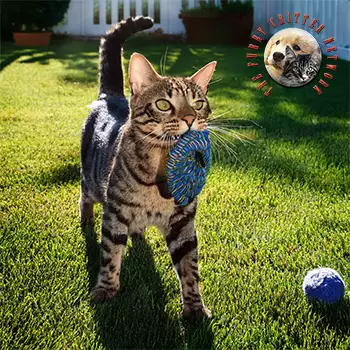

Play Needs & Drive

The California Spangled was bred to look like a wild spotted cat, and its play behavior reflects that heritage with striking fidelity. These cats possess an intense, focused prey drive that goes well beyond casual batting at a dangling string. When a California Spangled locks onto a moving target, its entire body shifts into a predatory posture — lowered shoulders, wide-set hindquarters, and a stillness that precedes an explosive burst of speed. Play sessions with this breed feel less like casual entertainment and more like observing a genuine hunting sequence.

This intensity means that the California Spangled's enrichment needs are substantial and non-negotiable. A bored California Spangled does not simply nap more; it redirects its hunting energy toward destructive targets. Shredded furniture, knocked-over objects, ambush attacks on ankles, and obsessive attention to closed doors are all common symptoms of insufficient play. The breed requires a minimum of two to three dedicated interactive play sessions per day, each lasting at least fifteen to twenty minutes, in addition to access to self-directed play options throughout the day.

The quality of play matters as much as the quantity. The California Spangled is a thinking hunter. It stalks, plans approach angles, and adjusts its strategy based on how the prey moves. Toys and play techniques that are too predictable will lose this cat's interest quickly. The most engaging play mimics the erratic, unpredictable movement patterns of real prey — sudden direction changes, pauses that trigger the cat's anticipation, and bursts of speed that provoke a chase response.

Age modifies play needs but does not eliminate them. Older California Spangled cats may have shorter play sessions, but they retain their predatory instincts and their need for mental engagement. Adjusting toy selection and play intensity to match the cat's physical condition — slower movements, lower jumps, more emphasis on puzzle solving — keeps senior cats enriched without overtaxing aging joints.

Interactive Wand & Prey Toys

Wand toys are the cornerstone of interactive play for the California Spangled. A well-constructed wand toy with interchangeable attachments allows the owner to simulate a complete hunting sequence: the prey appears, moves, hides, is stalked, chased, caught, and consumed. This full sequence — stalk, chase, pounce, catch, kill bite — is essential for providing genuine satisfaction, as a California Spangled that chases endlessly without ever catching anything will become frustrated rather than enriched.

The wand itself should be long enough to keep the owner's hands well clear of the action. The California Spangled's pounces are powerful and fast, and a wand that is too short invites accidental scratches. Rods in the 36-inch range with a flexible, responsive tip allow for the fluid, lifelike movements that hold this breed's attention. Cheap wands with rigid plastic shafts and fixed attachments cannot replicate the darting, fluttering, scurrying motion patterns that trigger the full predatory sequence.

Attachment variety is important because the California Spangled discriminates between prey types and engages differently with each. Feathered attachments that mimic birds prompt aerial leaps and mid-air catches. Furry or mouse-like attachments dragged along the floor elicit the low, crouching stalk followed by a ground-level pounce. Insect-like attachments with erratic buzzing movements trigger rapid swatting and short chases. Rotating through different attachment types across play sessions prevents habituation and keeps the cat's response sharp.

At the end of every wand play session, the cat should be allowed to catch the prey and carry it away. This completion of the hunt cycle is what produces the neurochemical satisfaction that calms the cat after play. Ending a session by pulling the toy away while the cat is still in high chase mode leaves arousal elevated and can lead to redirected aggression or restless pacing. After the catch, follow immediately with a small treat or a meal to simulate the eat phase of the hunt-catch-eat cycle.

Puzzle Feeders & Cognitive Toys

The California Spangled's intelligence is one of its defining characteristics, and puzzle toys that challenge problem-solving ability are as important to this breed's enrichment as physical play. A puzzle feeder transforms a routine meal into a cognitive task, requiring the cat to manipulate sliding panels, lift covers, dig into compartments, or roll a dispenser to access food. For a breed that processes novel challenges with visible concentration and persistence, these toys provide a quality of mental engagement that passive toys cannot match.

Difficulty level should be matched to the individual cat's experience and escalated gradually. Starting with a simple stationary puzzle — a board with open wells or a muffin tin covered with tennis balls — allows the cat to learn the concept that effort produces food. Once the cat solves these basic puzzles quickly and consistently, progression to intermediate designs with sliding doors, rotating discs, or stacked chambers maintains the challenge. The California Spangled's problem-solving ability means it will master most commercial puzzles faster than average, so having several puzzles in rotation and periodically reintroducing older ones after a rest period extends their useful life.

Rolling food dispensers serve a different cognitive function. These toys require the cat to push, bat, or roll the device to release kibble through a small opening. The feedback loop — action produces reward — is simple, but the physical engagement of chasing the rolling object across the floor adds a kinetic dimension that stationary puzzles lack. For the California Spangled, a food-dispensing ball used for a portion of the daily kibble ration provides both mental stimulation and light exercise between dedicated play sessions.

DIY puzzle options should not be overlooked. Cardboard boxes with holes cut in the sides and treats hidden inside, paper bags with kibble scattered at the bottom, and egg cartons with food placed in the cups all provide genuine enrichment at minimal cost. The California Spangled's curiosity means it will investigate any novel object in its environment, and disposable puzzles that can be replaced frequently offer the advantage of novelty — the cat encounters a slightly different challenge each time, which keeps cognitive engagement high.

Solo & Automated Toys

While interactive play with a human partner is irreplaceable for the California Spangled, solo toys and automated devices play an important supporting role during the hours when the owner is unavailable. The key distinction is between toys that hold the cat's attention independently and toys that are ignored within minutes. The California Spangled's intelligence means it quickly identifies toys with repetitive, predictable patterns and loses interest once the pattern is learned.

Automated laser toys that project a moving dot in randomized patterns across the floor and walls can provide bursts of engagement, particularly for cats with high chase drive. However, laser play carries an important caveat for a prey-driven breed like the California Spangled: the cat can never catch the dot. Extended laser sessions without a tangible catch at the end can produce frustration, obsessive scanning behavior, and anxiety. If using an automated laser toy, pairing it with a physical treat or toy placed at the laser's final position gives the cat a tactile catch that completes the sequence.

Motion-activated toys that respond to the cat's touch — balls that roll when batted, mice that vibrate and scurry when disturbed — are a better match for solo play because they provide the sensory feedback of contact. These toys create a call-and-response dynamic where the cat's action produces a visible, touchable reaction, which sustains interest far longer than a static plush mouse. Look for toys with variable response patterns that prevent the cat from predicting exactly how the toy will react.

Kicker toys — elongated, stuffed toys designed to be grabbed, wrestled, and kicked with the hind legs — satisfy the California Spangled's desire to grapple with prey-sized objects. The best kicker toys are roughly the length of the cat's torso, firmly stuffed to provide resistance during bunny-kicking, and covered in a durable fabric that can withstand extended sessions. Some kicker toys include dried catnip or silver vine powder in the filling, which adds olfactory stimulation that can rekindle interest in a toy the cat has otherwise mastered.

Catnip, Silver Vine & Sensory Play

Catnip sensitivity is genetically determined, and roughly 50-70% of domestic cats carry the gene that produces the characteristic euphoric response to nepetalactone, the active compound in Nepeta cataria. For California Spangled cats that are responsive, catnip is a powerful enrichment tool that can transform ordinary toys into high-value objects and create bursts of intense, self-directed play. The response typically lasts five to fifteen minutes and includes rolling, rubbing, chin-marking, and animated chasing of catnip-infused toys.

Silver vine (Actinidia polygama) is an effective alternative for cats that do not respond to catnip. Research has shown that silver vine elicits a response in a higher percentage of cats than catnip does, and some cats that are indifferent to catnip respond strongly to silver vine. The active compounds — actinidine and dihydroactinidiolide — produce a similar range of euphoric behaviors. Offering both catnip and silver vine during an initial trial period helps identify which substance, if either, your California Spangled responds to most strongly.

Tatarian honeysuckle wood is a third option in the feline euphoriants category. Shavings or small pieces of the wood produce a response in some cats that do not react to either catnip or silver vine. For a California Spangled owner assembling a comprehensive enrichment toolkit, having all three substances available ensures that the cat has access to olfactory stimulation regardless of its specific genetic response profile.

Sensory play extends beyond chemical stimulants. Crinkle materials that produce a rustling sound when touched mimic the noise of small prey moving through leaf litter and can trigger investigative behavior in the California Spangled. Textured surfaces — corrugated cardboard, sisal, fleece, and felt — provide tactile variety that encourages the cat to scratch, knead, and manipulate objects with its paws. Water play, while not universal in the breed, appeals to some California Spangled cats; a shallow dish with floating toys or a dripping faucet can provide minutes of focused investigation. The goal is to engage as many senses as possible, creating an environment where the cat encounters varied stimuli throughout the day.

Scratching Posts & Surfaces

Scratching is a non-negotiable behavior for all cats, serving essential functions that include claw maintenance, scent marking through interdigital glands, full-body stretching, and stress relief. For the California Spangled, with its powerful forelimbs and strong grip, providing adequate scratching surfaces is not optional — failure to do so will result in the cat selecting its own surfaces, which will invariably include furniture, door frames, and carpet.

Vertical scratching posts should be tall enough for the California Spangled to stretch to its full body length while scratching. For this breed, that means a minimum post height of 32 inches, with 36 inches or taller being preferable. The post must be stable enough to resist tipping when the cat leans its full weight into it during vigorous scratching. A wide, heavy base or wall-mounting hardware is essential. Sisal rope wrapping is the most universally preferred scratching substrate for cats and holds up well under heavy use, though it will need periodic replacement as it frays.

Horizontal and angled scratching surfaces provide variety that accommodates different scratching postures. Some California Spangled cats prefer to scratch horizontally, pulling their claws through a flat surface with the body lowered, which works different muscle groups than vertical scratching. Corrugated cardboard scratching pads are inexpensive and highly attractive to most cats, though they produce debris and wear out relatively quickly under heavy use. Angled scratching ramps offer a compromise between vertical and horizontal orientations and can be positioned next to furniture that the cat has previously targeted.

Strategic placement is as important as the scratching surface itself. Cats scratch most frequently upon waking, after play sessions, and in locations where they want to deposit territorial scent marks. Placing scratching posts near the cat's primary sleeping area, near entry points to rooms, and adjacent to any furniture the cat has shown interest in scratching directs the behavior to appropriate surfaces. A California Spangled household should have a minimum of three to four scratching surfaces distributed across the cat's primary territory, with at least one vertical and one horizontal option available.

Toy Safety & Rotation

The California Spangled's powerful jaws and enthusiastic play style demand attention to toy safety that goes beyond what is sufficient for gentler breeds. Small components — plastic eyes on plush mice, bells inside balls, feathers attached with thin thread — can be detached and ingested, creating choking hazards or gastrointestinal obstructions. Inspect all toys before introduction and remove any small, detachable parts. During play, monitor for signs of toy degradation and retire items that are coming apart.

String, ribbon, yarn, elastic, and rubber bands should never be available as toys or left unattended where the cat can access them. Linear foreign bodies are among the most dangerous ingestion hazards for cats, as they can anchor at one point in the digestive tract and cause the intestines to bunch, leading to perforation and potentially fatal peritonitis. The California Spangled's intense hunting behavior makes it more likely to ingest string-like materials during play, so wand toy strings should be stored out of reach when not in active use under human supervision.

Toy rotation is a strategy that leverages the California Spangled's strong novelty response. Rather than leaving all toys out continuously — which leads to habituation and boredom — divide the toy collection into three or four sets and rotate them on a weekly basis. When a set of toys reappears after a two-to-three-week absence, the cat responds to them with renewed interest, effectively extending the useful life of each toy and maintaining higher overall engagement.

Material quality matters for durability and safety. Toys made from natural materials — leather, wool felt, untreated wood — tend to be more durable than their synthetic counterparts and do not carry the risk of chemical off-gassing that some cheap plastic toys do. For plush toys, double-stitched seams and reinforced construction delay the inevitable destruction by a cat that treats every toy as genuine prey. Investing in fewer, higher-quality toys that survive extended play sessions is more cost-effective and safer than cycling through large quantities of disposable products.

Always consult a qualified professional before making any health-related decisions. This content is provided for informational reference only and should not replace professional guidance specific to your animal.