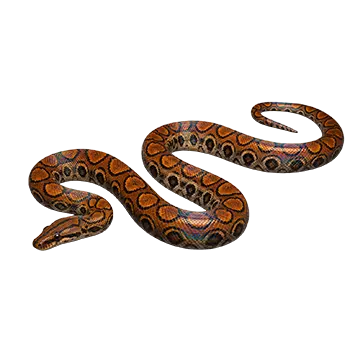

Brazilian Rainbow Boas (Epicrates cenchria) reach adult size between three and four years of age, at which point most individuals measure four to five and a half feet in total length, with exceptional specimens occasionally reaching six feet. Females tend to be slightly larger and heavier-bodied than males, though there is significant overlap between the sexes, and body size alone is not a reliable method of sex determination. An adult male in good condition typically weighs between two and four pounds, while a well-maintained female ranges from three to five pounds. These are medium-bodied boas — muscular and solidly built without the bulk of larger boa or python species.
The hallmark feature of the adult Brazilian Rainbow Boa is the spectacular iridescent sheen produced by microscopic ridges on the dorsal scales that act as diffraction gratings, splitting white light into its component wavelengths. Under natural or direct artificial light, the scales produce vivid rainbow reflections that shift and shimmer as the snake moves. This optical effect is at its most dramatic in freshly shed adults and is one of the primary reasons for the species' enduring popularity in the reptile hobby. The base coloration in adults is typically a rich reddish-brown to deep orange, overlaid with a series of dark-bordered dorsal saddles and lateral ocelli that are more sharply defined than in juvenile specimens.
Once an adult Brazilian Rainbow Boa has reached its full length, growth effectively ceases, and the keeper's focus shifts from supporting development to maintaining optimal body condition. An adult in prime condition has a smoothly rounded body profile with no visible spine or rib outlines, well-defined muscle tone along the dorsal surface, and clear, bright eyes between shed cycles. The belly should be flat or very slightly rounded when the snake is resting on a flat surface, with no excessive lateral bulging that would indicate fat accumulation. Maintaining this body condition over the animal's two-decade-plus lifespan requires disciplined feeding, appropriate exercise through environmental enrichment, and consistent veterinary oversight.
Shedding frequency in adults slows considerably compared to juveniles. While a rapidly growing juvenile may shed every four to six weeks, a healthy adult typically sheds every six to ten weeks, with some individuals going up to twelve weeks between sheds during cooler months or periods of reduced feeding. Each shed should be complete and delivered in a single piece. Partial or fragmented sheds in an adult that previously shed cleanly often indicate declining humidity, dehydration, the onset of a health problem, or the presence of external parasites, and should be investigated rather than dismissed as a one-time occurrence.