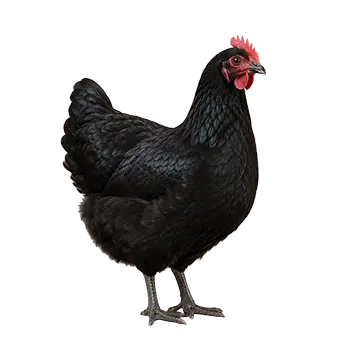

The Australorp Chicken is an Australian breed developed in the early twentieth century from Black Orpington stock imported from England. The name Australorp is a contraction of Australian Orpington, reflecting the breed's direct lineage from William Cook's famous English dual-purpose breed. Australian poultry breeders took the Orpington and selectively bred it with a sharper focus on egg production and utility characteristics rather than the exhibition qualities that were increasingly dominating Orpington breeding in England. The resulting bird was leaner, more active, and dramatically more productive than its English ancestor while retaining the Orpington's outstanding temperament.
The breed achieved international fame through a series of egg-laying contests in the 1920s that demonstrated productivity levels previously thought impossible for a heritage breed. In the most celebrated trial, conducted at the Burnley Agricultural College in Victoria during 1922-1923, a team of six Australorp hens laid 1,857 eggs in 365 days, averaging 309.5 eggs per hen per year. This extraordinary performance generated worldwide attention and established the Australorp as the premier utility layer of its era. Export demand surged, with birds shipped to England, the United States, South Africa, and numerous other countries where breeders recognized the commercial potential of such prolific layers.
The Australian Poultry Standard recognizes three color varieties of the Australorp: Black, White, and Blue. The American Poultry Association admitted the Black Australorp to the Standard of Perfection in 1929, with the breed classified in the English class due to its Orpington ancestry. The APA does not currently recognize the White or Blue varieties in standard large fowl, though bantam Australorps are recognized. In Australia, where the breed holds national significance as the country's most important poultry contribution to world agriculture, all three varieties are exhibited and maintained by dedicated breeders preserving the breed's heritage and genetic diversity.
Foundation stock for the Australorp likely included crosses beyond the Orpington itself, with historical accounts suggesting contributions from White Leghorns, Langshans, and Minorcas during the breed's formative period. These outcrosses helped shift the Australorp toward greater egg production and a more active, utility-oriented body type while the Orpington base contributed size, hardiness, and temperament. The exact breeding formulas used by early Australian developers varied between programs, and some historical details remain debated among breed historians. Regardless of the precise recipe, the outcome was a breed that combined heritage robustness with production capability that challenged the specialized laying breeds of the day.