Saint Shepherd
The Saint Shepherd is a cross between the Saint Bernard and the German Shepherd. Because each hybrid inherits a unique combination of traits from both parents, we recommend thoroughly researching both breeds before choosing a Saint Shepherd. Pay special attention to temperament, health issues, and care requirements, as your dog may express characteristics from either parent breed.
Saint Bernard
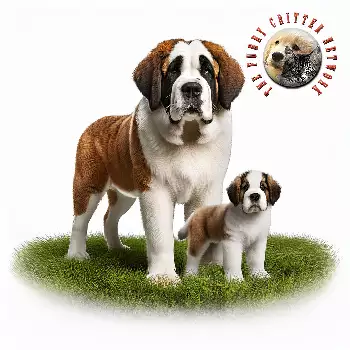
The Saint Bernard stands as one of the most recognizable giant breeds in the world, with males typically reaching 28 to 32 inches at the shoulder and weighing between 140 to 180 pounds, while females measure slightly smaller at 26 to 28 inches and 120 to 140 pounds. This massive breed possesses a powerful, muscular build with substantial bone structure that conveys both strength and nobility, characteristics essential to their historical role as mountain rescue dogs. The head is particularly impressive, being large and broad with a slightly wrinkled forehead, deep-set dark eyes that express intelligence and kindness, and medium-sized pendant ears set high on the skull. The muzzle is short and blunt with well-developed flews that contribute to the breed's notable tendency to drool, especially after eating or drinking. Saint Bernards come in two distinct coat varieties: shorthaired and longhaired. The shorthaired variety features a dense, smooth coat that lies close to the body and requires less maintenance, while the longhaired variety displays medium-length fur that is slightly wavy but never curly or shaggy. Both coat types feature a thick, protective undercoat that provides excellent insulation against cold weather, reflecting the breed's Alpine origins. The breed's coloration is predominantly white with red, mahogany, brindle, or brown patches distributed across the body, and most individuals display the characteristic dark mask around the eyes and ears. White markings typically appear on the chest, feet, tail tip, nape of neck, and as a distinctive blaze on the face. The breed's overall proportions emphasize balance and symmetry despite its enormous size, with a deep chest, straight topline, and well-muscled hindquarters that enable surprising agility for such a large dog. The tail is long, heavy, and carried low with a slight upward curve at the tip during movement. Saint Bernards shed heavily throughout the year, particularly during seasonal coat changes in spring and fall, and their impressive double coat requires regular brushing and grooming to maintain its condition and manage loose hair throughout the home.
Key Characteristics
Temperament Temperament Temperament Temperament Temperament Temperament Training a Saint Bernard requires patience and consistency, as the breed can display an independent streak stemming from their heritage as autonomous working dogs in mountain rescue operations. Early socialization is essential to ensure they develop into well-adjusted adults comfortable with various people, animals, and environments. These dogs mature slowly, often not reaching full physical and mental maturity until two to three years of age, so owners should maintain realistic expectations during the extended puppy phase.
Health Considerations Health Considerations Health Considerations Health Considerations Health Considerations Health Considerations Osteosarcoma, an aggressive bone cancer, affects giant breeds at higher rates than smaller dogs, and Saint Bernards are particularly susceptible to this devastating disease that often appears in middle-aged dogs. Additional health concerns include entropion where the eyelids roll inward causing irritation, cruciate ligament injuries due to their substantial body weight, wobbler syndrome affecting the cervical spine, and degenerative myelopathy. Maintaining a healthy weight is critical for this breed, as obesity dramatically increases stress on already vulnerable joints and organs.
German Shepherd

The German Shepherd is a medium to large-sized breed renowned for its athletic, muscular build and noble bearing. Males typically stand 24 to 26 inches at the shoulder and weigh between 65 to 90 pounds, while females measure 22 to 24 inches and weigh 50 to 70 pounds. The breed standard emphasizes a body that is longer than it is tall, with a deep chest, strong back, and smooth curves that enable the powerful, ground-covering trot for which the breed is famous. The head is proportionate to the body with a slightly domed forehead, strong wedge-shaped muzzle, and powerful jaws that meet in a scissor bite. The most distinctive facial features are the alert, almond-shaped dark eyes and the large, erect ears that stand parallel and open forward. The German Shepherd possesses a dense double coat designed to provide protection in various weather conditions. The outer coat is medium length, straight to slightly wavy, harsh in texture, and lies close to the body, while the undercoat is thick and soft. Longer hair appears on the neck, forming a slight ruff, and on the backs of the legs and tail. The most common coloration is the classic black and tan pattern featuring a dark saddle over a lighter base, though the breed also comes in sable, solid black, black and red, black and cream, and black and silver. While all-white German Shepherds exist, this coloration is disqualified from showing under most breed standards. The German Shepherd's movement is characterized by a smooth, effortless trot that covers maximum ground with minimum effort, reflecting the breed's origins as a herding dog capable of working long hours. The tail is long, bushy, and carried in a gentle saber curve when at rest. German Shepherds are notorious shedders, earning them the nickname German Shedders among owners. They shed continuously throughout the year with heavy seasonal shedding occurring twice annually, requiring regular brushing to manage loose hair and maintain coat health.
Key Characteristics
Temperament Temperament Temperament Temperament Temperament Temperament The breed requires significant time and attention from their owners, as they do not do well when left alone for extended periods and may develop separation anxiety if isolated from their family. German Shepherds are high-energy dogs that need substantial daily exercise and mental stimulation to remain balanced and well-behaved, with two to three hours of activity recommended for adult dogs. They generally get along well with children when raised together and can coexist peacefully with other household pets, though some individuals may display same-sex dog aggression or strong prey drive toward smaller animals.
Health Considerations Health Considerations Health Considerations Health Considerations Health Considerations Health Considerations German Shepherds are susceptible to various forms of cancer, including hemangiosarcoma affecting blood-rich organs and osteosarcoma affecting the bones. Additional health concerns include diabetes, pannus and other eye conditions including cataracts, perianal fistulas, epilepsy, and hypothyroidism. Panosteitis, sometimes called growing pains, commonly affects young German Shepherds between 6 to 18 months of age, causing shifting leg lameness that typically resolves on its own. Responsible breeders conduct comprehensive health screening including hip and elbow evaluations, cardiac examinations, and genetic testing to minimize the transmission of hereditary conditions.
Important to Remember
Each hybrid dog is unique and may inherit any combination of traits from either parent breed. The information above represents the characteristics of the purebred parent breeds. Your Saint Shepherd may favor one parent over the other or display a blend of both. We strongly encourage you to read the complete breed profiles for both the Saint Bernard and German Shepherd to fully understand the range of possible temperaments, health concerns, and care requirements.