German Shepherd

German Shepherd Dog

Quick Facts

🐕 Breed Group
Herding Group
📏 Size Category
Large
📏 Height
Males: 24-26 inches, Females: 22-24 inches
⚖️ Weight
Males: 65-90 lbs, Females: 50-70 lbs
⏱️ Life Expectancy
9-13 years
🧣 Coat Type
Double coat, medium length
🎨 Coat Colors
Black and tan, black and red, sable, black, bi-color
😀 Temperament
Confident, courageous, intelligent
🏃 Exercise Needs
High
🎓 Training Difficulty
Easy to moderate
👶 Good with Children
Excellent with family children
🐾 Good with Other Pets
Good with proper socialization

Other Names & Breed Recognition

German Shepherd is the name that most of the world actually uses for this breed. The formal registry name is German Shepherd Dog, with the word "Dog" appended to distinguish it from the human occupation of shepherding, but in everyday conversation, on veterinary forms, in news coverage, and across popular culture, the breed is simply the German Shepherd. It is one of those cases where the shortened name has so thoroughly replaced the official one that most people do not realize a longer version exists.

The breed goes by several other names as well. Alsatian was the standard British name for decades, adopted during and after World War I to distance the breed from its German origins during a period of intense anti-German sentiment. The UK Kennel Club officially used Alsatian until 1977, when it reverted to German Shepherd Dog. In Germany, the breed is called the Deutscher Schaferhund, which translates directly to German Shepherd Dog. The abbreviation GSD is common in breed communities, online forums, and among enthusiasts who write about the breed frequently.

Every major kennel club in the world recognizes this breed. The AKC places it in the Herding Group, the UKC in the Herding Dog group, the FCI in Group 1 among the sheepdogs, and the Kennel Club in the Pastoral group. It has been one of the most popular breeds in the United States for decades and consistently ranks near the top of AKC registration statistics.

People who search for German Shepherd rather than German Shepherd Dog are looking for exactly the same breed. The shortened name captures the vast majority of public interest and search traffic, and anyone researching the breed's health, temperament, or history should know that both names lead to the same animal with the same standards and the same characteristics. When you see a police K-9 unit, a search and rescue team, or a guide dog working in public, the handler will almost always refer to it simply as a German Shepherd, and the general public understands immediately what breed they mean. The formal name lives in registry paperwork; the shortened name lives everywhere else.

German Shepherd Organizations & Standards

The Verein fur Deutsche Schaferhunde, commonly known as the SV, is the breed's founding parent club. Established in 1899 by Captain Max von Stephanitz, the SV is the largest single-breed club in the world and has shaped nearly every aspect of how the German Shepherd has developed over the past century. The SV maintains its own breed registry, hosts the annual Sieger Show, and administers a comprehensive system of breed surveys, working titles, and health testing that German breeders must navigate before their dogs are approved for breeding. The SV's influence extends far beyond Germany, as many international breeders model their programs on its standards.

In the United States, the German Shepherd Dog Club of America has served as the AKC parent club since 1913. The GSDCA maintains a Code of Ethics, administers breed-specific health programs, and hosts the national specialty show. The club's Health Award of Merit program requires dogs to pass OFA hip and elbow evaluations, OFA cardiac and thyroid testing, and the GSDCA temperament test. Degenerative myelopathy DNA testing is also recommended, though the results do not currently disqualify a dog from the program due to ongoing research.

The breed standard describes a strong, agile, well-muscled dog that is longer than tall, with a smoothly curved topline and a confident, ready-to-work expression. Males should stand 24 to 26 inches at the shoulder, females 22 to 24 inches. The standard emphasizes a balanced, effortless gait that reflects the breed's original purpose as a sheep-tending and herding dog. Colors include black and tan, black and red, sable, solid black, and bi-color, with the classic saddle-back pattern being the most recognizable to the general public.

The FCI standard and the AKC standard differ in some structural preferences, most notably in angulation and topline. The German show lines tend toward more extreme rear angulation and a more sloped topline, while working lines and many American breeders prefer a more moderate structure. This split has been a source of ongoing discussion within the breed community, with health and working ability at the center of the debate. Regardless of which standard a breeder follows, the health testing expectations remain consistent - hips, elbows, cardiac, thyroid, and DM testing represent the baseline that separates responsible breeders from those cutting corners. The CHIC program through OFA provides a centralized database where buyers can verify that a breeder's claims about health testing are backed by actual recorded results.

Kennel Club Recognition

  • American Kennel Club (AKC): Recognized in 1908, Herding Group
  • United Kennel Club (UKC): Recognized, Herding Dog
  • Canadian Kennel Club (CKC): Recognized, Herding Dogs
  • FCI: Recognized, Group 1
  • The Kennel Club (UK): Recognized, Pastoral

German Shepherd Physical Description

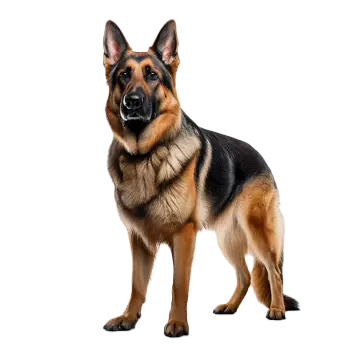
The German Shepherd is a large, athletic dog whose physical design communicates purpose and capability at a glance. Males typically stand 24 to 26 inches at the shoulder and weigh 65 to 90 pounds. Females are noticeably smaller, standing 22 to 24 inches and weighing 50 to 70 pounds. The body is distinctly longer than tall, creating the rectangular outline that is characteristic of the breed and that reflects its trotting heritage as a sheep-herding dog.

The head is strong and noble without being coarse, with a moderately broad skull that tapers cleanly into a long, wedge-shaped muzzle. The jaws are powerful, closing in a complete scissor bite with large, firmly set teeth. Eyes are medium-sized, almond-shaped, and dark, carrying an expression of alert intelligence that is one of the breed's most identifiable features. Ears are large, pointed, and carried erect, set moderately wide and tilted slightly forward. In puppies, the ears may flop until the cartilage strengthens, typically standing fully erect by six to eight months of age.

The neck is relatively long and muscular, carried at approximately 45 degrees in a relaxed stance and raised higher when the dog is alert or in motion. The chest is deep, reaching to the elbow, and moderately broad. Ribs are well-sprung but not barrel-shaped, allowing for the lung capacity and heart room that sustained trotting requires. The topline flows in a smooth, gradual slope from the withers toward the croup, which is long and gently angled.

The double coat consists of a dense, straight or slightly wavy outer coat of medium length and a thick, soft undercoat. The coat is shorter on the head, ears, and front of the legs and longer on the neck, the backs of the legs, and the tail. A long-coated variety exists and is recognized in some registries but considered a fault in others. The most familiar color pattern is the black saddle overlaying a tan or red body, but sable, solid black, bi-color, and black and silver also occur. Sable German Shepherds carry individual hairs banded with multiple colors, producing a wolf-like appearance that many working line breeders favor. White German Shepherds exist but are disqualified in the AKC conformation ring, though they have their own dedicated following and registry.

Movement is where the German Shepherd's physical design truly comes together. The breed was built to trot efficiently over long distances, and a well-constructed German Shepherd covers ground with a smooth, far-reaching stride that appears almost effortless. The topline should remain firm during movement, and the dog should single-track at moderate speeds. Good movement requires correct angulation front and rear, a strong back, and the overall balance that allows the dog to sustain a working trot for hours without fatigue. Watching a well-built German Shepherd move at a flying trot is one of the breed's most impressive displays, and experienced breeders evaluate gait as one of the most important indicators of structural soundness.

The tail is bushy, reaching at least to the hock, and carried in a gentle saber curve when relaxed. During movement or excitement, the tail may rise but should not curl over the back. The overall picture of a well-built German Shepherd is one of balance, strength, and readiness - a dog that looks like it could herd sheep all morning, track a lost person through the woods all afternoon, and still have enough energy to play fetch in the evening.

Affectionate With Family
German Shepherds bond intensely with their family unit. They are loyal to the point of being shadows, following their people from room to room and wanting to be involved in every activity.
Good With Young Children
Well-socialized German Shepherds are excellent with the children in their family. They are patient and protective, though their size warrants supervision with very young kids.
Good With Other Dogs
Socialization makes the difference here. German Shepherds can coexist well with other dogs but some individuals, particularly intact males, may show same-sex assertiveness.
Shedding Level
Shedding is legendary in this breed. The double coat blows out heavily twice a year and sheds consistently between those periods. Expect hair on everything you own.
Coat Grooming Frequency
Regular brushing two to three times per week is the minimum, with daily sessions during seasonal coat blows. The undercoat needs attention to prevent matting.
Drooling Level
Not a significant drooler under normal conditions. Some drooling may occur around mealtimes or during heavy panting, but it is not a persistent issue.
Coat Type
The medium-length double coat has a dense, harsh outer layer and a thick undercoat. It provides good protection in various weather conditions.
Openness To Strangers
German Shepherds are typically reserved with unfamiliar people, which is part of their natural guarding instinct. They observe before they engage.
Playfulness Level
Energetic and enthusiastic about play, especially activities that involve chasing, retrieving, or problem-solving. They maintain a playful side well into adulthood.
Watchdog/Protective Nature
Among the best natural watchdogs of any breed. They are territorial, alert, and have both the confidence and physical ability to back up their protective instincts.
Adaptability Level
Adaptable to many living situations as long as exercise needs are met. They do well in urban, suburban, and rural settings when properly stimulated.
Trainability Level
One of the most trainable breeds in existence. Their intelligence, work ethic, and desire to please their handler make them exceptional students for virtually any task.

German Shepherd History & Development

The name German Shepherd became the standard casual reference for a breed that was formally created in 1899, when a German cavalry officer named Max von Stephanitz attended a dog show and purchased a working sheepdog that embodied everything he believed a utility dog should be. That dog, Horand von Grafrath, became the first registered German Shepherd Dog and the foundation of a breeding program that would produce one of the most versatile and successful working breeds in history.

Von Stephanitz's vision was not a show dog or a pet. He wanted a working animal of superior intelligence, physical soundness, and trainable temperament that could serve whatever purpose society demanded. When the sheep-herding tradition began to decline, he pivoted the breed toward police and military service, recognizing that the same qualities that made a great herding dog - responsiveness to the handler, courage under pressure, tireless work ethic - translated directly into law enforcement and military applications.

The breed proved its value dramatically during both World Wars, serving as messenger dogs, sentries, supply carriers, and Red Cross search dogs. German Shepherds returning home with soldiers became powerful ambassadors for the breed, and their popularity in the United States exploded in the 1920s and 1930s, boosted further by canine film stars like Rin Tin Tin and Strongheart. It was during this period that the shortened name German Shepherd became the dominant public reference, with "Dog" dropping away in casual usage as the breed became a household name that needed no formal introduction.

The anti-German sentiment of the World Wars led to the adoption of alternate names in some countries, most notably "Alsatian" in Britain, where the name persisted officially until 1977. In the United States, the breed's popularity was strong enough that the German name survived intact, though some breeders briefly marketed them as "shepherd dogs" without the German prefix. The official name was eventually restored everywhere, but the shortened version had already cemented itself in English-speaking culture. Today, German Shepherd is the name used in news reports, veterinary offices, pet stores, and everyday conversation, while German Shepherd Dog remains the formal registry designation.

The breed's post-war development split into distinct lines - show lines bred primarily for conformation and working lines bred for performance in protection sports, police work, and military service. This divergence has created ongoing discussion about what the breed should look like and what it should be capable of. Show line dogs tend toward heavier bone, more angulation, and the dramatic sloped topline that wins in the conformation ring. Working line dogs tend toward moderate structure, higher drive, and the physical soundness needed for demanding professional roles. The name German Shepherd applies to all of them equally, whether the dog is patrolling with a K-9 officer, competing in Schutzhund trials, or sleeping on the family couch.

German Shepherd Temperament & Personality

The German Shepherd's temperament is the reason this breed has succeeded in more roles than arguably any other dog on the planet. Police work, military service, search and rescue, guide dog work, therapy, detection, herding, and family companionship - the list of jobs this breed performs well is almost absurdly long. Behind that versatility is a temperament that combines high intelligence, strong work drive, and a deep desire to bond with and work for a specific handler.

Loyalty is the trait that German Shepherd owners mention first and most often. These dogs do not spread their affection casually. They bond intensely with their family, particularly with one primary person, and that bond becomes the center of the dog's emotional world. A German Shepherd that has chosen its person will follow them everywhere, keep them in sight constantly, and show visible distress when separated for extended periods. This is not neediness - it is a profound attachment that reflects the breed's heritage as a handler-focused working dog.

With their own family, German Shepherds are affectionate, playful, and genuinely gentle with children they have been raised with. The protective instinct extends naturally to the smallest family members, and many owners describe their German Shepherd positioning itself between the children and any perceived threat without being asked. This instinct needs to be managed through socialization so the dog can distinguish between a genuine threat and a neighborhood kid running through the yard.

The breed's reserve with strangers is not aggression - it is assessment. A well-socialized German Shepherd will observe a new person, read the body language of its owner, and decide how to respond based on that information. If the owner is relaxed and welcoming, the dog will typically follow suit. If the situation feels tense, the dog will remain alert and positioned to respond. This discernment is what makes the breed so valued in protection roles and so reliable as a family guardian.

The flip side of this intelligence and drive is that German Shepherds need a job. They are not dogs that do well with nothing to do. Without adequate mental stimulation and physical exercise, they become anxious, destructive, and prone to developing neurotic behaviors like excessive barking, pacing, and self-directed licking. The breed needs an engaged owner who provides structure, training, and daily activity that gives the dog a sense of purpose.

Anxiety is a real concern in the breed, and it shows up in several forms. Separation anxiety develops when the intense bond with the owner is disrupted by prolonged absence. Noise sensitivity can produce panic responses to thunderstorms, fireworks, or other loud events. Generalized nervousness appears in dogs that were inadequately socialized or that come from lines where temperament stability was not prioritized. Choosing a well-bred puppy from parents with solid temperaments and investing in thorough socialization during the first year are the best defenses against anxiety-related issues.

German Shepherd Family Life & Living Requirements

The German Shepherd adapts well to family life when the family understands what the breed needs and commits to providing it. These are not low-maintenance dogs. They require daily exercise, consistent training, regular grooming, and meaningful interaction with their people. In return, they offer a level of loyalty, protection, and companionship that few breeds can match.

With children, the German Shepherd is typically patient, protective, and willing to tolerate a level of activity that would irritate many breeds. They become especially bonded to children they grow up with, and the relationship between a German Shepherd and its family's kids is often one of the most rewarding aspects of owning the breed. That said, the dog's size and energy level require supervision with very young children, and teaching kids how to interact respectfully with the dog is always appropriate.

Housing requirements are flexible as long as exercise needs are met. German Shepherds do well in houses with yards, but they can also thrive in apartments or urban settings if they get sufficient daily activity. The key variable is not square footage but the owner's commitment to getting the dog out and moving every day. A German Shepherd with a 30-minute yard to run in but an owner who ignores it will be worse off than one in an apartment with an owner who provides two hours of daily activity.

With other pets, socialization is the determining factor. German Shepherds raised with cats and smaller dogs typically coexist peacefully, though their herding instinct may lead to chasing behavior that needs to be managed. Introductions to new animals should be handled carefully, and the breed's prey drive, while moderate compared to true hunting breeds, is high enough that small animals should not be left unsupervised with the dog.

The financial commitment is real. German Shepherds are prone to several expensive health conditions, and veterinary costs for a large breed add up over time. Hip and elbow issues alone can result in surgical bills measured in thousands of dollars. Food, preventive care, training classes, and grooming supplies represent an ongoing expense that prospective owners should factor into their decision. Pet insurance is worth investigating early, before any pre-existing conditions develop.

German Shepherd Training & Exercise Needs

If you want a dog that lives to learn, the German Shepherd is hard to beat. This breed's trainability is legendary, and it stems from a combination of high intelligence, strong work drive, and an eagerness to collaborate with a handler it respects. The best German Shepherd training relationships feel like partnerships where the dog is an active, engaged participant rather than a passive recipient of commands.

Training should begin early and remain consistent throughout the dog's life. Puppy socialization is particularly critical because the German Shepherd's natural wariness of strangers can become problematic if the dog is not exposed to a wide variety of people, places, and situations during the critical developmental period. A well-socialized puppy grows into an adult that can distinguish between normal everyday encounters and genuine threats, which is exactly what you want from a breed with strong protective instincts.

Positive reinforcement is the foundation of effective German Shepherd training. These dogs are sensitive to their handler's tone and body language, and they respond far better to reward-based methods than to punishment. Corrections should be fair, consistent, and proportional. The breed's willingness to work is a gift that harsh training methods can damage permanently. Once a German Shepherd loses trust in its handler, rebuilding that relationship is difficult.

Exercise needs are high. Plan on a minimum of 60 to 90 minutes of daily activity, and understand that this should include both physical exertion and mental challenge. Walking alone is not enough for most German Shepherds. Jogging, hiking, swimming, fetch, agility, tracking, obedience training, and protection sports all provide the intensity that the breed craves. Off-leash exercise in safe, enclosed areas allows the dog to run and explore at its own pace.

The breed excels in structured activities that give it a sense of purpose. Obedience trials, tracking tests, herding events, agility competitions, and Schutzhund or IPO training provide outlets that match the German Shepherd's desire to work. Even owners who have no interest in competition can use training exercises from these disciplines to keep their dog mentally sharp and physically fit. A German Shepherd that has a training routine it looks forward to each day is a dramatically better household companion than one whose mind has nothing productive to occupy it. The investment in training pays dividends in behavior, health, and the quality of the relationship between dog and owner.

German Shepherd Health Concerns

The German Shepherd's popularity has been both a blessing and a curse for its health profile. The enormous demand for puppies has led to irresponsible breeding by people more interested in profit than in health testing, and the breed carries a health burden that reflects decades of inadequate screening in some lines. Responsible breeders work hard to produce healthy dogs, and buyers who do their homework can find well-bred German Shepherds with excellent health, but awareness of the breed's specific vulnerabilities is essential.

Exocrine pancreatic insufficiency occurs in this breed more frequently than in most others and involves the pancreas failing to produce adequate digestive enzymes. Affected dogs lose weight despite normal or increased appetite because they cannot properly absorb nutrients from their food. The condition is manageable with enzyme supplementation added to each meal. Perianal fistulas, hemangiosarcoma, and allergic skin conditions are additional breed-specific concerns that merit awareness.

Common Health Issues

  • Hip dysplasia is the most commonly documented orthopedic condition in the breed - Involving abnormal hip joint development that leads to pain and progressive arthritis. OFA hip evaluation is the minimum screening standard for breeding stock.
  • Elbow dysplasia involves developmental abnormalities in the elbow joint that cause lameness and discomfort - OFA elbow evaluation is recommended alongside hip screening for all breeding dogs.
  • Degenerative myelopathy - DM, is a progressive spinal cord disease that begins with hind-leg weakness and progresses to paralysis. A DNA test identifies at-risk dogs, and the GSDCA recommends testing all breeding stock.
  • Gastric dilatation-volvulus - Bloat/GDV, is a life-threatening emergency where the stomach fills with gas and may twist, requiring immediate emergency surgery. Deep-chested breeds like the German Shepherd face elevated risk.
  • Exocrine pancreatic insufficiency - EPI, occurs when the pancreas fails to produce adequate digestive enzymes, causing weight loss and malabsorption despite normal appetite. The condition is managed with enzyme supplementation at each meal.
  • Perianal fistulas are painful draining tracts around the anus that disproportionately affect German Shepherds - Treatment typically involves immunosuppressive medications and sometimes surgery.

Preventive Care & Health Monitoring

  • Complete GSDCA-recommended health testing including OFA hip and elbow evaluation - Cardiac screening, thyroid testing, and DM DNA testing before breeding any dog. Verify results on the OFA database.
  • Request DM DNA test results on both parents before purchasing a puppy - Avoiding matings between two carriers significantly reduces the risk of producing affected offspring.
  • Discuss prophylactic gastropexy with your veterinarian - Particularly for dogs from lines with a history of bloat. This surgical procedure can be performed during spay or neuter.
  • Feed a high-quality diet appropriate for large breeds and monitor body condition closely - Maintaining lean body weight throughout life reduces stress on joints affected by dysplasia.
  • Provide consistent daily exercise that includes both physical activity and mental stimulation. A well-exercised German Shepherd maintains better joint health - Healthier weight, and more stable temperament.
  • Schedule annual wellness exams that include a thorough orthopedic evaluation - Blood work including thyroid panel, and discussion of any changes in gait, energy level, or digestive function.

German Shepherd Grooming & Maintenance

If you are considering a German Shepherd, you need to make peace with hair. The double coat sheds year-round at a moderate level, then erupts into a full-scale coat blow twice a year, typically in spring and fall, when the undercoat comes out in clumps that can fill a grocery bag in a single brushing session. There is no way to eliminate this shedding. You can only manage it.

Regular brushing two to three times per week is the baseline for coat maintenance between seasonal blows. During the heavy shedding periods, daily brushing with an undercoat rake or deshedding tool is essentially mandatory if you want to keep hair tumbleweeds from colonizing every corner of your home. An outdoor brushing session is ideal during these periods because the volume of loose hair is genuinely impressive.

Bathing should happen only when the dog is dirty or every four to six weeks, whichever comes first. The coat's natural oils provide some weather protection, and over-bathing strips those oils and can lead to dry, itchy skin. Use a dog-specific shampoo and make sure to rinse completely, paying particular attention to the thick undercoat where shampoo residue can hide.

Ear checks should happen weekly since the large, erect ears can collect debris and are sometimes prone to infections, particularly in dogs that swim. Clean with a veterinarian-approved solution and dry thoroughly. Nails need trimming every two to three weeks, and dental care follows the standard recommendation of daily brushing supplemented by dental chews and professional cleanings.

The grooming commitment for a German Shepherd is moderate overall, but the shedding factor is genuinely significant. Prospective owners who are particular about keeping a spotless home should understand that a German Shepherd will challenge that standard daily. A good vacuum cleaner and a relaxed attitude toward dog hair are essential accessories for life with this breed.