Mally Foxhound
The Mally Foxhound is a cross between the Alaskan Malamute and the American Foxhound. Because each hybrid inherits a unique combination of traits from both parents, we recommend thoroughly researching both breeds before choosing a Mally Foxhound. Pay special attention to temperament, health issues, and care requirements, as your dog may express characteristics from either parent breed.
Alaskan Malamute

The Alaskan Malamute is a large, powerful breed built for strength and endurance in harsh Arctic conditions, representing one of the oldest northern sled dog breeds. The breed standard specifies males stand 25 inches at the shoulder and weigh 85 pounds, while females measure 23 inches and weigh 75 pounds, though many individuals exceed these dimensions with males ranging from 70 to over 100 pounds depending on lineage. The heavily boned, compact body is built for pulling heavy loads over long distances rather than racing speed. The thick double coat provides essential insulation against extreme cold, featuring a coarse outer guard coat of medium length over a dense, woolly undercoat measuring one to two inches deep. The coat lies close to the body but may stand somewhat away due to the undercoat's thickness. Colors range from light gray through intermediate shadings to black, with sable and red variations also recognized. White predominates on the underbody, legs, feet, and portions of the face, often with characteristic facial markings including a cap over the head and mask markings. The broad head features a bulky muzzle, erect triangular ears that appear small in proportion to the head, and dark brown almond-shaped eyes conveying a friendly, interested expression. Unlike some related breeds, Malamutes never have blue eyes according to breed standards. The plumed tail is carried over the back in a gentle curve, serving as a warm covering for the face when the dog curls up in cold conditions. The feet are large, tight, and well-furred between the toes for traction on ice and snow. The overall impression is one of substantial power combined with a dignified, wolf-like appearance reflecting the breed's ancient Arctic heritage.
Key Characteristics
Temperament Temperament Temperament Temperament Temperament Temperament Strong pack instincts influence Malamute behavior significantly, creating dogs that prefer company and may develop destructive behaviors or excessive howling when left alone too long. They generally welcome strangers with friendly enthusiasm, making them poor candidates for guard duty despite their imposing appearance. However, they may display aggression toward unfamiliar dogs, particularly those of the same sex, and their powerful prey drive poses risks around smaller animals. This breed requires substantial exercise including long walks, hiking, or activities engaging their natural pulling instincts. Without adequate stimulation, Malamutes commonly dig enormous holes and vocalize persistently.
Health Considerations Health Considerations Health Considerations Health Considerations Health Considerations Health Considerations Idiopathic polyneuropathy constitutes a breed-specific neurological condition affecting nerve function, causing progressive weakness, poor coordination, and changes in vocalization beginning as early as eight weeks of age. Blood testing allows identification of carriers, supporting breeding decisions that reduce disease prevalence. Hypothyroidism affects metabolism and may cause weight gain, lethargy, and coat problems. The breed demonstrates predisposition to bloat or gastric dilatation-volvulus, a life-threatening emergency requiring immediate veterinary intervention. Zinc deficiency occurs due to breed-specific absorption issues, sometimes requiring supplementation. Expected lifespan ranges from 10 to 14 years with appropriate health management.
American Foxhound
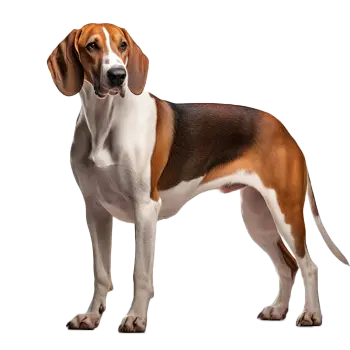
The American Foxhound is a medium to large scent hound built for speed, stamina, and the ability to cover vast distances while pursuing quarry across challenging terrain. Males typically stand 22 to 25 inches at the shoulder and weigh 65 to 70 pounds, while females measure 21 to 24 inches and weigh 60 to 65 pounds. The body is moderately long, muscular, and strong, designed for the endurance required during extended foxhunts. The chest is deep but notably narrow compared to some hound breeds, providing lung capacity without impeding running efficiency. The close-lying, hard coat of medium length protects against brush and weather during hunts while requiring minimal maintenance. While any color is acceptable by breed standard, tricolor patterns combining black, white, and tan predominate, with other combinations including blue and white, brown and white, or tan and white also appearing. The coat texture is dense enough to protect against undergrowth yet smooth to the touch. The head features a slightly domed skull of fair length, a straight, square-cut muzzle, and large, wide-set ears that hang low and long, reaching nearly to the tip of the nose when drawn forward. These pendulous ears help funnel scent toward the nose during tracking work. Large brown or hazel eyes convey a gentle, pleading expression characteristic of the breed. The forelegs are long, straight, and well-boned, while powerful hindquarters provide propulsion during the chase. The tail is set moderately high and carried gaily with a slight curve but not turned forward over the back. The overall appearance is one of athletic refinement, distinguishing the American Foxhound from its stockier English cousin.
Key Characteristics
Temperament Temperament Temperament Temperament Temperament Temperament The breed possesses legendary stamina developed through generations of breeding for foxhunts that lasted hours across challenging terrain. Without adequate exercise, typically requiring at least one to two hours of vigorous activity daily, Foxhounds may channel their energy into unwanted behaviors including digging, escaping enclosures, or the breed's characteristic musical howling that can carry for miles. This distinctive voice, charming to enthusiasts but potentially problematic in close neighborhoods, reflects hunting heritage where vocalizations communicated location to distant handlers. American Foxhounds generally show friendly interest in strangers rather than protective wariness, making them poor watchdogs.
Health Considerations Health Considerations Health Considerations Health Considerations Health Considerations Health Considerations The breed's long, pendulous ears create susceptibility to ear infections when moisture, debris, or wax accumulates in the ear canal. Regular ear cleaning and inspection during grooming helps prevent painful infections caused by bacteria or yeast overgrowth. Hypothyroidism affects some individuals, causing metabolic slowing with symptoms including weight gain, lethargy, and coat changes. The Pelger-Huet anomaly, an inherited condition affecting white blood cell development, occurs in the breed, though the most common form produces no clinical symptoms and is typically discovered during routine blood testing. Dental disease progresses more rapidly in Foxhounds than average, potentially shortening lifespan if not addressed through regular dental care. Obesity represents a significant risk given the breed's love of food. Expected lifespan ranges from 11 to 13 years.
Important to Remember
Each hybrid dog is unique and may inherit any combination of traits from either parent breed. The information above represents the characteristics of the purebred parent breeds. Your Mally Foxhound may favor one parent over the other or display a blend of both. We strongly encourage you to read the complete breed profiles for both the Alaskan Malamute and American Foxhound to fully understand the range of possible temperaments, health concerns, and care requirements.