Aki-Poo
The Aki-Poo is a cross between the Akita and the Poodle. Because each hybrid inherits a unique combination of traits from both parents, we recommend thoroughly researching both breeds before choosing a Aki-Poo. Pay special attention to temperament, health issues, and care requirements, as your dog may express characteristics from either parent breed.
Akita
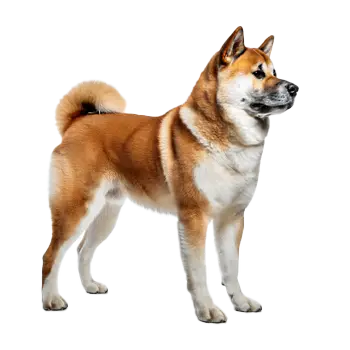
The Akita is a large, powerful dog with a substantial build that reflects its heritage as a cold-weather working breed from the mountains of northern Japan. Males typically stand between 26 and 28 inches at the shoulder and weigh between 100 and 130 pounds, while females range from 24 to 26 inches and weigh 70 to 100 pounds. The breed possesses a muscular, well-proportioned frame that is slightly longer than it is tall, with heavy bone structure providing the power and endurance needed for their historic hunting roles. The chest is wide and deep, reaching to the elbow, with well-sprung ribs that contribute to the breed's impressive lung capacity and stamina. The head is massive and broad, forming a blunt triangle when viewed from above, with a short muzzle, well-defined stop, and powerful jaws. The Akita's coat is one of its most distinctive features, consisting of a thick double layer that provides excellent insulation against harsh weather conditions. The outer coat is straight, harsh, and stands somewhat off the body, while the undercoat is dense, soft, and plush. Coat length measures approximately two inches at the withers and rump, with shorter hair on the head, legs, and ears, and longer, more profuse fur on the tail. American Akitas can be any color including white, brindle, and pinto with well-defined markings, while Japanese Akitas are typically red, fawn, sesame, brindle, or pure white with the characteristic urajiro markings of cream or white coloring on the sides of the muzzle, cheeks, chest, and inner legs. Additional distinguishing features include small, dark, deeply set triangular eyes that give the breed its characteristic dignified and alert expression, and erect triangular ears that are small in relation to the head size and slightly rounded at the tips. The tail is large, full, and carried high, curling over the back in a gentle or double curl that complements the breed's balanced silhouette. The Akita's cat-like feet are tight and well-knuckled with thick pads suited for working in snow, and the overall appearance conveys strength, alertness, and nobility befitting this ancient Japanese breed.
Key Characteristics
Temperament Temperament Temperament Temperament Temperament Temperament Training an Akita requires patience, consistency, and a confident handler who can establish clear leadership without harsh methods. These intelligent dogs can learn quickly but possess an independent and sometimes stubborn streak that may cause them to question commands rather than comply eagerly. Positive reinforcement techniques work best, and training should begin early while the dog is still manageable in size. Akitas thrive when given a job to do and respond well to mental challenges that engage their sharp minds.
Health Considerations Health Considerations Health Considerations Health Considerations Health Considerations Health Considerations Gastric dilatation-volvulus, commonly known as bloat, represents a serious and potentially life-threatening emergency for Akitas and other large, deep-chested breeds. This condition occurs when the stomach fills with gas and twists, cutting off blood supply to vital organs. Progressive retinal atrophy is another inherited condition that causes gradual degeneration of the retina, eventually leading to blindness. Akitas may also be affected by von Willebrand's disease, a bleeding disorder, and acquired myasthenia gravis, which causes muscle weakness. Regular veterinary checkups, health screening of breeding stock, and awareness of warning signs help ensure early detection and treatment of potential health issues.
Poodle

The Poodle is an elegant, well-proportioned dog that comes in three recognized size varieties, each sharing the same refined build and distinctive appearance. Standard Poodles stand over 15 inches at the shoulder and typically weigh between 45 and 70 pounds, making them the largest variety and closest to the breed's original form as water retrievers. Miniature Poodles measure between 10 and 15 inches and weigh 12 to 20 pounds, while Toy Poodles stand 10 inches or under and weigh approximately 5 to 7 pounds. All varieties share a square-proportioned body with a straight back, long elegant neck, and proud carriage that conveys an air of distinction and dignity. The Poodle's coat is perhaps its most famous characteristic, consisting of a dense, curly, single-layer coat that continues to grow rather than shedding seasonally like most breeds. This unique coat texture, often described as hair rather than fur, requires regular professional grooming every four to six weeks to prevent matting and maintain the dog's health and appearance. The coat can be styled in various clips, from the elaborate Continental and English Saddle clips seen in show rings to the more practical Sporting or Puppy clips preferred by many pet owners. Poodles come in a wide array of solid colors including black, white, apricot, cream, brown, blue, gray, silver, red, and cafe-au-lait. Physically, Poodles have a moderately rounded skull with a long, straight muzzle and dark, oval-shaped eyes that express alertness and intelligence. The ears hang close to the head, set at or slightly below eye level, with long, wide, and thickly feathered leather. Poodles move with a light, springy gait that demonstrates their athletic heritage as water retrievers, with sound, effortless movement being essential to the breed standard. Their webbed feet and water-resistant coat are remnants of their original purpose retrieving waterfowl for hunters.
Key Characteristics
Temperament Temperament Temperament Temperament Temperament Temperament Standard Poodles tend to be more reserved and calm than their smaller counterparts, while Toy and Miniature Poodles may exhibit more excitable and sensitive temperaments. All varieties are emotionally attuned to their owners and can be quite sensitive to household tension or stress. Training should always utilize positive reinforcement methods, as Poodles respond poorly to harsh corrections and may become anxious or withdrawn. Their combination of intelligence, trainability, and affectionate nature makes Poodles excellent companions for families, singles, and seniors alike.
Health Considerations Health Considerations Health Considerations Health Considerations Health Considerations Health Considerations Progressive retinal atrophy is an inherited eye condition that causes gradual vision loss and eventual blindness, while cataracts and other eye problems also occur with increased frequency in the breed. Standard Poodles are susceptible to gastric dilatation-volvulus, commonly known as bloat, a life-threatening emergency requiring immediate veterinary intervention. Von Willebrand's disease, a blood clotting disorder, can be identified through DNA testing, allowing breeders to avoid producing affected puppies. Epilepsy, causing recurrent seizures, is another inherited condition seen in Standard Poodles. Regular health screenings, genetic testing of breeding stock, and purchasing puppies from responsible breeders significantly reduce the risk of inherited health problems.
Important to Remember
Each hybrid dog is unique and may inherit any combination of traits from either parent breed. The information above represents the characteristics of the purebred parent breeds. Your Aki-Poo may favor one parent over the other or display a blend of both. We strongly encourage you to read the complete breed profiles for both the Akita and Poodle to fully understand the range of possible temperaments, health concerns, and care requirements.