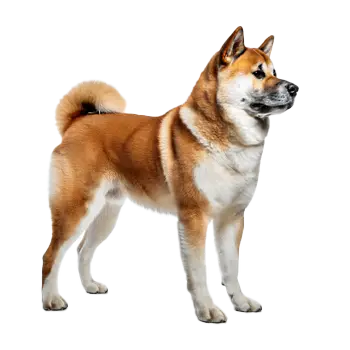
The Akita makes an impression the moment you lay eyes on one. This is a big, powerful dog - not sleek-powerful like a sighthound, but dense and heavy, like something carved rather than assembled. Males can top 130 pounds on a frame that stands up to 28 inches at the shoulder, and they carry that weight with a grounded, deliberate quality that reads as gravitas rather than clumsiness. Even at rest, an Akita looks like it is paying attention.
The head is the breed's most striking feature. It is broad and massive, with a flat skull that widens between the ears. The forehead shows a distinct furrow, and the stop is well-defined. The muzzle is broad and deep, blunt at the end, and about two-thirds the length of the skull from the back of the occiput to the stop. The lips are tight and black. The nose is broad and black in most colors; white Akitas may have a brownish or liver-colored nose, which is acceptable but not preferred by many breeders. The jaw is strong, with a scissors bite required by the standard.
The eyes are the feature that most distinctly sets the Akita's expression apart from other spitz breeds. They are small, triangular in shape, set deeply into the skull, and angled slightly upward toward the ears. The color is dark brown, and the expression they produce is one of cool, alert assessment rather than the open friendliness you see in breeds with rounder, lighter eyes. When an Akita looks at you, it feels considered rather than reflexive.
The ears are firmly erect, thick in texture, and triangular with a slight forward lean when the dog is at attention. They are set wide on the skull and proportionally small relative to the head size. The ear carriage is characteristic of the breed - they do not droop, fold, or flop, even in puppies past a certain age, and ears that fail to come up correctly are a fault under the standard.
The neck is thick, muscular, and relatively short, widening toward the shoulders. There is minimal dewlap. The neck feeds into a level topline that remains firm whether the dog is standing or moving. The chest is broad and deep, reaching to the elbow. The ribs are well-sprung. The loin is muscular and moderately tucked. The body overall gives an impression of substance in every dimension - nothing about an Akita reads as lean or rangy.
The tail is one of the breed's most important and recognizable physical traits. It is thick, full, and carried over the back in a full, double, or three-quarter curl, or in a sickle position. The curl should be firm enough to keep the tail from touching the flank. The tail is one of the few reliably portable features of the breed's Japanese heritage - the plush, curled-over-the-back tail is immediately recognizable and consistent across both the American and Japanese types.
The forequarters are heavily boned, with shoulders that are well-muscled and moderately laid back. The legs are straight and the pasterns are slightly angled. The feet are large, round, and well-knuckled with thick pads - a working dog's feet, built for traction and terrain. The hindquarters are heavily muscled through the thigh, with moderate angulation at stifle and hock. The hocks are well let down and firm.
The double coat consists of a soft, dense, stand-off undercoat beneath a harsh, straight outer coat of medium length. The coat is slightly longer at the withers and rump. On the tail, the hair is longer and stands off the body, contributing to the full, plush appearance of the curl. The coat should not be wavy or silky. Long coats appear in the breed and while they produce a beautiful dog, they are a disqualification in the conformation ring. In terms of color, the American-type Akita standard accepts all colors including white, brindle, and pinto patterns. Pinto dogs show a white base with large, evenly-placed patches of color. All colors should be brilliant and clear. The urajiro pattern - the cream or white shading on specific areas of the face and body - is characteristic of the breed and highly valued in the Japanese type.
Movement in the Akita is brisk and powerful. The gait is sound, strong, and covering - this dog should move as if it means it, not amble. At a trot, the legs converge toward a center line, and the back remains level. Any indication of weakness, looseness, or waddling is a serious fault. When you watch a well-built Akita move across a field, the combination of size, balance, and efficiency is genuinely impressive.
Affectionate With Family
★★★★☆
Akitas form deep, loyal bonds with their household and are known to be affectionate and playful with family members they trust. That warmth is reserved exclusively for the inner circle - do not expect it to extend to the wider world.
Good With Young Children
★★☆☆☆
Akitas do best with older, respectful children who understand boundaries. Their size and strength can be a hazard around toddlers, and they do not tolerate rough handling or the erratic movement patterns small children produce.
Good With Other Dogs
★★☆☆☆
Same-sex dog aggression is a documented and well-established trait in Akitas. Multi-dog households require careful management, and off-leash dog parks are generally not a good idea for this breed.
Shedding Level
★★★★☆
Akitas blow their dense undercoat twice a year in a dramatic, weeks-long shed event that produces large clumps of fur across every surface. Between blow-outs, shedding is moderate but ongoing.
Coat Grooming Frequency
★★★☆☆
Weekly brushing manages the coat year-round, with daily brushing required during the biannual coat blow. A high-velocity dryer can cut down on blow-out time significantly.
Drooling Level
★☆☆☆☆
Akitas are a dry-mouthed breed and produce minimal drool under normal circumstances. A wet jowl is not a feature of life with an Akita.
Coat Type
★★★☆☆
The Akita carries a dense double coat with a soft, plush undercoat and a harsh outer coat of medium length. It requires regular maintenance but is far less demanding than a long-coated or corded breed.
Openness To Strangers
★☆☆☆☆
Reserved with strangers is an understatement for many Akitas. They are naturally suspicious of unfamiliar people and will not warm up simply because you tell them to - trust is earned slowly with this breed.
Playfulness Level
★★★☆☆
Within the family circle, Akitas can be surprisingly goofy and playful, especially with people they trust. The serious exterior drops at home, though they are not the perpetually bouncy type.
Watchdog/Protective Nature
★★★★★
The Akita was purpose-built to guard, and that instinct is fully intact. They are silent watchers who do not bark unnecessarily but respond decisively when they perceive a genuine threat to their household.
Adaptability Level
★★☆☆☆
Akitas prefer predictable routines and familiar environments. They do not adapt easily to chaos, frequent change, or environments that expose them to constant unfamiliar people and stimulation.
Trainability Level
★★☆☆☆
Akitas are intelligent dogs who understand training perfectly well and choose when to comply. They respond best to experienced handlers who work with the breed's independent nature rather than against it.