Wolf-Chow

Eurasier

Quick Facts

🐕 Breed Group
Non-Sporting Group
📏 Size Category
Medium
📏 Height
Males: 20-24 inches, Females: 19-22 inches
⚖️ Weight
Males: 51-71 lbs, Females: 40-57 lbs
⏱️ Life Expectancy
12-14 years
🧣 Coat Type
Double coat, medium-length
🎨 Coat Colors
Fawn, red, wolf-grey, solid black, black and tan
😀 Temperament
Calm, even-tempered, reserved with strangers, devoted to family
🏃 Exercise Needs
Moderate
🎓 Training Difficulty
Moderate - responds best to positive reinforcement
👶 Good with Children
Yes, especially older children who respect boundaries
🐾 Good with Other Pets
Yes, with proper socialization

Other Names & Breed Recognition

The Wolf-Chow is the original name given to the breed now formally recognized as the Eurasier, representing one of the most transparent naming conventions in dog breeding history. When Julius Wipfel began his breeding program in Weinheim, Germany in 1960, he crossed carefully selected Wolfspitz dogs with Chow Chows, and the resulting puppies received a name that plainly described their parentage by combining halves of each parent breed's name. The Wolf-Chow designation served the breed well during its developmental years, clearly communicating exactly what these dogs were and where they came from.

The name remained in official use for twelve years, from 1960 through 1972, covering the entire first phase of the breed's development. During this period, Wipfel and collaborator Charlotte Baldamus refined the cross, selecting for the calm dignity of the Chow Chow and the alert attentiveness of the Wolfspitz while breeding away from undesirable traits in either foundation stock. The Wolf-Chow dogs of this era lacked the Samoyed influence that would later soften certain characteristics and broaden the gene pool, but they established the fundamental type and temperament that would carry forward into the finished breed.

The transition away from the Wolf-Chow name came in 1972 when Samoyed bloodlines entered the program. With three foundation breeds now contributing rather than two, the original name no longer accurately described the breed's composition. The German Spitz Club also protested using an existing breed name within the designation, and kennel club regulations generally prohibited incorporating established breed names into new breed identifiers. Wipfel chose Eurasier to reflect the geographical origins of all three contributing breeds, combining European and Asian heritage into a single term. The FCI granted official recognition under this new name in 1973.

Today the Wolf-Chow name survives primarily as a historical reference, appearing in breed documentation rather than everyday use among owners or breeders. Some longtime enthusiasts in Germany still use the term informally when discussing the breed's origins. The breed is also sometimes called simply Eurasian in English-speaking countries, though Eurasier remains the preferred designation across all major registries including the FCI, Canadian Kennel Club, United Kennel Club, and The Kennel Club in the United Kingdom. The AKC currently lists the breed in its Foundation Stock Service program, reflecting its growing but still modest presence in the United States.

Wolf-Chow Organizations & Standards

The Wolf-Chow's journey through breed organizations is inseparable from its transition to the Eurasier name, as formal recognition only came after the breed had evolved beyond its original two-breed foundation. The most significant early milestone was recognition by the Federation Cynologique Internationale in 1973, which placed the breed in FCI Group 5 covering Spitz and Primitive Types, specifically within Section 5 for Asian Spitz and Related Breeds. This classification came just thirteen years after the breeding program began, a remarkably quick acceptance that reflected the meticulous documentation Julius Wipfel and his collaborators maintained throughout the development process. The German Kennel Club, the Verband fur das Deutsche Hundewesen, granted recognition simultaneously, working in coordination with the FCI to establish breed standards.

The FCI standard remains the foundational document governing the breed's physical and temperamental requirements across most of the world. It specifies a balanced, well-constructed medium-sized Spitz type dog with prick ears, calling for males to stand 52 to 60 centimeters at the withers weighing 23 to 32 kilograms, and females at 48 to 56 centimeters weighing 18 to 26 kilograms. The standard permits a wide range of coat colors including fawn, red, wolf-grey, solid black, and black and tan, while specifically excluding pure white, white patches, and liver coloring. One distinctive allowance in the standard is that the breed may display a pink, blue-black, or spotted tongue, a trait inherited from the Chow Chow influence that traces directly back to the Wolf-Chow era.

The Canadian Kennel Club became the first North American registry to grant full recognition in 1995, classifying the Eurasier in its Working Group. The United Kennel Club followed on January 1, 1996, placing the breed in its Northern Breed Group and using the Eurasier designation while noting the Wolf-Chow origins in historical documentation. The Kennel Club in the United Kingdom transferred the breed from its import register to full breed register status in 2013, classifying it in the Utility Group. In the United States, the American Kennel Club has accepted the Eurasier into its Foundation Stock Service, a preliminary program that allows breeds to build populations toward eventual full recognition. The United States Eurasier Club serves as the primary breed organization in America, maintaining standards aligned with the FCI and operating a rescue coordination service in partnership with the Eurasier Club of Canada.

Breeding requirements across these organizations emphasize comprehensive health testing including evaluation of hips, elbows, patellas, eyes, thyroid function, and screening for Dandy-Walker Like Malformation. These protocols reflect the breed community's commitment to maintaining genetic diversity in a breed with a relatively small global population.

Kennel Club Recognition

  • United Kennel Club (UKC): Recognized, Northern Breed Group
  • Canadian Kennel Club (CKC): Recognized, Working Group
  • FCI: Recognized, Group 5 - Spitz and Primitive Types
  • The Kennel Club (UK): Recognized, Utility Group

Wolf-Chow Physical Description

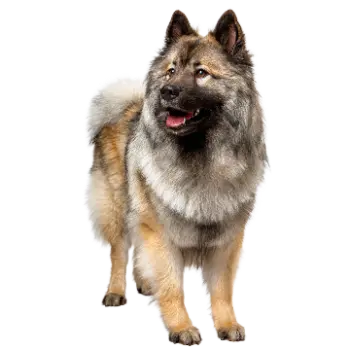
The Wolf-Chow presents a balanced and well-proportioned silhouette that immediately identifies it as a Spitz type dog, carrying the unmistakable influence of both the Wolfspitz and the Chow Chow in its overall construction. This is a medium-sized breed that conveys substance without heaviness, standing with a confident posture that suggests both alertness and composure. Males typically measure 20 to 24 inches at the shoulder and weigh between 51 and 71 pounds, while females stand slightly smaller at 19 to 22 inches and weigh 40 to 57 pounds. The overall impression is of a dog built for endurance and adaptability rather than speed or raw power.

The head is wedge-shaped when viewed from above or in profile, with the skull and muzzle being approximately equal in length and running parallel to one another. The stop is clearly defined but not abrupt, creating a smooth transition between the broad skull and the tapering muzzle. The ears are medium-sized, triangular, and carried erect with slightly rounded tips, set so that the distance between them roughly equals the width of each ear at its base. The eyes are medium-sized and dark, set with a slight oblique angle that gives the face an intelligent and somewhat knowing expression. Eye rims carry black pigmentation, as does the nose, contributing to a clean and well-defined facial structure.

One of the most distinctive features inherited from the Chow Chow side of the Wolf-Chow's ancestry is the possibility of a pigmented tongue. The breed standard allows for pink, blue-black, or spotted tongues, and this variation can appear within a single litter. While not every individual displays the blue-black tongue commonly associated with the Chow Chow, the presence of tongue pigmentation in any degree serves as a visible reminder of the breed's foundation stock.

The body is slightly longer than it is tall, creating a rectangular outline that contributes to the breed's fluid and effortless movement. The chest is deep, reaching to the elbow, with well-sprung ribs that provide ample lung capacity. The topline is level and firm, flowing into a broad and well-muscled loin. The tail is one of the breed's most expressive features, carried curved over the back or to the side when the dog is alert or in motion, and hanging naturally when relaxed. The tail is well-feathered with long hair that fans out attractively during movement.

The coat is perhaps the Wolf-Chow's most visually striking characteristic. A thick, dense undercoat provides insulation and weather resistance, while medium-length guard hairs lie loosely over the body, creating a plush but not excessive outer layer. The coat is shorter on the face, ears, and front of the legs, while longer feathering adorns the backs of the front legs, the breeches on the hind legs, and the tail. The neck carries slightly longer coat than the body but should not form a pronounced mane. The breed appears in a beautiful range of colors including fawn, red, wolf-grey, solid black, and black and tan, with the wolf-grey coloring being particularly evocative of the Wolfspitz heritage encoded in the original Wolf-Chow name.

Movement is smooth and ground-covering, with good reach in front and strong drive from behind. The gait should appear effortless and balanced, without excessive bounce or lateral movement. When moving at a trot, the legs tend to converge toward a center line beneath the body, a characteristic that contributes to the breed's efficient and tireless movement pattern. The overall physical impression of the Wolf-Chow is one of harmonious proportion and understated elegance, a dog designed not for extremes but for balanced functionality and lasting companionship.

Affectionate With Family
The Wolf-Chow bonds intensely with its family members and craves close physical proximity throughout the day. This breed will follow its people from room to room and thrives on consistent companionship.
Good With Young Children
Patient and gentle with children who approach calmly and respect boundaries. The Wolf-Chow prefers to initiate contact on its own terms rather than tolerating rough or unpredictable handling.
Good With Other Dogs
Generally accepting of other dogs, particularly those raised alongside them, though the breed's natural reserve extends to unfamiliar canines. Early socialization broadens acceptance significantly.
Shedding Level
The thick double coat sheds moderately year-round and heavily during two seasonal blowouts in spring and fall. Regular brushing manages the volume but hair on clothing and furniture is unavoidable.
Coat Grooming Frequency
Weekly brushing maintains the coat during most of the year, with daily sessions needed during seasonal shedding periods. The coat is manageable but requires consistent attention to prevent matting.
Drooling Level
The Wolf-Chow is a clean-mouthed breed with virtually no drooling tendency. Owners can expect dry floors and furniture with this naturally tidy companion.
Coat Type
A dense undercoat provides insulation while medium-length guard hairs create the breed's plush appearance. The coat varies in length across the body, with longer feathering on legs and tail.
Openness To Strangers
Reserved and cautious with unfamiliar people, the Wolf-Chow observes newcomers before deciding whether interaction is warranted. This deliberate approach to strangers is a breed hallmark, not a flaw.
Playfulness Level
Surprisingly playful within its family circle, the Wolf-Chow enjoys interactive games and activities with people it trusts. Outdoors the breed shows lively enthusiasm that contrasts with its calm indoor demeanor.
Watchdog/Protective Nature
Naturally alert and observant, the Wolf-Chow reliably signals unusual activity without excessive barking. The breed takes its role as household sentinel seriously while remaining composed rather than reactive.
Adaptability Level
Adapts well to various living spaces from apartments to rural homes, provided human companionship remains consistent. The breed struggles with changes in family composition or prolonged isolation.
Trainability Level
Intelligent and eager to cooperate with handlers who use positive methods, the Wolf-Chow learns quickly and retains lessons well. Harsh correction undermines trust and shuts down the breed's willing engagement.

Wolf-Chow History & Development

The story of the Wolf-Chow begins not with the name itself but with the vision of one man who believed the ideal family companion could be deliberately created rather than discovered among existing breeds. Julius Wipfel of Weinheim an der Bergstrasse in Germany was inspired by a large, black Spitz-type dog of uncertain origin that had been left behind by an Allied soldier during the post-World War II occupation. This dog, known informally as the Canadian, possessed remarkable qualities that captivated Wipfel despite serious behavioral flaws including a strong predatory drive. Wipfel became convinced that a breeding program combining the best traits of specific Spitz breeds could produce a dog with all of the Canadian's appealing qualities and none of its dangerous tendencies.

In 1960, Wipfel partnered with Charlotte Baldamus and a small group of dedicated enthusiasts to begin crossing Wolfspitz dogs with Chow Chows. The name Wolf-Chow arose naturally from this pairing, a straightforward compound that identified both parent breeds without pretension or ambiguity. This was not a marketing decision or a committee choice but simply a practical label that told breeders and puppy buyers exactly what they were getting. The Wolf-Chow name served the program well during its formative decade, providing clear identity to a deliberate breeding effort that might otherwise have been dismissed as casual crossbreeding.

The Wolf-Chow dogs of the 1960s represented an intermediate step rather than a finished product. Wipfel and his collaborators were methodical in their selection, tracking temperament, physical characteristics, and health across generations. Nobel laureate Konrad Lorenz, one of the founders of modern ethology, acquired a Wolf-Chow puppy from Charlotte Baldamus and later praised the breed's character as the finest he had encountered in any dog. This endorsement from a scientist of Lorenz's stature lent significant credibility to Wipfel's program during its critical early years.

The decisive turning point came in 1972 when Wipfel introduced Samoyed blood into the Wolf-Chow lines. This addition brought new qualities including a softer expression, enhanced sociability, and important genetic diversity to a breeding pool that risked becoming too narrow. With three foundation breeds now contributing, the Wolf-Chow name became inaccurate, and the German Spitz Club's formal protest against using an existing breed name in the designation provided additional impetus for change. Wipfel selected Eurasier as the new name, elegantly capturing the geographical span of the breed's ancestry from European Wolfspitz and Samoyed lines to the Asian Chow Chow heritage.

The FCI recognized the renamed breed in 1973, cementing the transition from Wolf-Chow to Eurasier in the official record. From that point forward, the Wolf-Chow name entered the historical record while the breed itself continued evolving under its new identity. The breed spread gradually from Germany to other European countries and eventually to North America, gaining CKC recognition in 1995 and UKC recognition in 1996. Today approximately 9,000 Eurasiers exist worldwide, a modest number that reflects the breed community's deliberate emphasis on quality over quantity. The Wolf-Chow name endures as a reminder that every finished breed began as an experiment, and that the most successful experiments are the ones guided by patience, documentation, and a clear vision of what the end result should be.

Wolf-Chow Temperament & Personality

The Wolf-Chow's temperament is a carefully engineered blend of qualities drawn from three distinct Spitz breeds, and the result is a companion dog with a personality that feels both ancient and thoroughly modern. From the Chow Chow comes a dignified reserve with strangers, a quality that many owners find appealing precisely because it means their dog's affection is genuine rather than indiscriminate. From the Wolfspitz comes a quiet attentiveness, an awareness of surroundings that makes the breed an effective watchdog without the excessive barking that plagues many alert breeds. From the Samoyed comes a warmth toward family that softens the more aloof tendencies of the other two foundation breeds and creates a dog that genuinely thrives on human companionship.

The defining characteristic of the Wolf-Chow's personality is its deep bond with family members. This is not a breed that distributes its loyalty broadly or adjusts easily to changes in household composition. The breed forms intense attachments to its primary people and can become visibly distressed when separated from them for extended periods. Kenneling, chaining, or prolonged isolation is genuinely damaging to a Wolf-Chow's psychological health and will produce a withdrawn or anxious dog rather than a merely bored one. This breed does best in households where at least one family member is present for most of the day, and many owners report that their Wolf-Chow follows them from room to room simply to maintain proximity.

With strangers, the Wolf-Chow maintains a polite but unmistakable distance. This is not aggression or fear but a genuine reserve that takes time and repeated positive exposure to overcome. The breed will typically observe newcomers from a slight remove, gathering information before deciding whether closer interaction is warranted. Pushing a Wolf-Chow to accept handling from unfamiliar people before the dog has reached its own conclusion about that person's trustworthiness is counterproductive and can erode the dog's confidence. Experienced owners learn to let their dog set the pace of introductions and find that patience consistently produces better results than pressure.

Within the family unit, the Wolf-Chow is affectionate, playful, and surprisingly adaptable. These dogs enjoy activities ranging from long walks to structured training sessions to simple relaxation on the couch, and they adjust their energy level to match the household's rhythm with notable sensitivity. They are calm and quiet indoors, rarely barking without genuine cause, and their alert nature means they will reliably signal unusual activity without creating false alarms. Children who are taught to respect the dog's boundaries find a patient and gentle companion, though the breed's reserve means it typically bonds most strongly with the adults who provide primary care and daily interaction.

The emotional intelligence of the Wolf-Chow is frequently noted by owners and breed specialists alike. These dogs read household dynamics with remarkable accuracy, responding to tension or stress with their own heightened vigilance and reflecting calm environments with visible relaxation. They are extremely sensitive to harsh correction and will shut down or withdraw in response to raised voices or punitive training methods. This sensitivity is not a weakness but rather a feature of a breed designed from the ground up to be a responsive and emotionally attuned household companion.

Wolf-Chow Family Life & Living Requirements

The Wolf-Chow fits into family life with a grace that reflects its deliberate design as a household companion, but prospective owners should understand that this breed's needs are emotional as much as they are physical. The single most important requirement for a Wolf-Chow is consistent human presence. This is not a breed that tolerates being left alone for a full workday, and households where everyone is away from morning until evening will find themselves with a genuinely unhappy dog. Families where at least one person works from home, has a flexible schedule, or can include the dog in daily activities provide the ideal environment for this breed's emotional wellbeing.

Children and Wolf-Chows generally coexist well, particularly when the children are old enough to understand and respect the dog's need for personal space. The breed is patient and gentle with youngsters who approach calmly and allow the dog to initiate contact on its own terms. Very young children who grab, pull, or crowd the dog may find that the Wolf-Chow simply removes itself from the situation rather than tolerating rough handling, which is actually a desirable response but can disappoint toddlers who want a more physically interactive playmate. Teaching children to sit quietly and let the dog come to them produces much better outcomes than encouraging immediate hands-on interaction.

The breed's adaptability to different living spaces is one of its practical strengths. Wolf-Chows can thrive in apartments provided they receive adequate daily exercise and mental engagement, and they are equally content in houses with large yards. The key variable is not square footage but human interaction. A Wolf-Chow in a small apartment with an attentive owner who provides daily walks and companionship will be far happier than one in a sprawling estate where it spends most of its time alone in the yard. The breed's calm indoor demeanor and minimal barking make it a surprisingly good apartment resident, though neighbors in close quarters will appreciate the breed's naturally quiet disposition.

Other pets in the household are generally accepted without significant conflict, especially when introductions occur during the Wolf-Chow's puppyhood. The breed lacks a strong prey drive compared to many Spitz types, a characteristic deliberately selected during the breeding program. Cats, smaller dogs, and other household animals typically coexist peacefully with a well-socialized Wolf-Chow, though the breed's reserve with unfamiliar animals mirrors its reserve with unfamiliar people and early positive exposure produces the most harmonious multi-pet households.

Wolf-Chow Training & Exercise Needs

Training a Wolf-Chow requires an approach that respects the breed's intelligence and emotional sensitivity in equal measure. These dogs learn quickly and retain lessons well, but they respond poorly to repetitive drills or heavy-handed correction. The breed was designed as a thinking companion, not a mechanical performer, and training sessions that engage the dog's mind and reward its cooperation produce far better results than those that rely on dominance or physical correction. Positive reinforcement using food rewards, verbal praise, and play is not merely a preference with this breed but a practical necessity, as harsh methods will damage the trust that forms the foundation of the Wolf-Chow's willingness to work with its handler.

Early socialization is particularly important for the Wolf-Chow given its natural reserve with strangers. Puppies should be exposed to a wide variety of people, environments, sounds, and experiences during the critical developmental window between eight and sixteen weeks. The goal is not to eliminate the breed's characteristic caution around unfamiliar people but to ensure that caution remains calm and confident rather than tipping into anxiety or fearfulness. Well-socialized Wolf-Chows maintain their dignified reserve while remaining comfortable and relaxed in novel situations, which is the ideal expression of the breed's temperament.

The breed's exercise needs are moderate and well-suited to active families without demanding the extreme physical output required by working or sporting breeds. A daily walk of approximately one hour, combined with some off-leash play or structured activity, satisfies most Wolf-Chows and keeps them physically and mentally content. These dogs enjoy hiking, swimming, and canine sports such as agility and rally obedience, and their intelligence makes them capable participants in activities that combine physical movement with problem-solving. The breed's moderate energy level means it adapts well to days with less activity without becoming destructive, though regular exercise should remain the baseline expectation.

Mental stimulation deserves as much attention as physical exercise in the Wolf-Chow's daily routine. Puzzle toys, scent work, and training games that challenge the dog's thinking keep the breed engaged and prevent the boredom that can lead to withdrawal or quiet mischief. The Wolf-Chow is not a breed that becomes visibly destructive when understimulated, which can mislead owners into thinking the dog is content when it may actually be disengaging from a life that lacks sufficient enrichment. Providing regular opportunities for the dog to use its considerable intelligence is one of the most important aspects of responsible Wolf-Chow ownership.

Wolf-Chow Health Concerns

The Wolf-Chow benefits from the genetic diversity inherent in a breed created from three distinct foundation stocks, and as a result it is generally considered a healthy breed with an average lifespan of 12 to 14 years. However, like all breeds, there are specific health conditions that prospective owners and breeders should understand and monitor for throughout the dog's life.

Eye conditions including entropion, ectropion, and distichiasis have been documented in the breed. Distichiasis involves eyelashes growing in abnormal locations or directions, which can cause irritation and corneal damage in affected dogs. Dandy-Walker Like Malformation is a neurological condition identified in the breed that affects cerebellar development and can cause coordination problems. This condition is inherited in an autosomal recessive pattern, meaning both parents must carry the gene for puppies to be affected, and DNA testing is available to identify carriers before breeding decisions are made.

Common Health Issues

  • Autoimmune thyroiditis leading to hypothyroidism - Affecting an estimated 15 to 18 percent of the breed population with symptoms including weight gain, lethargy, and coat deterioration
  • Hip dysplasia causing abnormal joint development that can lead to arthritis and mobility problems in affected dogs - Hip dysplasia causing abnormal joint development that can lead to arthritis and mobility problems in affected dogs
  • Patellar luxation where the kneecap displaces from its normal position - Representing the most common skeletal condition in the breed
  • Elbow dysplasia resulting in abnormal joint development - Lameness, and reduced range of motion
  • Distichiasis involving abnormally positioned eyelashes that can cause corneal irritation and damage - Distichiasis involving abnormally positioned eyelashes that can cause corneal irritation and damage
  • Dandy-Walker Like Malformation - A neurological condition affecting cerebellar development that is inherited in an autosomal recessive pattern
  • Exocrine pancreatic insufficiency where the pancreas fails to produce adequate digestive enzymes - Exocrine pancreatic insufficiency where the pancreas fails to produce adequate digestive enzymes
  • Gastric dilatation-volvulus - A life-threatening bloat condition that can affect deep-chested breeds

Preventive Care & Health Monitoring

  • Regular thyroid panel testing beginning at two years of age and repeated annually to detect autoimmune thyroiditis before clinical symptoms develop - Regular thyroid panel testing beginning at two years of age and repeated annually to detect autoimmune thyroiditis before clinical symptoms develop
  • Radiographic evaluation of hips and elbows at two years of age through OFA or PennHIP certification programs - Radiographic evaluation of hips and elbows at two years of age through OFA or PennHIP certification programs
  • Veterinary assessment of patellas through physical examination to identify luxation before it causes joint damage - Veterinary assessment of patellas through physical examination to identify luxation before it causes joint damage
  • Annual eye examinations to screen for entropion - Ectropion, and distichiasis
  • DNA testing for Dandy-Walker Like Malformation to identify carriers before breeding decisions are made - DNA testing for Dandy-Walker Like Malformation to identify carriers before breeding decisions are made
  • Maintenance of healthy weight throughout life to reduce stress on joints and minimize arthritis risk - Maintenance of healthy weight throughout life to reduce stress on joints and minimize arthritis risk
  • Feeding smaller meals and avoiding vigorous exercise around feeding times to reduce bloat risk - Feeding smaller meals and avoiding vigorous exercise around feeding times to reduce bloat risk
  • Regular dental care through brushing or veterinary cleanings to prevent periodontal disease - Regular dental care through brushing or veterinary cleanings to prevent periodontal disease

Wolf-Chow Grooming & Maintenance

The Wolf-Chow's double coat is one of its most visually appealing features, and maintaining it in good condition requires regular but not excessive attention. The thick undercoat provides insulation against both cold and heat, while the medium-length guard hairs create the breed's characteristic plush appearance. Weekly brushing with a slicker brush or pin brush is sufficient during most of the year to remove loose hair, prevent tangles, and distribute natural oils throughout the coat. The areas most prone to matting are behind the ears, in the feathering on the backs of the legs, and in the breeches on the hindquarters, and these spots deserve particular attention during grooming sessions.

Twice a year, typically in spring and fall, the Wolf-Chow undergoes a heavy seasonal shed where the undercoat releases in large volumes over a period of several weeks. During these shedding periods, daily brushing becomes necessary to manage the volume of loose hair and prevent matting of the coat. Warm baths during heavy shedding help loosen the undercoat, and using a high-velocity dryer afterward removes dead hair efficiently. Owners who stay on top of the seasonal shed find it manageable, while those who fall behind can face significant matting that may require professional grooming intervention.

One critical rule that applies to the Wolf-Chow and cannot be overstated is that the coat should never be shaved or clipped short. The double coat serves as the breed's natural temperature regulation system, providing insulation against heat as effectively as it protects against cold. Shaving a Wolf-Chow does not make the dog cooler in warm weather but instead removes its natural protection against sunburn and overheating, and the coat may never grow back to its original texture and density after being cut. Owners in warm climates should rely on providing shade, fresh water, and limiting exercise during the hottest parts of the day rather than resorting to clipping.

Beyond coat care, the Wolf-Chow's routine maintenance needs are straightforward. Nails should be trimmed every two to three weeks or as needed to prevent overgrowth that can affect the dog's gait and comfort. Ears should be checked weekly for signs of infection or debris, and teeth benefit from regular brushing or the use of dental chews to maintain oral health. The breed is naturally clean and does not develop a strong doggy odor under normal conditions, so bathing beyond the seasonal shed periods is only necessary when the dog has gotten genuinely dirty.