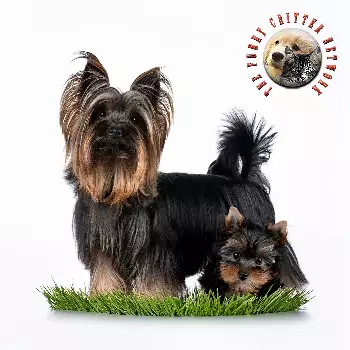
The Sydney Silky is a small dog that carries itself with a confidence and elegance that belies its toy classification. Standing roughly 9 to 10 inches at the shoulder and weighing between 8 and 10 pounds, this is not a fragile lapdog in a delicate package. The Silky Terrier has a sturdy, moderately low-set frame with enough substance and muscular development to remind you that there is working terrier blood behind that glamorous coat. When a well-built Silky moves across a room, the gait is free, light-footed, and purposeful, with none of the mincing steps sometimes associated with toy breeds.
The head is one of the breed's most expressive features. It is moderately long and wedge-shaped, with a flat skull that is slightly longer than the muzzle. The stop is shallow but defined, and the muzzle tapers to a strong jaw with a clean scissor bite. The nose is black and well-defined. The eyes are small, dark, and almond-shaped, set with a keen, intelligent expression that communicates the terrier alertness running through this breed's veins. There is nothing soft or doleful about a Silky Terrier's gaze. These eyes are always watching, always assessing, always ready for something interesting to happen.
The ears are small, V-shaped, and set high on the skull. They stand fully erect, giving the face an attentive, animated quality that contributes to the breed's characteristically sharp expression. The ears are fine in leather and free of long hair, which keeps them looking neat and accentuates the head's clean lines.
The body is compact and moderately low-set, with a level topline and a chest that is moderately deep and wide enough to accommodate good lung capacity for the breed's size. The ribs extend well back, and there is a slight tuck-up at the loin. The legs are straight and fine-boned but not fragile, with small, neat cat feet and well-arched toes. The overall proportions create a dog that is slightly longer than it is tall, giving the silhouette a pleasing balance.
The tail is traditionally docked in the United States and carried high but not over the back. In countries where docking is prohibited, the natural tail is of moderate length and carried with a slight upward curve. Whether docked or natural, the tail expresses the breed's characteristic enthusiasm.
The coat is the breed's signature and the feature that earned it every one of its names. It should be flat-lying, fine in texture, and genuinely silky to the touch, not woolly, wavy, or coarse. The hair parts along the spine from the back of the skull to the base of the tail and falls straight down each side. In a well-maintained show coat, the hair reaches floor length along the sides, creating a flowing curtain of silk that moves with the dog. The coat on the head falls forward into a topknot. The legs and feet carry shorter hair, and the ears should be free of long coat.
Color is blue and tan in adults, with the blue portion covering the body from the back of the skull to the tail. The blue ranges from silver blue to dark slate blue, and it should be clear and even, without sootiness or dark smudging. The tan markings appear on the muzzle, cheeks, around the base of the ears, on the legs, and around the vent. Puppies are born with black-and-tan coloring, and the gradual transition to blue occurs as they mature, typically completing by 18 months of age.
Affectionate With Family
★★★★☆
Sydney Silkies bond closely with their families and enjoy being near their people, though they show affection on their own terms rather than with constant neediness. They are loyal companions who prefer engagement over passive cuddling.
Good With Young Children
★★☆☆☆
The breed's small size makes it vulnerable to injury from rough handling, and its terrier temperament means it may snap when feeling cornered or mishandled. Better suited to families with older, respectful children.
Good With Other Dogs
★★★☆☆
Generally sociable with other dogs when properly socialized, though the breed's terrier confidence can lead it to challenge much larger dogs. Same-sex tensions may occur, particularly between intact dogs.
Shedding Level
★★☆☆☆
The single-layer silky coat sheds minimally compared to double-coated breeds. Loose hair is more likely to be caught in the coat during brushing than deposited on furniture and clothing.
Coat Grooming Frequency
★★★★☆
The long, fine coat requires frequent brushing to prevent tangles and matting. A full show coat demands daily attention, while a shorter pet trim reduces maintenance to several sessions per week.
Drooling Level
★☆☆☆☆
Sydney Silkies are not droolers. The breed's clean, refined muzzle produces virtually no excess saliva under normal circumstances.
Coat Type
★★★★☆
The single-layer coat is fine, flat-lying, and genuinely silky in texture. It parts along the spine and falls straight down each side, requiring dedicated maintenance to preserve its quality.
Openness To Strangers
★★★☆☆
Alert and initially vocal when strangers approach, the Sydney Silky warms up reasonably quickly once it determines no threat exists. Not aggressive toward visitors but not immediately effusive either.
Playfulness Level
★★★★☆
Spirited and energetic, the Sydney Silky approaches play with terrier enthusiasm. Interactive games, toy chasing, and exploration all engage this breed's natural curiosity and energy.
Watchdog/Protective Nature
★★★★☆
The breed's alert nature and vocal tendencies make it an effective watchdog despite its small size. A Sydney Silky will announce every visitor, passing animal, and suspicious sound with conviction.
Adaptability Level
★★★★☆
The compact size and moderate exercise needs make this breed adaptable to apartments, houses, and various living situations. The main limitation is noise sensitivity in close-quartered housing due to the breed's barking tendency.
Trainability Level
★★★☆☆
Intelligent and quick to learn, but the terrier independence means compliance is selective. Positive reinforcement and short, varied training sessions produce the best results with this breed.