Scottie

Scottish Terrier

Quick Facts

🐕 Breed Group
Terrier Group
📏 Size Category
Small
📏 Height
Males: 10 inches, Females: 10 inches
⚖️ Weight
Males: 19-22 pounds, Females: 18-21 pounds
⏱️ Life Expectancy
11-13 years
🧣 Coat Type
Wiry double coat, hard outer with soft dense undercoat
🎨 Coat Colors
Black, wheaten, brindle
😀 Temperament
Independent, confident, dignified, spirited, loyal
🏃 Exercise Needs
Moderate
🎓 Training Difficulty
Moderate to High
👶 Good with Children
Best with older children
🐾 Good with Other Pets
Requires careful management; high prey drive

Other Names & Breed Recognition

Scottie is the name that most people actually use when talking about the Scottish Terrier, even if the full breed name is what appears on the registration papers. It is one of those nicknames that has become so widespread that it functions almost as a co-equal name rather than a casual abbreviation. You hear it from judges at dog shows, from veterinarians discussing breed-specific health concerns, from rescue volunteers coordinating placements, and from every owner who has ever introduced their dog to a stranger on a walk. The nickname is universally understood and carries no ambiguity about which breed it refers to.

The Scottish Terrier itself is one of the oldest of the Highland terrier breeds, developed in Scotland to go to ground after badgers, foxes, and other burrowing quarry in the rocky terrain of the Scottish countryside. The breed's formal name identifies its national origin, but for much of its early history it was simply one of several small, rough-coated terrier types found across the Scottish Highlands. The process of distinguishing these various terrier types from one another and establishing them as separate breeds took decades of debate among Victorian-era dog fanciers before the Scottish Terrier emerged with its own standard and identity in the late nineteenth century.

The breed has also been known historically as the Aberdeen Terrier, a name that referenced the city where the breed was particularly popular and where some of the earliest breeding programs were established. This older designation has largely fallen out of use, replaced by the formal Scottish Terrier and the ubiquitous Scottie. The breed's silhouette is one of the most recognizable in the dog world, immortalized on everything from Monopoly game pieces to whisky labels to presidential photographs, as several United States presidents kept Scottish Terriers in the White House.

Across registries, the Scottie is classified within the Terrier group. The American Kennel Club recognized the breed in 1885, placing it in the Terrier Group. The United Kennel Club, Canadian Kennel Club, and The Kennel Club in the United Kingdom all classify the breed similarly. The Federation Cynologique Internationale places the Scottish Terrier in Group 3, Section 2, among the Small Terriers.

Scottie Organizations & Standards

The Scottish Terrier Club of America serves as the AKC parent club and the central organizational body for Scottie enthusiasts in the United States. The STCA promotes responsible breeding, organizes national specialty shows, and maintains an active health trust fund that supports research into the breed-specific conditions affecting Scottish Terriers. The club's role in establishing and updating the CHIC program requirements ensures that breeders pursuing health certification are testing for the conditions most relevant to the breed's genetic profile.

The breed has deep organizational roots in its native Scotland and throughout the United Kingdom. Scottish Terrier clubs in the UK were among the earliest breed-specific organizations established during the Victorian era, and The Kennel Club recognized the breed in its Terrier Group early in its history. The breed's popularity among British and American dog fanciers ensured robust organizational support from the outset.

The AKC recognized the Scottish Terrier in 1885, making it one of the earliest breeds admitted to the registry. The AKC standard describes the Scottie as a small, compact, short-legged, sturdily built dog of good bone and substance. Males and females stand approximately 10 inches at the shoulder, with males weighing 19 to 22 pounds and females weighing 18 to 21 pounds. The standard specifies three acceptable coat colors: black, wheaten ranging from light straw to deep gold, and brindle of any shade. The breed's distinctive profile features a long head relative to body size, erect ears, short back, and a tail carried high, creating the characteristic silhouette that is unmistakable even at a distance.

The United Kennel Club, Canadian Kennel Club, and The Kennel Club in the United Kingdom all classify the Scottish Terrier within their respective Terrier groups. The Federation Cynologique Internationale places the breed in Group 3, Section 2, among the Small Terriers.

As of January 2025, CHIC certification for Scottish Terriers requires three tests. A DNA test for Von Willebrand Disease, the severe Type III form that affects this breed, screens for the most dangerous inherited bleeding disorder. A DNA test for Craniomandibular Osteopathy identifies dogs carrying the gene responsible for abnormal skull bone growth in puppies. A veterinary evaluation for patellar luxation completes the required testing. Optional tests that breeders are encouraged to pursue include autoimmune thyroiditis panels and ACVO eye examinations.

Kennel Club Recognition

  • American Kennel Club (AKC): Recognized in 1885, Terrier Group
  • United Kennel Club (UKC): Recognized, Terrier Group
  • Canadian Kennel Club (CKC): Recognized, Terrier Group
  • FCI: Recognized, Group 3
  • The Kennel Club (UK): Recognized, Terrier Group

Scottie Physical Description

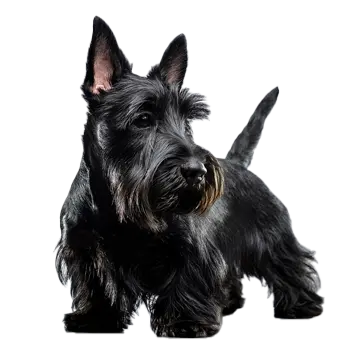
The Scottie is a dog built low to the ground with a density of bone and muscle that seems almost impossible for its ten-inch height. This is not a delicate toy breed that happens to be short. It is a powerfully constructed small dog whose physical proportions were shaped by the demands of going underground after quarry in Scottish rock and earth. Every element of the breed's conformation reflects that original purpose, from the short, sturdy legs to the broad chest to the remarkably strong head that leads the way into tight spaces.

The body is short-backed and compact, with the height at the withers approximately equal to the length of the back from withers to tail set. The chest is broad and deep, hanging well down between the forelegs, with the ribcage carried well back. The overall impression is of a dog that is wider and heavier than it looks from a distance, and picking up a Scottie for the first time always surprises people who expected something lighter based on the breed's modest height. Males and females both stand approximately 10 inches at the shoulder, with males weighing 19 to 22 pounds and females 18 to 21 pounds.

The head is the Scottie's most dramatic feature and the element most responsible for the breed's unmistakable silhouette. It is long relative to the body, with a flat skull of moderate width and a slight but definite stop. The muzzle is roughly equal in length to the skull, giving the head an overall elongated appearance that is unique among terrier breeds. The nose is large and black, and the jaws are powerful with a full scissors bite. The cheeks are flat and clean, without prominent musculature that would interrupt the smooth line of the head.

The eyes are small, almond-shaped, dark brown, and set wide apart under heavy eyebrows. The expression produced by these deeply set eyes is one of keen, piercing intelligence, often described as varminty, a terrier-specific term that conveys the sharp, focused look of a dog bred to hunt. The ears are small, pointed, and carried erect, set well up on the skull and covered with short, velvety hair. The combination of erect ears, deep-set eyes, and heavy brow furnishings creates the characteristically alert, no-nonsense expression that defines the breed.

The neck is moderately short, thick, and muscular, setting into well-laid-back shoulders. The forelegs are heavy-boned and straight, though the feet may turn slightly outward. The feet themselves are large relative to the dog's size, round and thick with heavy pads, built for digging. The hindquarters are remarkably powerful, with broad, muscular thighs that provide the driving force behind the breed's surprisingly ground-covering gait. Despite its short legs, a well-built Scottie moves with a free, agile stride that covers ground with efficiency.

The tail is about seven inches long, carried high with a slight curve but never curled over the back. It is thick at the base and tapers to a point, functioning as a handle that was historically useful for pulling the dog backward out of a burrow. The coat is a broken double coat with a hard, wiry outer layer and a soft, dense undercoat. The beard, eyebrows, and leg furnishings are longer and softer in texture, creating the distinctive facial framing and skirted silhouette that make the Scottie immediately recognizable. Acceptable colors are black, wheaten in shades from light straw to deep gold, and brindle of any combination.

Affectionate With Family
The Scottie bonds deeply to its household but expresses affection with dignified restraint rather than effusive demonstration, preferring quiet proximity to constant physical contact.
Good With Young Children
Best suited to families with older children who respect the breed's personal space, as the Scottie does not tolerate rough handling and may correct overly physical youngsters.
Good With Other Dogs
The breed carries a documented tendency toward dog-directed aggression, particularly with same-sex dogs, and will not back down from confrontations regardless of the other dog's size.
Shedding Level
The wiry outer coat traps loose undercoat rather than releasing it, resulting in minimal shedding when the coat is properly maintained through regular grooming.
Coat Grooming Frequency
The coat demands regular brushing, periodic hand-stripping or clipping every six to eight weeks, and daily beard maintenance to prevent matting and staining.
Drooling Level
The Scottie is not a drooler, though the beard does collect water after drinking and can leave damp tracks across floors if not wiped.
Coat Type
The broken double coat features a hard, wiry outer layer over a soft, dense undercoat, with longer furnishings on the beard, eyebrows, and legs that create the breed's distinctive silhouette.
Openness To Strangers
Characteristically reserved and evaluating with unfamiliar people, the Scottie maintains deliberate distance until it decides on its own terms whether a newcomer is acceptable.
Playfulness Level
The Scottie engages in play on its own terms, particularly enjoying games that involve chasing or digging, but it is not as relentlessly playful as some other terrier breeds.
Watchdog/Protective Nature
Alert, territorial, and fearless, the Scottie takes its watchdog duties seriously, announcing any perceived intrusion with a bark that carries authority well beyond the breed's modest size.
Adaptability Level
The breed adapts well to apartments and various living situations thanks to its moderate size and exercise needs, though its barking tendencies require management in shared-wall housing.
Trainability Level
Highly intelligent but fiercely independent, the Scottie learns quickly but decides for itself whether and when to comply, requiring patient, creative training that respects the breed's autonomy.

Scottie History & Development

The nickname Scottie has been attached to the Scottish Terrier for so long that its origins as a casual abbreviation are essentially lost to time. By the early twentieth century, the name was already appearing in popular literature and newspaper columns, and it became further entrenched through the breed's cultural visibility in everything from presidential pet coverage to board game iconography. Franklin Roosevelt's Scottie, Fala, became one of the most famous dogs in American political history, and George W. Bush's pair of Scottish Terriers, Barney and Miss Beazley, continued the breed's association with the White House decades later. These high-profile appearances always used the name Scottie, cementing it in the public vocabulary.

The breed behind the nickname traces its documented history to the Scottish Highlands, where small, rough-coated terriers were used to pursue vermin and burrowing game through rocky terrain. The specific breed we now recognize as the Scottish Terrier was not clearly differentiated from other Highland terrier types until the late nineteenth century, when a period of vigorous debate among British dog fanciers resulted in the formal separation of the Scottish Terrier, West Highland White Terrier, Cairn Terrier, and Skye Terrier into distinct breeds with their own standards.

The Scottish Terrier was first shown under its own name in 1879, and the first breed standard was written in 1880. Before the name was settled, the breed was known variously as the Aberdeen Terrier, the Hard-Haired Scotch Terrier, and simply the Highland Terrier. The AKC recognized the Scottish Terrier in 1885, making it one of the earliest terrier breeds admitted to the American registry. The Scottish Terrier Club of America was founded in 1900, establishing organizational infrastructure that would support the breed through over a century of American involvement.

The breed reached its peak of mainstream popularity in the 1930s and 1940s, when Scotties were among the most fashionable companion dogs in both the United States and the United Kingdom. That cultural moment has faded, and the breed's registration numbers have declined significantly from their historical highs. Today the Scottie is considered an uncommon breed, maintained by a dedicated community of fanciers who value its distinctive character and are actively working to address the health challenges that affect the breed through genetic testing and research funding.

The name Scottie outlasted all the other informal designations because it captured something essential about the breed's character. It is compact, direct, and unpretentious, exactly like the dog it describes. The Aberdeen Terrier sounded overly formal. The Highland Terrier was too vague. But Scottie conveyed familiarity and affection without sacrificing the breed's inherent dignity. It is the name that stuck because it fit, and it continues to serve as the primary way most people refer to the breed in everyday conversation, in breed rescue communications, in veterinary records, and in the homes of the dedicated owners who share their lives with these independent, characterful dogs.

Scottie Temperament & Personality

The Scottie's temperament is the concentrated essence of terrier character distilled into a ten-inch frame. This is a breed that was developed to go underground alone, confront dangerous quarry in total darkness, and make independent decisions about how to handle whatever it encountered. That heritage has produced a dog of extraordinary self-confidence, fierce independence, and a dignity that can border on stubbornness when the dog's agenda conflicts with its owner's. The Scottie does not look to its handler for reassurance. It assesses situations on its own terms and acts according to its own judgment, a quality that earns it the frequent descriptor of catlike among people who live with the breed.

The bond between a Scottie and its primary person is deep but expressed with restraint rather than effusive demonstration. This is not a dog that smothers you with kisses or flings itself onto your lap demanding attention. It is a dog that positions itself nearby, monitors your activities with quiet intensity, and responds to your return home with a dignified greeting that conveys genuine pleasure without theatrical excess. The Scottie's loyalty is real and unshakeable, but it is offered on the dog's terms rather than delivered on demand.

With strangers, the Scottie is characteristically reserved and watchful. The breed does not rush to greet unfamiliar people and may maintain a polite but unmistakable distance from visitors until it decides they are acceptable. This reserve is not fear or anxiety. It is the deliberate evaluation of a dog that takes its personal space seriously and does not grant access to its social circle casually. Socialization from puppyhood broadens the range of people the Scottie is comfortable with, but the underlying aloofness is a breed trait that persists regardless of socialization efforts.

The Scottie's relationship with other dogs requires careful management. The breed carries a documented tendency toward dog-directed aggression, particularly between dogs of the same sex, and it will not back down from a confrontation regardless of the other dog's size. A Scottie that decides it has been challenged will engage with the tenacity of a dog ten times its weight, which makes off-leash interactions with unfamiliar dogs a genuine risk. Early socialization helps, but the breed's combative instincts should never be underestimated.

Prey drive is substantial. The Scottie was bred to hunt and kill vermin, and that drive remains fully intact in the modern pet. Squirrels, rabbits, rats, and other small animals trigger an immediate chase response that the breed's low-slung speed makes surprisingly effective. Cats in the household can work if the Scottie is raised with them from puppyhood, but the introduction of new small animals to an adult Scottie's territory is risky.

Scottie Family Life & Living Requirements

Living with a Scottie means accepting a dog that has opinions about how the household should operate and is not shy about expressing them. This breed inserts itself into family life as a dignified participant rather than an eager-to-please subordinate, and the dynamic works best in homes where the owners appreciate independence and character rather than constant affection and compliance. The Scottie is loyal, protective, and genuinely devoted to its family, but it delivers those qualities through its own distinctive behavioral vocabulary rather than through the universal dog language of tail-wagging excitement.

The breed's moderate size and moderate exercise requirements make it adaptable to various living situations, including apartments. At roughly 10 inches tall and 18 to 22 pounds, the Scottie does not require vast space to be comfortable. Its exercise needs are real but manageable, consisting of daily walks and play sessions rather than the sustained athletic output demanded by larger working breeds. The breed's tendency to bark at perceived disturbances is the primary concern in apartment or shared-wall housing, and training a reliable quiet command early in the dog's life is essential for harmonious urban living.

With children, the Scottie is best suited to families with older kids who understand how to interact with a dog that values its personal space. The breed is sturdy enough to handle reasonable play but does not tolerate rough handling, grabbing, or intrusions into its space around food and possessions. Very young children who have not yet learned to respect a dog's boundaries may provoke a corrective snap from a Scottie that has reached its threshold. Supervision and clear household rules about dog-child interaction are non-negotiable.

Other dogs in the household require careful selection and introduction. Same-sex pairings with Scotties often produce conflict, and the breed's willingness to escalate means that disagreements can turn physical quickly. Opposite-sex pairings tend to work more smoothly, though individual temperaments always matter more than broad generalizations. Small pets including hamsters, guinea pigs, and rabbits should be kept securely separated from a breed whose entire evolutionary history revolves around catching and dispatching small animals.

The Scottie's health profile, particularly its elevated risk for bladder cancer, is a factor that responsible families should understand before acquiring the breed. Minimizing exposure to lawn chemicals, providing a diet that includes fresh vegetables, and establishing a routine of regular veterinary urine screenings from middle age onward are practical steps that can support the dog's long-term health within the household setting.

Scottie Training & Exercise Needs

Training a Scottie is an exercise in negotiation rather than command. The breed is intelligent, understands what you want with minimal repetition, and then makes a calculated decision about whether compliance serves its interests. This is not defiance in the way that a dominant or aggressive dog might challenge its handler. It is the rational independence of a breed that was developed to work alone underground, making its own decisions without human direction. Successful Scottie training requires a handler who can be patient, creative, and willing to make training sessions feel like the dog's idea rather than an imposed obligation.

Positive reinforcement is the only approach that produces reliable results with this breed. Food motivation varies among individual Scotties, but most respond well to high-value treats delivered with enthusiasm. Harsh corrections or confrontational methods produce a dog that either shuts down completely or digs in with a stubbornness that makes a mule look cooperative by comparison. Training sessions should be short, varied, and ended on a positive note before the dog loses interest.

Socialization deserves early, consistent attention. The Scottie's natural reserve with strangers and potential for dog-directed aggression make the socialization window between eight and sixteen weeks critically important. Structured exposure to unfamiliar people, dogs, environments, and situations during this period builds the behavioral foundation that will shape the adult dog's comfort level in the world. Socialization does not eliminate the Scottie's fundamental independence or aloofness, but it does ensure that these traits manifest as calm confidence rather than reactive fear.

Exercise needs are moderate and well-suited to the breed's physical capabilities. Two or three walks daily totaling 30 to 60 minutes, combined with play sessions in a secure area, satisfy the Scottie's physical requirements. The breed's short legs and heavy build are not designed for marathon running or sustained high-intensity exercise, but it is more athletic and agile than its compact frame might suggest. Digging is a natural behavior that reflects the breed's earth-dog heritage, and providing a designated digging area can redirect this instinct away from garden beds and landscaping. Mental enrichment through puzzle toys, scent games, and short training sessions keeps the Scottie's active mind occupied and reduces the likelihood of boredom-driven misbehavior like excessive barking or destructive chewing.

Scottie Health Concerns

The Scottie carries a more complex health profile than many small terrier breeds, with several breed-specific conditions that require awareness, testing, and in some cases lifelong monitoring. Life expectancy ranges from 11 to 13 years, and while many Scotties live healthy, active lives within that span, the breed's predisposition to certain cancers and genetic disorders means that informed ownership and responsible breeding are particularly important.

Scottie Cramp is a neurological condition unique to the breed, caused by a defect in serotonin metabolism. Affected dogs experience muscle spasms, an arched back, and abnormal gait during episodes triggered by excitement, stress, or sustained exercise. The condition is not progressive and not life-threatening, but it does affect quality of life during episodes. Patellar luxation and Cushing's disease also occur in the breed at rates that warrant veterinary awareness.

Common Health Issues

  • Transitional cell carcinoma - TCC, of the urinary bladder affects Scottish Terriers at 18 to 20 times the rate of other breeds. This aggressive cancer typically appears in middle-aged to older dogs with symptoms that mimic urinary tract infections, including blood in the urine and straining to urinate.
  • Von Willebrand Disease Type III is the most severe form of inherited bleeding disorder - In which affected dogs produce little or no clotting factor, risking spontaneous severe hemorrhage or fatal bleeding during surgery. A DNA test reliably identifies carriers and affected dogs.
  • Craniomandibular osteopathy causes abnormal bone growth in the skull and jaw of puppies between three and eight months of age - Producing painful swelling and difficulty eating. The condition usually stabilizes by one year and a DNA test is available.
  • Scottie Cramp is a breed-specific neurological disorder caused by defective serotonin metabolism that produces muscle spasms - Arched back, and gait abnormalities during episodes triggered by excitement or stress. It is not progressive or life-threatening.
  • Patellar luxation involves displacement of the kneecap from its normal groove - Causing intermittent lameness and a skipping gait that can progress to chronic joint damage in severe cases.
  • Cushing's disease involves chronic overproduction of cortisol - Typically from a pituitary tumor, causing symptoms including increased thirst and urination, hair loss, pot-bellied appearance, and lethargy.

Preventive Care & Health Monitoring

  • Von Willebrand Disease Type III DNA testing should be performed on all breeding stock and results registered with OFA. Clear-to-carrier pairings prevent affected offspring - While carrier-to-carrier matings must never be done.
  • Craniomandibular Osteopathy DNA testing is required for CHIC certification as of 2025 and should be completed on all breeding candidates to identify carriers of this painful developmental condition. - Craniomandibular Osteopathy DNA testing is required for CHIC certification as of 2025 and should be completed on all breeding candidates to identify carriers of this painful developmental condition.
  • Patellar luxation evaluation by a veterinarian should be performed and results registered with OFA as part of the breed's CHIC requirements. - Patellar luxation evaluation by a veterinarian should be performed and results registered with OFA as part of the breed's CHIC requirements.
  • Bladder cancer screening through regular urine analysis beginning at age six or seven allows earlier detection of transitional cell carcinoma - The BRAF gene urine test developed at Purdue University can identify cancer cells before clinical symptoms appear.
  • Environmental management to reduce bladder cancer risk includes minimizing exposure to herbicide- and pesticide-treated lawns - Providing a diet that includes green leafy and yellow-orange vegetables at least three times weekly, and avoiding known environmental carcinogens.
  • Optional thyroid and eye examinations supplement the required CHIC tests and help identify autoimmune thyroiditis and ocular conditions that may affect individual dogs. - Optional thyroid and eye examinations supplement the required CHIC tests and help identify autoimmune thyroiditis and ocular conditions that may affect individual dogs.

Scottie Grooming & Maintenance

The Scottie's wiry double coat is one of the breed's defining physical features and also one of its more demanding maintenance requirements. Like other wire-coated terrier breeds, the Scottish Terrier's coat is maintained in proper condition through hand-stripping, a process in which dead outer coat hairs are pulled out by hand or with a stripping knife to allow new wiry growth to emerge. This technique preserves the correct harsh texture and maintains the rich color depth that the breed standard requires.

Hand-stripping is typically performed every six to eight weeks by a groomer experienced with terrier coats, though some dedicated owners learn to perform the technique themselves. The alternative is clipping, which is faster and more widely available but softens the coat texture over time and can fade the color, particularly in black-coated dogs where clipping may produce a grayish cast. Many pet owners opt for clipping as a practical compromise, accepting the altered coat texture in exchange for the convenience of more readily available and less time-consuming grooming.

Between stripping or clipping sessions, the coat needs brushing two to three times per week to prevent the undercoat from matting and to keep the furnishings looking tidy. The beard requires daily attention, as it collects food, water, and outdoor debris with remarkable efficiency. Wiping the beard after meals and combing through it regularly prevents staining and the development of an unpleasant odor that comes from chronic dampness trapped in facial hair. The eyebrow furnishings also benefit from regular combing to keep them from obstructing the dog's vision.

The Scottie's coat sheds minimally when properly maintained, which is one of the breed's practical advantages for indoor living. The wiry outer coat traps loose undercoat rather than releasing it freely, which means less hair on furniture and clothing but also means that regular grooming is necessary to remove that trapped hair before it mats. Nail trimming every two to three weeks, regular dental care, and periodic ear cleaning complete the maintenance routine for a breed whose distinguished appearance rewards the effort invested in its upkeep.