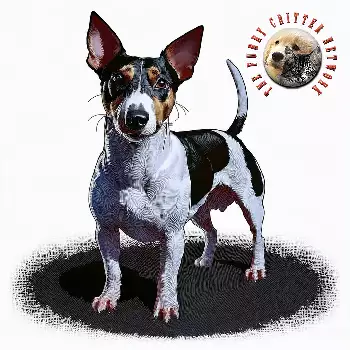
When you look at a Ratting Terrier, you are looking at a dog shaped entirely by the demands of its work. Nothing about this breed's physical structure is accidental or decorative. Every proportion, every angle, every muscle group reflects generations of selection for a dog that needed to be fast enough to course small game across open ground, agile enough to navigate tight spaces in barns and root cellars, and tough enough to dispatch vermin without hesitation. The result is a compact, athletic animal that moves with a confidence and economy of motion that larger, flashier breeds often lack.
The head gives the first impression of the breed's character. It is clean and wedge-shaped when viewed from above, with a moderately broad skull that narrows smoothly toward the muzzle. The stop is defined but not abrupt, creating a balanced profile that avoids both the blunt coarseness of a bull breed and the narrow sharpness of a toy. The jaws are strong and well-developed, capable of delivering the quick, decisive bite that ratting work demands. The teeth meet in a scissors bite, and the lips are tight and clean. Nose pigment is usually black, though it may be lighter in dogs with dilute coat colors.
Ears on the Ratting Terrier vary more than on most standardized breeds, and this variation is permitted within the breed standard. You will see erect ears, tipped ears that fold forward at the top, and button ears that fold over closer to the skull. All three configurations are acceptable, and ear set tends to be a matter of individual genetics rather than a breeding priority. The eyes are set moderately apart and range from round to slightly oval, projecting an alert and inquisitive expression. Color tracks with coat pigmentation, from deep brown in darker dogs to lighter amber tones in dilute patterns.
The body is where the Ratting Terrier's working heritage becomes most apparent. The build is rectangular, meaning the dog is slightly longer than it is tall, but without the exaggerated length that creates back problems in some low-slung breeds. The chest reaches to the elbow and provides ample heart and lung capacity for sustained effort. Ribs are well sprung to protect the internal organs but not so rounded as to create a barrel shape that would slow the dog through tight spaces. The topline is level and firm with a subtle arch over the loin, providing the spinal flexibility needed for the explosive turns and directional changes that characterize vermin pursuit. A visible tuck-up at the flank reinforces the athletic silhouette.
The front assembly features straight, moderately boned legs with slightly sloped pasterns that act as natural shock absorbers. The shoulders are well laid back, allowing for good forward reach during movement. Behind, the hindquarters carry more muscular development, with well-angulated stifles and strong hocks that provide the driving force for acceleration. The feet are oval and compact, with thick pads and arched toes built for traction on uneven ground. Tails present in three natural variations: full length, naturally bobbed, and docked, with all three equally acceptable. A full-length tail is typically carried in an upward curve when the dog is engaged or alert.
The coat is short, smooth, and dense, lying flat against the body with a healthy gloss that indicates good condition. Coat texture should feel firm and sleek rather than soft or silky. The breed comes in an impressive range of pied color patterns, always combining one or more colors with white. You will find combinations involving black, red, chocolate, blue, lemon, fawn, and apricot, often with tan markings. This variety of coloring is one of the breed's visual signatures and reflects the diverse genetic contributions from the multiple breeds that went into the Ratting Terrier's development.
Movement is smooth and efficient, with balanced reach and drive that covers ground without wasted energy. The gait stays true at all speeds, with no tendency toward paddling, crossing, or crabbing. A well-built Ratting Terrier in motion looks like exactly what it is: a working dog built to go all day without breaking down.
Affectionate With Family
★★★★★
The Ratting Terrier bonds intensely with its household and thrives on close physical proximity to its people. Expect a dog that follows you from room to room and considers your lap its personal territory.
Good With Young Children
★★★★☆
This breed is a lively and willing playmate for children who treat it with respect. Very young children should be supervised, as the breed can be direct in setting physical boundaries.
Good With Other Dogs
★★★☆☆
Most Ratting Terriers coexist comfortably with other dogs when properly socialized. Individual temperament varies, and introductions should be handled thoughtfully rather than assumed to go smoothly.
Shedding Level
★★★☆☆
The short coat produces a steady moderate shed with seasonal increases in spring and fall. Routine brushing keeps the loose hair under control but does not eliminate it.
Coat Grooming Frequency
★☆☆☆☆
Grooming demands are among the lowest of any breed. A weekly brushing and periodic bath are all the coat maintenance most owners will ever need to perform.
Drooling Level
★☆☆☆☆
The Ratting Terrier is a clean-mouthed breed that produces essentially no drool. Furniture, clothing, and floors stay dry with this dog in the house.
Coat Type
★☆☆☆☆
A single-layered smooth coat that lies flat and tight against the body. It has a natural sheen and requires no trimming, clipping, or professional grooming.
Openness To Strangers
★★★☆☆
The breed typically warms up to unfamiliar people after a short assessment period. Well-socialized individuals are generally friendly, while undersocialized dogs may remain cautious or aloof.
Playfulness Level
★★★★☆
Play is a core part of this breed's daily life, and the Ratting Terrier approaches games with an enthusiasm that persists well beyond puppyhood. Interactive play with people is strongly preferred over solo entertainment.
Watchdog/Protective Nature
★★★★☆
Alert and perceptive, the Ratting Terrier notices environmental changes quickly and will vocalize to alert its household. Its alarms tend to be meaningful rather than indiscriminate.
Adaptability Level
★★★★☆
This breed handles changes in environment and routine with relative ease, adapting well to apartments, houses, travel, and new situations as long as its social and exercise needs remain met.
Trainability Level
★★★★☆
Quick to learn and generally cooperative, the Ratting Terrier responds best to positive methods and short, engaging sessions. Occasional independent thinking is part of the terrier package.