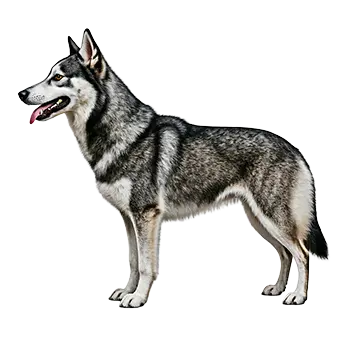
The reason people call this breed a Miniature Husky is immediately obvious the moment you see one. The Alaskan Klee Kai looks like someone took a northern sled dog and scaled it down to companion size while preserving every visual detail. The erect triangular ears, the striking facial mask, the almond-shaped eyes, the thick double coat, and the confident carriage all echo the appearance of the Alaskan and Siberian Huskies. The resemblance is so strong that people frequently mistake Klee Kai for husky puppies, which is both a compliment to the breed's design and a source of endless corrective conversations for their owners.
The head is wedge-shaped and proportionate to the body, with a moderate stop and a muzzle that tapers slightly from the skull to the nose without appearing pointed or snipey. The facial mask is a defining feature of the breed and consists of contrasting light and dark markings that create a distinct pattern unique to each individual dog. The eyes are medium-sized, almond-shaped, and may be brown, blue, green, hazel, or any combination of these colors. Heterochromia and parti-colored eyes are common and accepted. The ears are large relative to the head, triangular, erect, and set high, contributing to the alert, attentive expression that characterizes the breed.
The body is compact and well proportioned, slightly longer than tall, with a level topline and a chest that reaches to or near the elbow. The ribs are well sprung but not barrel-shaped, and there is a moderate tuck at the flank. The legs are straight and moderately boned, with oval, compact feet that are well furred between the pads for cold-weather protection. The tail is well furred and may be carried in a loose curl over the back or trailing behind the dog, depending on the individual's mood and activity level. The tail set and carriage are relaxed and natural rather than tightly curled.
The three size varieties create a broader range of physical presence than most single breeds offer. A toy Klee Kai under 13 inches and 10 pounds is a genuinely small dog that can be carried and fits comfortably in a lap. A standard Klee Kai at 17 inches and 25 pounds is a substantial small-to-medium dog that has real presence and substance. The miniature variety falls between these extremes and is the most commonly seen size. All three sizes should present the same balanced, proportionate appearance, and the breed standard does not distinguish between them except for height.
The coat is a functional double layer suited to cold climates. The outer coat is medium in length, straight, and protective, while the undercoat is dense and soft. The coat lies relatively flat against the body, giving the Klee Kai a cleaner outline than the fluffier Siberian Husky. Hair is shorter on the face, ears, and front of the legs, and longer on the tail, hindquarters, and around the neck. The breed is notably clean and fastidious, often grooming itself in a catlike manner, which means the coat tends to stay relatively tidy between brushing sessions.
Color and markings are a key element of the Klee Kai's visual appeal. The accepted colors, black and white, gray and white, red and white, and solid white, all feature sharp contrast between the darker dorsal areas and the lighter ventral and facial markings. The symmetry and clarity of the facial mask are particularly important to the breed's overall appearance. Red and white dogs range from deep mahogany to a lighter cinnamon shade, while gray and white dogs exhibit the classic wolf-gray coloring associated with northern breeds. The solid white variety lacks the characteristic mask patterning but should still display the breed's correct structure and proportions.
Affectionate With Family
★★★★☆
Alaskan Klee Kai form strong bonds with their immediate family and can be deeply affectionate with the people they trust. Their attachment tends to center on one or two primary people rather than being distributed equally.
Good With Young Children
★★☆☆☆
The breed's small size and reserved nature make it a better fit for families with older, calmer children. Rough handling or unpredictable movements from toddlers can trigger defensive reactions in a sensitive Klee Kai.
Good With Other Dogs
★★★☆☆
Klee Kai can get along with other dogs, particularly when raised together, but their strong prey drive and occasional territoriality require managed introductions and ongoing supervision with unfamiliar dogs.
Shedding Level
★★★★☆
The thick double coat sheds moderately year-round and blows out heavily twice a year during seasonal changes. During coat blows, the volume of loose fur can be surprising for a dog this size.
Coat Grooming Frequency
★★★☆☆
Weekly brushing keeps the coat in good condition during most of the year, with daily grooming needed during the intense shedding periods in spring and fall.
Drooling Level
★☆☆☆☆
Alaskan Klee Kai do not drool. The breed is notably clean and fastidious, often grooming themselves in a manner reminiscent of cats.
Coat Type
★★★☆☆
The double coat has a medium-length outer layer and a dense, insulating undercoat. The coat lies relatively flat and does not require trimming or professional styling.
Openness To Strangers
★☆☆☆☆
Reserve with strangers is a defining trait of the Alaskan Klee Kai. These dogs are typically wary, sometimes fearful, around unfamiliar people, and forcing interaction can increase anxiety rather than resolve it.
Playfulness Level
★★★★☆
Klee Kai are playful and energetic with people they trust, engaging enthusiastically in chase games, interactive toys, and backyard romps. Their play style is quick and agile.
Watchdog/Protective Nature
★★★★☆
Despite their small size, Klee Kai are alert and vocal watchdogs that will announce visitors and unusual activity. Their wariness of strangers reinforces their natural alertness.
Adaptability Level
★★★☆☆
The breed adapts to apartment living if exercise needs are met but does not handle changes in routine, environment, or household composition as easily as some companion breeds.
Trainability Level
★★★☆☆
Klee Kai are intelligent and capable of learning quickly, but they share the northern breed tendency toward independent thinking. Training requires patience, consistency, and creative motivation.