Irish Red and White Setter

Irish Red and White Setter

Quick Facts

🐕 Breed Group
Sporting Group
📏 Size Category
Medium
📏 Height
Males: 24-26 inches, Females: 22-24 inches
⚖️ Weight
Males: 55-75 pounds, Females: 45-65 pounds
⏱️ Life Expectancy
10-12 years
🧣 Coat Type
Flat, silky with feathering
🎨 Coat Colors
White with solid red patches; some flecking acceptable on muzzle and legs
😀 Temperament
Friendly, High-Spirited, Athletic, Loyal, Determined, Affectionate
🏃 Exercise Needs
Very High
🎓 Training Difficulty
Moderate
👶 Good with Children
Good with older children; rambunctious for toddlers
🐾 Good with Other Pets
Good with dogs; supervision needed with small animals

Other Names & Breed Recognition

The Irish Red and White Setter is the breed's official name and it is descriptive: this is an Irish setter with a coat that is predominantly white with solid red patches, as distinct from the all-red Irish Setter. The breed is often abbreviated as IRWS in breed circles, which is useful shorthand when distinguishing it from its more famous cousin in conversation or writing. In Ireland, where the breed was developed, it has historically been called the Rossmore Setter and the Arran Setter in older literature, names that reflected the families and geographic regions associated with its development. These names have fallen out of use but appear in historical records and breed histories.

It is important to understand that the Irish Red and White Setter is not a color variety of the Irish Setter - it is a separate breed with its own standard, separate registry entries, and its own parent clubs. The two breeds share ancestry and are closely related, but they have been separately registered and managed since the Irish Red and White Setter's revival in the 20th century. Confusion between the two is common among people unfamiliar with either breed, and the IRWS consistently lives in the shadow of its more popular and numerically abundant cousin.

In terms of formal recognition, the AKC added the Irish Red and White Setter to its Sporting Group as a fully recognized breed on January 1, 2009, after a period on the Foundation Stock Service beginning in 1996. The Kennel Club in the United Kingdom recognizes the breed within its Gundog Group. The FCI classifies it in Group 7 (Pointing Dogs), Section 2 (British and Irish Pointers and Setters). The Canadian Kennel Club recognized the breed in 1999. The United Kennel Club recognized it in 1995. The Irish Kennel Club, which played a central role in the breed's revival, has recognized and maintained records for the breed since the formal revival efforts of the 1970s and 1980s.

The breed remains numerically rare by any measure. Annual registrations with the Kennel Club in the United Kingdom rarely exceed 300. AKC registrations in the United States are similarly modest. Only a handful of dedicated breeders work with the breed in North America, and the total population across North America is estimated at around 500 dogs. This rarity means that buyers should be prepared for a waiting list and should not expect to find this breed at a local shelter or through a casual internet search.

Irish Red and White Setter Organizations & Standards

In Ireland, the primary organization for the breed is the Irish Red and White Setter Field and Show Society, which was formed in 1981 as part of the coordinated revival effort and has been the central body for breed development, field trial organization, and health oversight on the island of Ireland. In the United States, the Irish Red and White Setter Club of America serves as the AKC parent club, managing the breed standard, health programs, and breed promotion. In the United Kingdom, the Irish Red and White Setter Club was established as the breed's numbers grew following importation from Ireland in the 1980s.

The AKC-recommended health testing protocol for the Irish Red and White Setter covers three areas: hip evaluation (OFA or PennHIP), ophthalmologist evaluation for hereditary eye disease, and DNA testing for Canine Leukocyte Adhesion Deficiency Type I (CLAD). These three tests represent the CHIC minimum. Many conscientious breeders also test for Von Willebrand Disease Type I, a hereditary bleeding disorder, and Rod-Cone Dysplasia (rcd1), a form of Progressive Retinal Atrophy that causes progressive vision loss. Given the breed's small gene pool, responsible breeders are especially attentive to genetic diversity and health transparency.

The breed standard describes a strong, well-balanced, athletic dog built for a full day's work in the field. It is notably shorter and more compact than the Irish Setter - stockier in bone, less racy in outline, with a broader skull and a deeper chest. The standard is clear that this is a working gundog above all, and structure that would compromise function is not acceptable. The coat is flat and silky on the body with feathering at the ears, chest, back of legs, and tail; it should not be curly or wavy. The color pattern is specific: a predominantly white base coat with solid red patches. Flecking in chestnut or red is permissible on the muzzle and legs but heavy ticking throughout the coat is undesirable.

An important note for anyone considering this breed is the population size and its implications for health testing. The breed was revived from as few as ten individual dogs in the 1970s, meaning the global gene pool has always been narrow. The genetic diversity concern is real and ongoing, and responsible breeders track pedigrees carefully to avoid excessive inbreeding. The CLAD carrier rate identified in early US studies - roughly 13 percent of dogs tested - underscores why DNA testing before breeding is not optional but essential. UK breeders, working proactively with genetic testing, have reduced the incidence significantly. The same commitment to testing and transparency is expected from American breeders working within CHIC requirements.

The breed standard is maintained separately by the Irish, British, and American breed clubs, with minor variations in description but agreement on the core principles: a compact, athletic working gundog with a specific coat pattern, honest structure, and a temperament suited to the field. Judges evaluating the breed in the show ring are expected to prioritize working structure and type over any tendency toward exaggeration. The breed's small population means that breeders often look internationally for suitable mates, which is one reason why health test results from Ireland, the UK, and the United States are all tracked through OFA's public database whenever possible.

Kennel Club Recognition

  • American Kennel Club (AKC): Recognized in 2009, Sporting Group
  • United Kennel Club (UKC): Recognized, Gun Dog Group
  • Canadian Kennel Club (CKC): Recognized, Sporting Group
  • FCI: Recognized, Group 7
  • The Kennel Club (UK): Recognized, Gundog Group

Irish Red and White Setter Physical Description

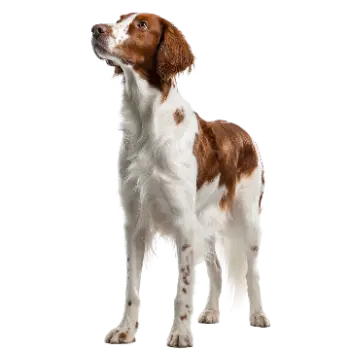
The Irish Red and White Setter is a medium to large athletic dog with a notably different silhouette from the Irish Setter despite the family resemblance. Where the Irish Setter is rangy, racy, and almost elegant in outline, the IRWS is shorter-coupled, broader in skull and chest, and more solidly built. This is a dog designed for sustained physical work across variable terrain, and the structure reflects that purpose. Males typically stand 24 to 26 inches at the withers and weigh 55 to 75 pounds; females are slightly smaller at 22 to 24 inches and 45 to 65 pounds. The overall impression should be one of substance and balance - powerful enough to work all day, proportionate enough to move with efficiency.

The head is broad and domed, distinctly wider between the ears than the Irish Setter's more refined skull. The muzzle is moderately long, nearly equal in length to the skull, and square at the end. The stop is clearly defined. The nose is wide, open, and well-pigmented - ideally dark but may be pink where the coat is white. The teeth meet in a scissors bite. The eyes are dark hazel to dark brown, round, and set forward on the skull. They give the dog an intelligent, earnest expression - this is a breed that looks like it is paying attention and generally is. Pale or yellow eyes are a fault.

The ears are set level with the eyes, moderately long, pendant, and covered with soft, wavy feathering that blends into the neck and cheek. They are not as heavily feathered as the Irish Setter's ears. The neck is moderately long and slightly arched, clean in throat, flowing smoothly into well-laid-back shoulders.

The body is strong and level in topline. The chest is deep with well-sprung ribs - this is where the breed's working depth comes from, and it also contributes to the elevated bloat risk that owners should understand. The loin is short and powerful. The croup is slightly sloped. The overall body is shorter in proportion to height than the Irish Setter - the IRWS is distinctly more compact.

The tail is set and carried level with or below the topline. It is well-feathered, strong at the base, tapering to a fine point, and should not be carried above the back. A flagging, upright tail carriage is incorrect for this breed.

The forelegs are straight and well-boned with strong pasterns. The hindquarters are well-muscled with good angulation - enough to generate the driving power needed for a full day's quartering in the field. The feet are round and firm with strong pads. The coat on the body is close-lying, flat, and silky - not curly, not wavy, not rough. Feathering appears at the ears, throat, chest, back of legs, and tail. This feathering is a hallmark of the breed but should not be excessive; a working dog cannot be hampered by coat.

The color pattern is one of the most recognizable features of any setter breed: white as the primary base coat with clearly defined solid red patches. The red ranges from light honey to rich chestnut. Distinct red patches appear most commonly on the head, ears, and body. Flecking in chestnut or red is permitted around the muzzle and up the foreleg but excessive ticking throughout the body is undesirable. This coat pattern was historically valued by hunters because it made the dog highly visible at distance in field cover.

Movement is free, ground-covering, and powerful. At the trot, the IRWS should demonstrate good reach in front and strong drive from behind, covering ground efficiently without wasted motion. At the gallop, which is the breed's natural working pace, they are fast and fluid. Any tendency to roll, paddle, or move with high-stepping front action is incorrect.

The sexual dimorphism in this breed is noticeable. Males are clearly more substantial than females - broader in skull, heavier in bone, and more muscular overall. Both sexes should look complete and proportionate within their respective frames. A male that looks feminine or a female that looks coarse are both departing from correct type. The overall quality to keep in mind with this breed is a sporting dog that looks genuinely capable of a full day's work: no exaggerations, no wasted structure, honest substance throughout.

One point of contrast worth understanding for those familiar with the Irish Setter: the IRWS should read as decidedly more compact and workmanlike. Side by side, the IRWS is shorter in leg, broader in the head, more heavily boned, and less refined in outline. The Irish Setter has an elegance of line that the IRWS does not share by design - the IRWS was built to work rough Irish terrain for hours, and that purpose is written into every proportion of the dog.

Affectionate With Family
Deeply devoted to its people and expressive about it - this is not a breed that shows affection from a polite distance. They want contact, involvement, and to be wherever you are.
Good With Young Children
Genuinely fond of children but can knock small ones over without meaning to given their size and exuberance. Better suited to families with children old enough to handle a dog that plays hard.
Good With Other Dogs
Generally sociable and good-natured with other dogs. This breed was traditionally worked in pairs and packs, and most individuals enjoy canine companionship.
Shedding Level
Moderate shedder. The flat, silky coat produces less loose fur than a heavy double coat, but the feathering sheds noticeably and shows up on upholstery.
Coat Grooming Frequency
The flat coat stays relatively tangle-free with a few brushings per week. Feathering on the ears and legs needs more attention to prevent mats, particularly after field work.
Drooling Level
Clean-mouthed and dry. Not a drooling breed.
Coat Type
A single-layer flat silky coat with moderate feathering - less coat than the Irish Setter and generally easier to maintain. No undercoat to contend with during shedding season.
Openness To Strangers
Friendly and outgoing with new people, though not quite as exuberantly indiscriminate as the Irish Setter. They warm up quickly and rarely show reserve.
Playfulness Level
Energetic, enthusiastic, and a dog that never really loses its puppy playfulness. Exercise burns the physical energy; the playful attitude is just part of who they are.
Watchdog/Protective Nature
Will alert you that someone is arriving but greets visitors far too warmly to function as a deterrent. Not a protective breed.
Adaptability Level
Poorly suited to urban or sedentary living. This is a breed that needs space, daily vigorous exercise, and ideally access to open land. Apartments and low-activity households are a poor fit.
Trainability Level
Intelligent and willing but carries an independent streak inherited from field work. Positive methods work; harsh corrections backfire. Consistency over a long period produces a reliable dog.

Irish Red and White Setter History & Development

The Irish Red and White Setter is older than the Irish Setter, though most people encountering it for the first time assume the opposite. Setting dogs with red and white coats appear in Irish and English art dating back to at least the 17th century, and written references to setter-type dogs in Ireland go back further still. The breed was developed by the landed gentry of Ireland to hunt upland game birds - primarily grouse, woodcock, snipe, and partridge - across the boggy, rough terrain of the Irish countryside. The red and white coat was considered a practical asset by hunters, as the high-contrast pattern made the dog easy to spot at distance in field cover.

Through the 18th century, the IRWS was the dominant setter type in Ireland. Early breed historians associate the development of the breed with families like the Rossmore and Arran estates, which gave the dog its early regional names. These were working dogs first, and their value was measured in the field. The shift away from the breed began in the mid-19th century when the preference for solid red coat color began to dominate the show ring and fashionable breeding programs. The all-red Irish Setter's rise through the show world of Victorian Britain drew attention and breeding resources away from the red and white type. By the time of World War I, the IRWS had nearly vanished - only a small number of dogs remained in Ireland, and the breed's survival was genuinely in doubt.

The first meaningful revival effort came from the Reverend Noble Huston and his cousin Dr. Elliott, who began selectively breeding the surviving IRWS dogs in the years after World War I and exporting specimens to other countries to spread the genetic load. Their work was continued by Will and Maureen Cuddy, who researched and documented the breed's genealogy in detail and established the Irish Red and White Setter Society in 1944. This organization formalized the revival effort and eventually helped the breed gain separate registration from the Irish Setter.

The second and more successful revival phase began around 1970. The Irish Kennel Club engaged the Irish Red Setter Club to help steward the revival, and the Irish Red and White Setter Field and Show Society was formed in 1981 to give the breed dedicated organizational support. Numbers grew slowly but steadily. By the 1980s, dogs were being imported to the United Kingdom, where the breed was initially developed more as a show dog than a field dog - a contrast to the breed's primary identity in Ireland, where it has always been first and foremost a working gundog.

AKC recognition, achieved in 2009, helped establish the breed in North America. Today, the IRWS remains rare - one of the less commonly encountered sporting breeds in the United States - but it has a devoted following among hunters and sport dog enthusiasts who value its field ability and find its personality and appearance compelling.

A key distinction worth understanding is that in Ireland, the IRWS has always been primarily a working gundog. In the United Kingdom, where the breed arrived primarily through the show dog community in the 1980s, the breed has developed more in the show direction than the field direction. In the United States, hunters and sport dog people have led the breed's development, keeping field ability central to breeding goals. This means that buyers seeking a functional hunting dog should seek breeders with active field programs rather than those focused solely on the show ring - the difference in drive, range, and nose between a well-bred field line and a show-focused line can be considerable.

Irish Red and White Setter Temperament & Personality

The Irish Red and White Setter is a high-energy, people-oriented dog with a friendly, outgoing personality that is very difficult not to like. They bond strongly to their families, enjoy physical contact, and are expressive about their affection. In the house, they are warm and social dogs that want to be involved in family activity rather than sidelined. They are genuinely good-natured and their enthusiasm for life is one of their most engaging characteristics - but that enthusiasm is large and physical, and it is worth understanding what that means in daily life.

As a field dog, the IRWS was bred to range widely, work independently, and persist at searching cover for birds for hours. Those traits translate directly to pet behavior. This is a dog with genuine high drive and a strong independent streak - not in the stubborn, difficult sense, but in the sense that they are confident, self-directed, and accustomed to making decisions in the field without constant handler input. Training an IRWS requires working with that independence rather than against it. Harsh corrections produce a dog that shuts down; positive, motivating, consistent training produces a dog that is genuinely enjoyable to work with.

The breed is friendly with strangers and not particularly suspicious of new people, though they are alert enough to notice arrivals. They are not a guard dog by nature or by inclination - they would greet an intruder enthusiastically. With children, the IRWS is fond and patient in temperament but physically rambunctious. Families with toddlers should be aware that this is a dog that moves fast, plays hard, and can knock a small child over without intending any harm. With older children who can handle a large, active dog, the IRWS is an excellent companion.

With other dogs, the breed is generally sociable. This is a breed with a long history of working alongside other gundogs in the field, and dog-dog aggression is not a breed characteristic. Small animals - cats, rabbits, small pets - require more caution given the breed's bird-hunting instincts and prey drive. IRWS dogs raised with cats from puppyhood typically coexist well; introductions to cats as adults require more careful management.

What this breed looks like when its needs are not met is specific: persistent indoor energy, destructive chewing when bored, attempts to self-exercise by escaping fenced areas, and increasing frustration expressed through jumping, pawing, and hyperactivity in the house. This is not a breed that accepts an inactive lifestyle without protest. An IRWS that gets adequate field running or vigorous daily exercise is a calm, pleasant housedog. One that does not is a problem in the making.

One characteristic that surprises some new owners is how quickly the IRWS matures emotionally. Puppies in this breed can maintain a high level of physical energy and mental puppy-ness through their second year. Buyers should be prepared for a dog that looks like an adult at twelve months but is still very much a high-energy, impressionable juvenile. Consistent training and adequate exercise from the beginning of puppyhood is what produces the settled adult dog that experienced IRWS owners describe.

The IRWS is at its best when it has a job. That job can be hunting, dog sports, or simply being a structured, exercised, mentally engaged family dog - but the dog needs purpose to be at its most stable and pleasant. People who have owned other active sporting breeds and managed them well often find the IRWS temperamentally familiar. People coming from more biddable, lower-drive breeds sometimes underestimate how much this dog's field heritage drives its daily behavioral reality.

Irish Red and White Setter Family Life & Living Requirements

Living with an Irish Red and White Setter is a genuine commitment to an active lifestyle. This is not a dog for apartment living, for sedentary households, or for owners who cannot provide a substantial amount of genuine outdoor exercise every day. It is a fit for active families with space, an interest in hunting or dog sports, and the time and energy to keep a high-drive sporting dog engaged and exercised.

Space requirements are real. The IRWS needs room to move - ideally a securely fenced property where the dog can stretch its legs fully. Fencing should be solid and at least five to six feet high; these are athletic dogs that can cover ground quickly and their recall in the presence of birds or other wildlife can be unreliable without proper training. A house with a yard is the minimum workable setup; rural properties with access to fields are ideal.

Exercise needs are genuinely high - higher than most sporting breeds. A daily minimum of 60 to 90 minutes of vigorous exercise is the realistic baseline for an adult IRWS, and that means real exercise: running, fetching, swimming, or field work. A neighborhood walk does not adequately meet this breed's needs. On days when outdoor exercise falls short, this dog will find ways to spend that energy indoors that you will not enjoy. Hunters who work dogs regularly in the field will find that the dog's exercise needs and hunting drive align naturally. Non-hunters need to think about alternatives: running companions, agility, retrieving drills, or access to dog parks with room to run.

Shedding is moderate - less than many sporting breeds - but the feathering on the ears, legs, and tail does collect debris after field work or outdoor activity. Plan for regular post-outing brushouts. The coat is relatively forgiving in daily life but cannot be ignored.

This breed needs company and does not thrive in isolation. Left alone for long stretches daily, an IRWS will develop anxiety-driven behavior - not because this breed is particularly fragile emotionally, but because a high-drive social dog needs both physical and social engagement to stay balanced. If your schedule regularly leaves the dog home alone for eight or more hours, adding a canine companion or a dog walker is worth considering.

Who is this breed not right for: people in apartments or small urban spaces, sedentary owners, people with very young children who cannot manage a large, enthusiastic dog safely, and anyone who thinks they want a pretty dog but cannot commit to the exercise reality.

For hunters, the calculus is different and often easier. A working IRWS that hunts regularly will come home from a day in the field naturally spent, and the household management requirements are dramatically reduced when the dog's drive is being channeled appropriately. Non-hunting owners of this breed need to think carefully about how they will provide a functional equivalent of that kind of full-body, mentally engaging work, because casual exercise is not sufficient and the dog will make that clear.

Irish Red and White Setter Training & Exercise Needs

Training an Irish Red and White Setter well requires patience, positive reinforcement, and the understanding that you are working with a dog that was built to make independent decisions in the field. The IRWS is not a dog that naturally defers to its handler in every situation - it is a dog that thinks and acts with confidence. That confidence is an asset in the field and a training challenge in daily life. The approach that works is building a genuine partnership through consistency, reward-based methods, and making training feel worth the dog's investment.

Harsh corrections do not work with this breed. An IRWS that is corrected harshly will shut down, become anxious, or begin avoiding training situations altogether. Raised voices, leash corrections delivered in frustration, and punitive methods produce a confused, unhappy dog and do nothing for reliability. What works is high-value reinforcement, clear communication, short sessions that end before the dog loses interest, and progressive difficulty that challenges without overwhelming.

Early socialization is essential. The IRWS puppy should be exposed to a wide range of people, environments, sounds, and situations during the critical socialization window of eight to sixteen weeks. The breed's natural friendliness makes this process generally pleasant, but it still needs to happen deliberately. A well-socialized IRWS puppy grows into a confident adult that handles novel environments without anxiety. An under-socialized one is more likely to become reactive or anxious despite the breed's generally stable temperament.

Recall training is the most important investment you can make with this breed. An IRWS that is off-leash near birds, rabbits, or other prey items will follow its nose without regard for your commands unless you have a reliable recall built on extensive, reward-rich training. Start recall work early, practice it constantly in progressively more distracting environments, and maintain it throughout the dog's life. A long line during the training phase allows the dog freedom of movement while keeping you in control.

For exercise, the IRWS does best with activities that combine physical and mental engagement. Hunting is the ideal, for obvious reasons. Agility, field trial work, tracking, and retrieving drills are all excellent alternatives. Running alongside a bicycle or with a jogging owner works for physical conditioning. The key is that this dog needs to run at speed, not just walk. A trotting pace on leash does not discharge the energy reserves of a dog built for a full day's quartering across open fields. Daily off-leash time in a safely fenced area, or access to a running partner willing to go fast and far, is the realistic baseline.

For owners interested in field work, the IRWS takes to bird work naturally and does not need to be taught the basics of pointing and quartering - it will demonstrate those instincts the first time it encounters game scent. What field training develops is steadiness, responsiveness to the handler, and the ability to work within hunting conventions reliably. A NAVHDA or AKC hunt test program provides structure and measurable goals for developing a IRWS as a working gundog.

Irish Red and White Setter Health Concerns

The Irish Red and White Setter is generally a hardy breed with a documented average lifespan of 10 to 12 years. However, several inherited conditions are documented specifically in this breed and require serious attention by both breeders and buyers. The breed's small founding population - estimated at as few as ten individual dogs at the time of the 1970s revival - creates ongoing genetic diversity challenges that make health transparency from breeders more important, not less.

Buyers should ask to see CLAD DNA test results, hip evaluation results, and ophthalmologist evaluation for both parents of any litter. Verify these results in the OFA public database before purchasing.

Common Health Issues

  • Canine Leukocyte Adhesion Deficiency Type I (CLAD): An inherited immune disorder that prevents white blood cells from fighting bacterial infections effectively. Affected puppies develop severe, recurrent infections and most do not survive to adulthood. It is a recessive condition preventable through DNA testing of breeding stock - A test is available and required by CHIC standards.
  • Von Willebrand Disease Type I - VWD, : A hereditary bleeding disorder caused by reduced levels of the von Willebrand clotting factor. Affected dogs may bleed longer than normal after injury or surgery. Severity ranges from mild to significant; a DNA test is available.
  • Progressive Retinal Atrophy - Rod-Cone Dysplasia Type 1 (rcd1): An inherited eye disorder causing degeneration of the retinal photoreceptors. Vision loss progresses and typically results in complete blindness, often before two years of age. A DNA test is available.
  • Hip Dysplasia: Malformation of the hip joint causing pain - Lameness, and eventual arthritis. OFA or PennHIP evaluation is required by CHIC health testing standards for breeding dogs.
  • Gastric Dilatation-Volvulus (Bloat): A life-threatening condition where the stomach fills with gas and twists on itself, cutting off blood supply. The IRWS's deep chest creates elevated risk. Owners should know the signs - Unproductive retching, hard distended abdomen, sudden distress - and treat as an immediate veterinary emergency.

Preventive Care & Health Monitoring

  • CLAD DNA testing: Confirm that both parents of any litter have been DNA tested clear or carrier status for CLAD - Two carriers should never be bred together. Verify results in the OFA public database before purchasing a puppy.
  • Hip and eye evaluations: Verify current OFA or PennHIP results and ophthalmologist clearance for both parents - These are CHIC requirements and should be publicly verifiable.
  • Bloat awareness: Avoid feeding a single large meal - Consider feeding two or three smaller meals daily. Avoid vigorous exercise immediately before or after feeding. Discuss prophylactic gastropexy with your veterinarian, particularly if your dog is a fast eater or shows signs of anxiety around feeding.
  • Regular ear maintenance: Check and clean ears weekly given the pendant ear conformation - Early detection of infection prevents chronic ear disease.

Irish Red and White Setter Grooming & Maintenance

The Irish Red and White Setter's coat is considerably easier to maintain than many sporting breeds. The body coat is flat, close-lying, and silky - not prone to matting and relatively self-cleaning after outdoor activity. Dirt and mud tend to dry and brush out without much effort. The feathering on the ears, chest, back of legs, and tail requires more attention and is where most grooming time will be spent.

For a pet dog that is not regularly working in the field, brushing two to three times per week is sufficient during normal maintenance periods. A pin brush works well for the body coat; a metal comb is more effective for working through the feathering on the ears and legs where debris and tangles accumulate. After field work or time in heavy cover, the dog should be brushed out completely - burrs, seeds, and plant material collect in the feathering and can work their way into the skin if left. The ears in particular need to be checked carefully after outdoor activity since the pendant ear leather and feathering can trap plant material close to the ear canal.

Bathing frequency is low for this breed. The silky, flat coat repels dirt well and dries relatively quickly. Bathing every six to eight weeks is typically sufficient for a pet dog unless the dog has gotten into something that requires immediate washing. Working dogs may need more frequent bathing depending on field conditions.

Ear health deserves consistent attention. The pendant ears of the IRWS create a warm, somewhat humid environment inside the ear canal that predisposes to infection if not kept clean. Weekly ear checks and gentle cleaning with an appropriate veterinary ear cleaner will prevent the bacterial and yeast overgrowth that is common in drop-eared breeds. Signs of infection include odor, discharge, redness, and the dog shaking its head or scratching at its ears.

Nail trimming every three to four weeks keeps feet comfortable and prevents the splaying and posture problems that come from overly long nails. Teeth brushing several times per week is the standard recommendation for any breed, and the IRWS is no exception. A coat trim is not required - the breed standard calls for a natural coat without significant scissoring - though some tidying around the ears and feet is common in show dogs.