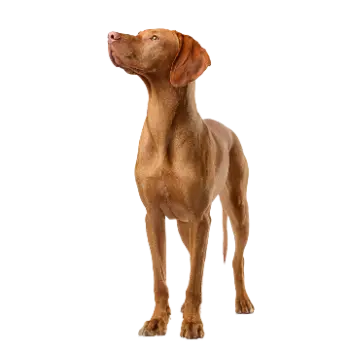
The Hungarian Pointer is one of those breeds where everything about its physical structure tells you what the dog was built to do. This is a medium-sized athlete designed for long days in the field, covering rough terrain at a steady pace while maintaining the sensitivity to detect and point game birds at considerable distance. Every feature serves a purpose, from the lean musculature to the self-colored nose that blends seamlessly into the golden-rust coat.
The overall silhouette is elegant without being fragile. Males stand 22 to 24 inches at the shoulder and weigh 55 to 60 pounds, with females slightly smaller at 21 to 23 inches and 44 to 55 pounds. The body is moderately long, with a deep chest that reaches to approximately the elbow and a visible tuck-up at the loin. The back is short and straight, flowing into a slightly rounded croup. The legs are straight, well-boned, and muscular, built for sustained movement rather than explosive sprinting. The tail is traditionally docked to about two-thirds of its natural length in countries where docking is permitted, though undocked tails are increasingly common and are carried with a slight upward curve.
The head is lean and aristocratic, with a moderately wide skull and a muzzle that tapers gently to a nose that must match the coat color. That self-colored nose is a defining feature of the breed. It should be some shade of brown that harmonizes with the golden-rust coat, and a black nose or a partially black nose is a disqualification in the show ring. The eyes are medium-sized, slightly oval, and blend with the coat color, giving the Hungarian Pointer a warm, intelligent expression that many owners describe as almost human in its emotional range. The ears are thin, silky, and set moderately low, hanging close to the cheeks with rounded tips.
The coat is the breed's simplest and most practical feature. It is short, smooth, dense, and close-lying with no undercoat, which means the Hungarian Pointer is not built for extreme cold. The coat feels somewhat coarse to the touch but lies flat and neat against the body, and the color should be an even golden rust throughout. Some dogs carry a small white patch on the chest or a few white hairs on the toes, which is permissible, but large white markings or any other color is not. The uniformity of that golden-rust color, from the tip of the nose to the pads of the feet, gives the Hungarian Pointer a sleek, monochromatic appearance that is instantly recognizable.
In motion, the Hungarian Pointer moves with a smooth, effortless gait that covers ground efficiently. The reach in front and drive from behind should be balanced, and the topline remains level during movement. There is a light, almost floating quality to the way a well-built Hungarian Pointer moves, which makes sense when you consider that this dog was expected to work for hours without tiring. Watching one move across a field is watching centuries of selective breeding for functional athleticism come together.
The overall impression should be of a dog that is powerful without being heavy, refined without being delicate, and athletic without being coarse. It is a breed that exists in a sweet spot between the heavier continental pointing breeds and the lighter, leggier setters, and that balance is exactly what makes the Hungarian Pointer so effective in the field and so striking in appearance. The breed's physical type has remained remarkably consistent over time, which speaks to the fact that the original breeders got the proportions right for the work the dog was intended to do.
Affectionate With Family
★★★★★
The Hungarian Pointer is famously devoted to its family and earned the nickname "Velcro dog" for its insistence on being as close to its people as physically possible at all times.
Good With Young Children
★★★★☆
This breed's gentle and patient nature makes it a natural fit for families with children. The Hungarian Pointer tends to be tolerant and playful without the roughness of some other sporting breeds.
Good With Other Dogs
★★★★☆
Most Hungarian Pointers get along well with other dogs, especially when socialized early. Their pack-oriented nature generally extends to canine housemates without significant conflict.
Shedding Level
★★★☆☆
The short coat sheds moderately year-round with seasonal increases. Regular brushing helps manage loose hair, but expect some golden-rust fur on your furniture and clothing.
Coat Grooming Frequency
★☆☆☆☆
Grooming the Hungarian Pointer is about as easy as it gets. The short, smooth coat needs only occasional brushing and the odd bath when the dog gets particularly dirty.
Drooling Level
★☆☆☆☆
This is a clean-mouthed breed that does not drool. The tight lip structure keeps things tidy after meals and drinks.
Coat Type
★☆☆☆☆
The Hungarian Pointer's coat is short, smooth, and close-fitting with no undercoat. It feels dense to the touch and lies flat against the body, providing minimal protection in cold or wet weather.
Openness To Strangers
★★★☆☆
Hungarian Pointers are generally friendly with new people once they have had a moment to assess the situation. They may alert to visitors at the door but warm up quickly with proper introductions.
Playfulness Level
★★★★★
This breed maintains a joyful, playful energy well into adulthood. The Hungarian Pointer approaches games of fetch, swimming, and field work with infectious enthusiasm.
Watchdog/Protective Nature
★★★☆☆
The Hungarian Pointer will alert you to unusual activity but is not a natural guard dog. Its protective instinct is moderate, driven more by loyalty than territorial aggression.
Adaptability Level
★★★☆☆
With adequate exercise the Hungarian Pointer can adapt to various living situations, but it does best with access to open space for running. This breed struggles in sedentary households.
Trainability Level
★★★★★
Eager to please and quick to learn, the Hungarian Pointer is highly trainable with positive methods. Harsh corrections are counterproductive with this sensitive breed.