Hrvatski Ovčar

Croatian Sheepdog

Quick Facts

🐕 Breed Group
Herding Group
📏 Size Category
Medium
📏 Height
Males: 17.5-21 inches, Females: 16-19 inches
⚖️ Weight
Males: 30-45 lbs, Females: 25-40 lbs
⏱️ Life Expectancy
12-14 years
🧣 Coat Type
Double coat - curly or wavy outer coat with soft undercoat
🎨 Coat Colors
Black, sometimes with small white markings on chest
😀 Temperament
Loyal, energetic, intelligent, protective
🏃 Exercise Needs
High
🎓 Training Difficulty
Moderate - eager to learn but can be independent
👶 Good with Children
Yes, with socialization
🐾 Good with Other Pets
Yes, with early introduction

Other Names & Breed Recognition

Hrvatski Ovčar is what you will hear if you visit the Slavonian countryside and ask a farmer what that quick, curly-coated black dog is called. The name translates simply to "Croatian Shepherd" and has been in use for centuries, long before anyone outside Croatia had reason to know the breed existed. In its homeland, this is not an alternate name. It is the only name. The English designation "Croatian Sheepdog" is the translation that international kennel clubs adopted for their registries.

The breed's documentation trail is unusually deep for such a little-known dog. The earliest written reference dates to 1374, in the archives of Bishop Peter Horvat of Djakovo, who described small black curly-coated dogs being used to manage livestock in the Slavonian region. A later document from 1752 by the veterinarian Bakic further describes dogs matching the same type, still working the same land, still black, still curly. That kind of continuity over four centuries of written records, with likely several more centuries of unrecorded history before that, makes the Hrvatski Ovčar one of the oldest documented herding breeds in Europe.

The FCI recognized the breed definitively in 1969, using the Croatian-language name as the official breed designation. The breed standard was first drafted by Otto Rohr in 1951, building on the selective breeding work that veterinarian and agronomist Stjepan Romić began in the 1930s. The UKC recognizes the breed in its Herding Dog group. In the United States, the AKC lists the Croatian Sheepdog in its Foundation Stock Service, which is the preliminary step toward potential full recognition. The breed is also sometimes called the Hoki in casual Croatian usage.

Outside Croatia and the surrounding Balkan region, the Hrvatski Ovčar remains genuinely rare. You are unlikely to encounter one at your local dog park in North America or Western Europe. This rarity means that finding a puppy requires patience, direct contact with breed-specific clubs, and often international coordination. It also means that the breed has been largely spared the genetic bottlenecks that come with sudden popularity surges.

Hrvatski Ovčar Organizations & Standards

The Croatian Kennel Club oversees the Hrvatski Ovčar in its country of origin and works with the FCI to maintain the breed standard. The FCI assigns the breed to Group 1, Section 1, as a sheepdog with working trial. This classification places the Hrvatski Ovčar alongside other working sheepdogs and reflects the expectation that the breed should retain functional herding ability, not merely the appearance of a working dog.

The breed standard describes a medium-sized dog of athletic build, with a body slightly longer than it is tall and a distinctive black curly or wavy coat that immediately sets it apart from other herding breeds in the region. Males stand between 17.5 and 21 inches at the withers, females somewhat smaller. The standard emphasizes a lively, agile dog with prick ears, an alert expression, and enough leg to cover ground efficiently over varied terrain. Weight should be proportionate to height, generally falling between 30 and 45 pounds for males.

Health testing for the Hrvatski Ovčar does not follow the structured CHIC model used for AKC breeds because the breed is not yet fully recognized by the AKC. However, responsible breeders within Croatia and internationally follow sensible protocols that include hip radiographs, eye examinations, and patellar evaluations. The Croatian Kennel Club maintains breeding guidelines aimed at preserving the breed's genetic health, and breeders are expected to screen for known orthopedic and reproductive concerns before pairing dogs.

The breed's rarity outside Croatia means that organizational infrastructure in countries like the United States is still developing. There is no dedicated AKC parent club yet, and breed-specific rescue organizations are essentially nonexistent in North America. Prospective owners will find their best resources through FCI-affiliated clubs, the Croatian Kennel Club directly, and informal networks of enthusiasts who maintain communication across borders. The UKC's recognition provides a venue for Hrvatski Ovčar owners in the US to participate in conformation and performance events, which helps build the breed's profile gradually.

Romić's breeding program in the 1930s deserves particular mention because it is essentially the reason the modern Hrvatski Ovčar exists in a standardized form. Before his intervention, the black curly sheepdogs of Slavonia were a recognized landrace type but not a formally managed breed. Romić selected dogs that matched the historical descriptions and bred them systematically, preserving the type that had persisted largely unchanged for centuries. The breed was first shown publicly at a dog show in Zagreb in 1949.

Kennel Club Recognition

  • United Kennel Club (UKC): Recognized, Herding Dog
  • FCI: Recognized, Group 1: Sheepdogs and Cattledogs

Hrvatski Ovčar Physical Description

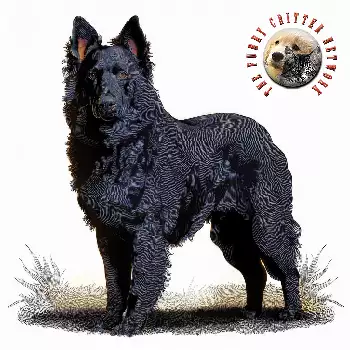
The Hrvatski Ovčar is immediately recognizable by its black curly coat, which gives it a texture somewhere between a coarse-haired terrier and a smaller poodle. The curls range from loose waves to tighter ringlets depending on the individual, and the hair length on the body runs from about 6 to 14 centimeters. The face, ears, and lower legs carry short, smooth hair that creates a clean contrast with the fuller body coat. This combination of short-faced and curly-bodied coat is one of the breed's most distinctive visual signatures.

The body underneath that coat is athletic and compact, built for speed and agility rather than raw power. The Hrvatski Ovčar is slightly longer than tall, with a moderate chest depth that provides plenty of lung capacity without creating the deep keel that increases bloat risk in some breeds. Despite this moderate build, the breed's deep-chested conformation still warrants awareness of gastric torsion, particularly in dogs that eat rapidly. The topline is level, the loin strong, and the croup slightly sloped. Everything about the structure says this is a dog designed to turn quickly, accelerate in short bursts, and keep moving through a long working day.

The head has a wedge shape with a moderate stop and a muzzle that provides good length for scenting without becoming elongated. The expression is alert and inquisitive, driven largely by the triangular prick ears that stand erect and rotate to track sound. The eyes are medium-sized and dark, set slightly obliquely, giving the dog a keen, intelligent look. The nose is always black.

Color is straightforward in this breed. The coat is black. Period. Some individuals show small white patches on the chest, and occasional white hairs may appear on the toes, but the overwhelming impression is solid black from nose to tail. This uniformity means that coat color is never a point of debate among breeders, and all the selection pressure goes toward structure, movement, and temperament rather than cosmetic variation.

Movement in the Hrvatski Ovčar is quick, light, and efficient. The gait at a trot shows good reach and drive without exaggeration, and the dog moves with a nimbleness that reflects its herding style. These dogs manage livestock by running wide arcs and making sharp directional changes, and their structure supports exactly that kind of movement. Watching one work sheep is like watching a dancer who happens to have four legs and a practical job to do.

The tail is naturally variable in this breed. Some individuals are born with a full-length tail that curves upward when active, while others have naturally short tails. Historically, working dogs in Croatia often had their tails docked, though this practice is declining. The standard accommodates both natural tail lengths. Males and females are broadly similar in build, though males tend to be slightly heavier and taller. The overall impression regardless of sex is a compact, agile, highly alert dog that looks ready to sprint at a moment's notice.

Size is worth emphasizing because the Hrvatski Ovčar occupies a sweet spot that many families find appealing. At 30 to 45 pounds and roughly 17 to 21 inches tall, this is a dog large enough to be a credible working partner and small enough to share a couch without displacing everyone else. It fits comfortably in a car, travels easily, and does not require the sheer volume of food that larger herding breeds demand. The moderate size also means fewer orthopedic stresses than you see in breeds pushing 70 or 80 pounds, which contributes to the Hrvatski Ovčar's reputation for physical longevity and sustained soundness well into its senior years. The feet are compact and oval with well-arched toes and tough pads, built for all-day work on varied terrain including the rocky hillsides and soft pastures of the Slavonian countryside.

Affectionate With Family
The Hrvatski Ovčar bonds intensely with its family and particularly with one primary person. This is a dog that wants to be at your heels from morning until night.
Good With Young Children
Patient and watchful around children it knows well, though its herding instinct may prompt it to circle and nudge small kids. Supervision during early interactions is important.
Good With Other Dogs
Generally sociable with other dogs when introduced properly, but its protective nature can make it wary during first meetings. Early socialization smooths these interactions considerably.
Shedding Level
The curly coat traps loose hair better than many double-coated breeds, resulting in moderate shedding. Seasonal coat changes in spring and fall increase hair loss temporarily.
Coat Grooming Frequency
Weekly brushing keeps the wavy coat manageable. The curl pattern resists heavy matting under normal conditions, but neglect during shedding season will create tangles.
Drooling Level
The Hrvatski Ovčar is a clean-mouthed breed with virtually no drooling tendency. Your furniture and clothing are safe.
Coat Type
The double coat features a soft, dense undercoat beneath a medium-length outer coat that ranges from wavy to curly, with hair length varying from about 6 to 14 centimeters on the body.
Openness To Strangers
The Hrvatski Ovčar is naturally reserved around unfamiliar people and needs time to warm up. It takes cues from its owner but will not rush to greet newcomers.
Playfulness Level
This breed maintains a strong play drive throughout its life and especially enjoys games that involve chasing, retrieving, or problem-solving. It is a willing and enthusiastic play partner.
Watchdog/Protective Nature
Centuries of guarding flocks in open country made the Hrvatski Ovčar a vigilant and vocal watchdog. It takes territorial duties seriously and will alert to any perceived irregularity.
Adaptability Level
Adapts well to different environments if exercise needs are met, but thrives most in settings where it has room to run. Extended confinement in tight spaces leads to frustration.
Trainability Level
Quick to learn commands and eager to work with a handler it respects. The Hrvatski Ovčar responds best to confident, consistent training and can be stubborn with hesitant owners.

Hrvatski Ovčar History & Development

The name Hrvatski Ovčar ties this breed directly to the Croatian people and the land they have farmed for over a thousand years. The earliest written documentation appears in 1374, when Bishop Peter Horvat of Djakovo described black curly-coated dogs working livestock in the Slavonian region of what is now eastern Croatia. That these dogs warranted a written description in a church archive suggests they were already a well-established and valued part of agricultural life, not a new or unusual sight.

A second significant document from 1752 by a local veterinarian confirms that dogs matching the same description were still working the same landscape nearly four centuries later. This extraordinary consistency suggests that the Hrvatski Ovčar was not so much bred as it was preserved. The dogs worked. The farmers kept the ones that worked best. The type perpetuated itself because it fit the job and the land perfectly. There was no formal breed club, no written standard, no show ring. Just dogs doing their job, generation after generation.

The origins of the breed's ancestral stock are debated. Some researchers believe the dogs descended from stock brought to the Slavonian region from Greece or Turkey, while others point to broader Balkan herding dog populations. The Hrvatski Ovčar shares some physical similarities with the Hungarian Mudi, a neighboring breed whose range overlaps geographically. Whether the two breeds share common ancestry or simply developed parallel traits in response to similar working demands remains an open question.

The breed's modern chapter begins in the 1930s with Stjepan Romić, a veterinarian and agronomist who recognized that the traditional black sheepdogs of Slavonia needed formal management if they were going to survive the 20th century. Romić began selectively breeding dogs that matched the historical descriptions, working to stabilize the type while maintaining the health and working instinct that centuries of natural selection had produced. His efforts transformed a working landrace into a documented breed with a reproducible standard.

The breed was first exhibited at a dog show in Zagreb in 1949, and Otto Rohr drafted the first formal breed standard in 1951. The FCI granted definitive recognition in 1969. Throughout the 20th century, the Hrvatski Ovčar remained primarily a working dog in rural Croatia rather than a show ring competitor or urban companion. This working orientation preserved the breed's physical soundness and behavioral integrity in ways that breeds subjected to heavy show selection sometimes lose. Today, the Hrvatski Ovčar is gaining slow but steady recognition internationally, though it remains far less common than most herding breeds outside its homeland.

The name itself carries weight in Croatian culture. Hrvatski means Croatian, and Ovčar means shepherd. It is a name that declares ownership and origin with no ambiguity. Unlike breeds whose names reference aristocratic patrons or geographic features, the Hrvatski Ovčar is named for the people and the work. That directness suits a breed that has never been about appearance or prestige but about function, loyalty, and partnership between a dog and the person who depends on it. For anyone searching for this breed by its Croatian name, that search reflects an understanding that the dog and its homeland are inseparable.

Hrvatski Ovčar Temperament & Personality

The Hrvatski Ovčar is a one-person dog living in a family dog's body. It will be friendly and affectionate with everyone in the household, but it picks a person, and that person becomes the center of its world. If you are the chosen one, expect a shadow. This dog will follow you from kitchen to bathroom to garage and back, positioning itself where it can see you at all times. That level of attachment is endearing when you are home and problematic when you are not. Separation anxiety is a real concern in this breed, and it needs to be addressed through gradual conditioning from puppyhood rather than ignored until it becomes destructive.

The working intelligence behind this breed is sharp and fast. The Hrvatski Ovčar processes new information quickly and retains commands with minimal repetition. It reads body language with an accuracy that can feel uncanny, often anticipating what you want before you articulate it. This responsiveness makes training enjoyable but also means the dog picks up on your stress, your hesitation, and your inconsistencies just as readily. If you are uncertain, the dog notices, and it will either step in to fill the leadership vacuum or become anxious depending on its individual confidence level.

Protective instincts run strong. The Hrvatski Ovčar was bred to guard flocks from predators and thieves in open country, and that vigilance translates directly into how it handles its domestic role. It will bark at unfamiliar visitors, position itself between family members and perceived threats, and patrol the property with genuine purpose. This is useful behavior when channeled appropriately and problematic when it becomes reactive barking at every passing jogger. Clear boundaries about what warrants an alert and what does not need to be established early and reinforced consistently.

With other animals, the Hrvatski Ovčar generally coexists well if introductions are handled thoughtfully. Its herding drive is strong enough that it may attempt to manage other household pets, circling cats or nudging smaller dogs into preferred positions. This behavior is instinct, not aggression, but it still needs redirection. The breed's prey drive is moderate, lower than many terrier or sighthound breeds, but a squirrel or rabbit in the yard will absolutely trigger a chase.

The stress pattern in this breed is worth understanding before you commit. A Hrvatski Ovčar that is adequately exercised, mentally engaged, and secure in its relationship with its person is a calm and contented companion. Remove any of those elements and the stress surfaces as barking, destructiveness, pacing, or herding behavior directed at inappropriate targets. Cooperation is the antidote. Give this dog a role, keep its body tired and its mind occupied, and maintain a predictable daily structure. In return, you get loyalty and attentiveness that few breeds can match.

Hrvatski Ovčar Family Life & Living Requirements

The Hrvatski Ovčar does best in a home where it has both a clear purpose and consistent human companionship. This is emphatically not a dog that does well when left alone in a yard for eight hours while the family is at work and school. Its attachment to people is too strong and its need for mental engagement too great to tolerate long stretches of isolation without consequences. If your household has someone home for most of the day, or if you can take the dog with you to work, the Hrvatski Ovčar will thrive.

With children, the breed is generally patient and protective, particularly with kids who are part of its own family. The herding instinct may cause the dog to try circling or nudging small children, which usually alarms the children less than it alarms the parents. Redirect this behavior consistently rather than punishing it, because the dog is not being aggressive, it is doing what several centuries of breeding tell it to do. Older children who participate in training and active play often develop the strongest bonds with the dog because they engage it as a working partner.

Housing requirements lean strongly toward space and access to the outdoors. A house with a fenced yard is the ideal setting. The Hrvatski Ovčar can adapt to apartment living if its exercise demands are met religiously, but this is a breed that really benefits from the ability to patrol a perimeter and move freely throughout the day. Rural and suburban environments suit it best. If you have livestock or a small farm operation, you have just described this breed's dream job.

The breed's barking tendency deserves honest mention in the context of close neighbors. The Hrvatski Ovčar was bred to bark as an alert and to communicate with its handler across open fields. That vocalness does not disappear in a domestic setting. Training can moderate the volume and frequency, but expecting a silent Hrvatski Ovčar is expecting a fish to avoid water. If you live in an apartment or a neighborhood with thin walls and low noise tolerance, factor this into your decision seriously.

Multi-pet households work well as long as the Hrvatski Ovčar is socialized early. It generally gets along with other dogs and can learn to coexist with cats. The herding instinct will surface with smaller animals, so supervision during the adjustment period is warranted. Once the dog understands that the household cat is not a sheep to be managed, the two usually settle into a comfortable coexistence.

Hrvatski Ovčar Training & Exercise Needs

Training the Hrvatski Ovčar is a rewarding experience because the breed genuinely enjoys learning and working alongside its handler. This is a dog that picks up new commands in a handful of repetitions and retains them reliably once learned. The key to successful training is not repetition, it is engagement. The Hrvatski Ovčar needs to feel like training is a collaborative activity rather than a one-sided lecture. Reward-based methods work exceptionally well because they frame the handler-dog relationship as a partnership rather than a hierarchy of commands.

That said, the breed has a streak of independence inherited from centuries of working at a distance from its shepherd. A dog that needed to make split-second decisions about which direction to send a stray sheep did not wait for verbal permission every time. This independence shows up in training as occasional moments where the dog evaluates your request before deciding whether to comply. Firm, calm consistency is the answer. Harsh corrections will damage the dog's trust. Patient repetition from a handler who clearly means what they say earns compliance and eventually enthusiastic cooperation.

Exercise requirements are substantial. The Hrvatski Ovčar was bred to run for hours managing livestock across open fields, and that stamina persists in the modern dog. Plan for at least 60 to 90 minutes of active exercise daily, and know that this is a floor, not a ceiling. Walking alone is not enough. This breed needs activities that engage both body and mind. Agility, herding trials, obedience competition, and fetch games that involve problem-solving are all excellent outlets. The breed excels at canine sports because of its combination of speed, agility, and trainability.

Socialization during puppyhood is critical because the Hrvatski Ovčar's natural wariness toward strangers can harden into reactivity if not addressed early. Expose the puppy to a variety of people, other dogs, environments, sounds, and surfaces during the first four months of life. Keep every experience positive. The goal is a confident adult that evaluates new situations calmly rather than defaulting to alarm barking or avoidance.

One common mistake with this breed is underestimating how much mental stimulation it needs on top of physical exercise. A physically tired Hrvatski Ovčar that has not been mentally engaged will find its own entertainment, and you will not appreciate its creativity. Puzzle feeders, scent work, new trick training, and any activity that makes the dog think serve as essential supplements to physical exercise. Think of it this way: the body needs a run, but the brain needs a job.

Hrvatski Ovčar Health Concerns

The Hrvatski Ovčar is one of the healthier herding breeds you will encounter, and this robustness is a direct benefit of centuries as a working landrace where natural selection did most of the heavy lifting. Dogs that could not work did not breed. Dogs that developed debilitating conditions did not survive to pass those conditions forward. The result is a breed with remarkably few documented genetic health problems. Multiple veterinary sources confirm that the breed has no known breed-specific inherited conditions at this time.

Because the Hrvatski Ovčar is not enrolled in the CHIC program and formal breed-specific health surveys are limited, some conditions may simply be underreported rather than absent. The breed's rarity means smaller sample sizes for health data collection. Responsible breeders compensate by testing for the conditions most commonly seen in medium-sized herding breeds and by maintaining transparent health records that prospective buyers can review.

Common Health Issues

  • Patellar luxation involves the kneecap slipping out of its normal groove - Causing intermittent skipping or persistent lameness depending on severity. Veterinary evaluation during the first two years catches this condition early.
  • Gastric dilatation and volvulus is a life-threatening emergency where the stomach fills with gas and rotates - The breed's moderately deep chest places it in the at-risk category for this condition.
  • Hip dysplasia has been reported at low rates in the breed - Involving abnormal development of the hip joint that can lead to arthritis over time.
  • Retained testicles occur occasionally in males - Where one or both testes fail to descend into the scrotum, increasing cancer risk and warranting surgical correction.
  • Cataracts have been noted in some individuals - Causing progressive lens opacity that can impair vision if left untreated.

Preventive Care & Health Monitoring

  • Hip radiographs before breeding help reduce the incidence of hip dysplasia in future generations and identify dogs that may need joint management early. - Hip radiographs before breeding help reduce the incidence of hip dysplasia in future generations and identify dogs that may need joint management early.
  • Patellar evaluation during routine veterinary visits catches kneecap instability before it progresses to chronic lameness requiring surgery. - Patellar evaluation during routine veterinary visits catches kneecap instability before it progresses to chronic lameness requiring surgery.
  • Feed two or three smaller meals daily instead of one large portion - And avoid vigorous exercise immediately after eating, to reduce the risk of gastric dilatation and volvulus.
  • Annual eye examinations screen for cataracts and other vision issues - Allowing early intervention when treatment options are most effective.
  • Male puppies should be checked for testicular descent by six months of age - With veterinary follow-up if one or both testes have not descended.

Hrvatski Ovčar Grooming & Maintenance

The curly coat of the Hrvatski Ovčar looks like it should be a grooming nightmare, but it is actually more forgiving than most people expect. The wave-to-curl pattern of the outer coat prevents the kind of dense matting you see in straight-coated double-coated breeds, because the curls create natural separation that allows air circulation and reduces tangling. Weekly brushing with a pin brush or wide-toothed comb is sufficient under normal conditions. Focus on the areas where friction occurs, particularly behind the ears, under the front legs, and along the inner thighs, as these spots are the most likely to develop tangles.

During the seasonal coat changes in spring and fall, the undercoat loosens and needs to come out. Increase brushing to every other day during these periods to prevent loose undercoat from getting trapped in the curls and forming mats. A slicker brush followed by a comb works well for pulling out the dead undercoat without damaging the outer coat's curl structure. If you fall behind during shedding season, you may encounter some stubborn mats that need careful detangling with a mat splitter rather than scissors, which would leave visible holes in the coat.

Bathing frequency for the Hrvatski Ovčar should be moderate, roughly every four to six weeks or as needed depending on the dog's activities. The curly coat does collect debris during outdoor work, and a quick rinse after particularly muddy outings saves you the trouble of brushing dried dirt out later. Use a mild dog shampoo that will not strip the coat's natural oils, as these oils help maintain the curl pattern and provide some water resistance. Allow the coat to air dry or use a low-heat dryer to preserve the curl structure.

Beyond coat care, the standard maintenance checklist applies. Trim nails every two to three weeks. Check and clean ears weekly, particularly after outdoor work where grass seeds or moisture could create problems. Establish a dental care routine early, whether that means brushing the dog's teeth several times a week or providing appropriate dental chews and scheduling professional cleanings. The face and lower legs, which carry short smooth hair, require no special grooming attention beyond keeping them clean. Overall, the Hrvatski Ovčar is a moderate-maintenance breed that rewards consistent weekly care with a healthy, attractive coat and clean presentation.