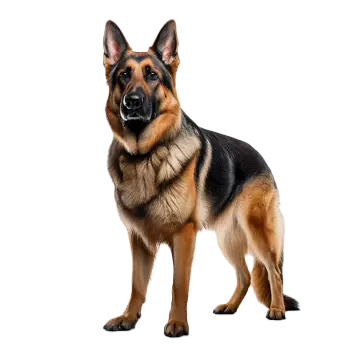
The Giant German Shepherd presents the unmistakable silhouette of the German Shepherd Dog amplified to substantially larger proportions, standing twenty-six to thirty-two inches at the shoulder and weighing anywhere from ninety to one hundred fifty pounds at maturity depending on the individual's frame, sex, and breeding. The visual impression is of a powerful, heavy-boned dog that retains the German Shepherd's characteristic outline, noble head carriage, and alert expression while adding a physical mass and presence that moves the animal out of the large-breed category and into giant-breed territory. Males typically outsize females by a significant margin, and the largest males can rival breeds traditionally classified as giant such as the Great Dane in terms of sheer physical footprint.
Structurally, well-bred Giant German Shepherds tend to present a more moderate angulation than the extreme rear angulation seen in many American show-line German Shepherds. Breeders selecting for increased size often favor straighter backs and more balanced proportions, in part because the extreme slope from withers to croup that has become common in some show lines creates additional mechanical stress on a frame already carrying more weight than the breed was designed for. The best specimens display a level or gently sloping topline, a deep and broad chest, well-sprung ribs that provide ample lung capacity, and strong, straight legs with substantial bone that supports the additional mass without appearing coarse or clumsy.
The head follows the classic German Shepherd wedge shape, broad between the ears and tapering to a strong, deep muzzle. The ears are large, erect, and carried forward when the dog is alert. The eyes are medium-sized, almond-shaped, and dark, conveying an expression of intelligence and confidence. In the largest individuals, the head can appear disproportionately large if the dog's body has not grown to match, a transient phase during the extended growth period that giant-sized dogs undergo. Most well-proportioned Giant German Shepherds achieve a balanced head-to-body ratio by the time they reach full maturity, which may not occur until three years of age or later.
The coat follows standard German Shepherd patterns and may be medium-length stock coat, long stock coat, or the plush long-coat variety that results from the recessive long-hair gene. Colors include the full range seen in standard German Shepherds: black and tan saddle patterns, black and red, sable in various intensities, solid black, black and cream, black and silver, and bi-color patterns. White coats occur but are not accepted in conformation contexts under any German Shepherd standard. The double coat consists of a harsh, weather-resistant outer layer and a dense, insulating undercoat that provides protection across a range of climatic conditions and sheds with remarkable productivity.
Affectionate With Family
★★★★★
The Giant German Shepherd forms exceptionally strong bonds with its household, often shadowing family members from room to room and seeking physical closeness whenever possible. Despite their imposing size, these dogs are remarkably tender with the people they consider their own, and their devotion to family runs deep enough that prolonged separation can trigger genuine distress.
Good With Young Children
★★★★☆
Giant German Shepherds generally interact well with children when properly socialized from an early age, often assuming a gentle and watchful role around younger family members. Their size demands supervision during interactions with small children simply because an enthusiastic nudge from a dog exceeding a hundred pounds can easily knock a toddler over, but intentional roughness toward children is rare in well-bred individuals.
Good With Other Dogs
★★★☆☆
Same-sex selectiveness and a confident bearing can make introductions to unfamiliar dogs a matter requiring careful management, particularly with intact males. Giant German Shepherds raised alongside other dogs from puppyhood typically coexist peacefully, but their size and natural assertiveness mean that disagreements can escalate quickly if not managed by an experienced handler.
Shedding Level
★★★★★
The Giant German Shepherd's dense double coat sheds heavily year-round and produces two dramatic seasonal coat blows each year during which loose undercoat comes out in quantities that seem physically impossible for a single animal. A high-velocity dryer and a quality undercoat rake become essential household tools rather than optional grooming accessories.
Coat Grooming Frequency
★★★★☆
Brushing two to three times weekly keeps the coat in reasonable condition during most of the year, but daily sessions become necessary during the spring and fall coat blows when the undercoat releases in sheets. The sheer surface area of a giant-sized dog means that grooming sessions take meaningfully longer than they would for a standard-sized German Shepherd.
Drooling Level
★★☆☆☆
Giant German Shepherds are not habitual droolers under normal circumstances, keeping their mouths relatively tidy compared to many other giant breeds. Some individuals produce noticeable saliva around mealtimes or when overheated, but persistent drooling is uncommon and may warrant a veterinary check if it develops.
Coat Type
★★★☆☆
The double coat consists of a dense, straight to slightly wavy outer layer that lies close to the body and a thick, soft undercoat that provides insulation against temperature extremes. Some Giant German Shepherds carry the long-coat gene, producing a plush or long-haired variant that is visually striking but requires additional grooming commitment.
Openness To Strangers
★★☆☆☆
Natural wariness toward unfamiliar people is a deeply embedded breed characteristic that the Giant German Shepherd inherits fully from its standard-sized counterpart. These dogs assess newcomers carefully before deciding whether to accept them, and their sheer physical presence makes their reserved demeanor more noticeable than it would be in a smaller dog.
Playfulness Level
★★★★☆
Giant German Shepherds retain a genuine playful streak well into adulthood, engaging enthusiastically in fetch, tug, and interactive games with their families. Their play style can be boisterous given their size, and they bring a physical intensity to games that requires durable toys and a handler prepared for the momentum of a dog that may exceed a hundred pounds at full gallop.
Watchdog/Protective Nature
★★★★★
The combination of the German Shepherd's legendary protective instincts and the imposing physical presence of a giant-sized dog creates one of the most effective natural deterrents available in a family companion. These dogs are constantly aware of their surroundings, alert to unusual sounds and movements, and prepared to position themselves between their family and any perceived threat.
Adaptability Level
★★☆☆☆
The Giant German Shepherd's substantial space requirements, high exercise demands, and sensitivity to prolonged isolation make it a poor candidate for small apartments or highly variable living situations. These dogs do best in homes with secure yards and consistent daily routines, and their size alone creates logistical realities that limit adaptability to compact living arrangements.
Trainability Level
★★★★★
The intelligence and eagerness to work that define the German Shepherd breed translate directly to the giant variant, producing a dog that learns quickly, retains training reliably, and takes genuine satisfaction in working with its handler. Early training is especially critical because managing a poorly trained dog of this size presents challenges that become exponentially more difficult as the dog matures past adolescence.