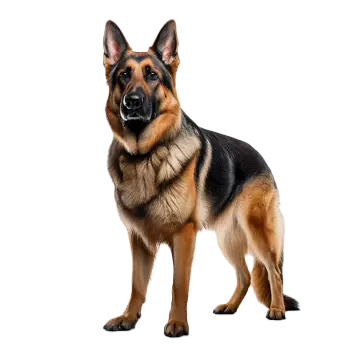
The German Shepherd Dog is a large, well-muscled working dog with a distinctive longer-than-tall outline and a characteristic combination of strength, agility, and elegance. When you see a well-structured GSD in full trot, the impression is of effortless, ground-covering movement - this is a dog bred to travel all day at a sustained pace, and its structure reflects that function. A well-built German Shepherd should look capable and balanced, not exaggerated in any direction.
The head is strong and wedge-shaped, in proportion to the body. The skull is moderately arched and gradually slopes into a long, refined muzzle without an abrupt stop. The muzzle is roughly equal in length to the skull, giving the head a clean, functional profile. The nose is always black. Lips are firmly fitted, dark-colored, and never loose or pendulous. The bite is a strong scissors bite with full dentition; missing teeth are a serious fault. The jaw is strongly developed, providing the gripping force that has made this breed invaluable in protection work.
The eyes are medium in size, almond-shaped, and set slightly oblique. Color ranges from medium to dark brown, with darker eyes preferred by the standard. The expression is keen, intelligent, and composed - the eyes of a dog that is paying attention to everything. Light, yellow, or glassy eyes are considered a fault, as they typically accompany a softer, less confident temperament.
The ears are moderately pointed, in proportion to the skull, and carried erect when alert. Puppy ears may not fully stand until the permanent teeth are in, sometimes taking until five to six months. The ear leather is firm and the ears should be parallel to each other and perpendicular to the ground when the dog is at attention. Soft ears, low-set ears, or ears that fly to the sides are considered faults. The neck is strong, muscular, and relatively long, allowing the head to be extended forward during the breed's characteristic tracking posture.
The body is longer than it is tall - the standard specifies the proportion of body length to height as 10 to 9. The chest is deep, reaching to the elbow, with well-sprung ribs that provide heart and lung capacity without barrel shape. The back is straight, strongly developed, and neither too long nor too short. The withers are higher than and sloping into the level back, a feature that gives the breed its characteristic outline. The loin is broad, strong, and firmly muscled, without weakness or instability under load.
The topline of the German Shepherd has been subject to controversy, particularly in show-bred lines where exaggerated rear angulation has produced a distinctly roached or sloping appearance from withers to croup. The original SV and FCI standards call for a straight back and moderate, functional angulation - not the extreme rear angulation seen in some American show-line dogs. Working-line GSDs and West German show-line dogs typically retain closer-to-standard rear structure.
The tail is bushy and reaches at least to the hock. At rest it hangs in a gentle curve. When the dog is alert or moving it may be carried higher but never above the level of the back. A tail carried high and rigid is a fault. The tail is never docked.
Forequarters are well laid back, with upper arm meeting the shoulder blade at approximately a right angle. The legs are straight and parallel when viewed from the front. Hindquarters show broad, well-muscled thighs with well-bent stifles and low hocks. The feet are compact and well-arched, with hard pads and short, dark nails.
The coat is the double coat standard for northern and herding breeds - a dense, hard outer coat lying close to the body, and a thick, softer undercoat. Coat length varies from the standard medium coat to the long coat, which is a recognized variation in most registries though historically considered a fault in strict show standards. Long-coated GSDs have become increasingly accepted and popular. White German Shepherd Dogs exist and are sometimes called Berger Blanc Suisse or White Swiss Shepherd, now recognized as a separate breed by the FCI. White coloring is a disqualification in AKC GSD competition.
Colors include sable (the most historically common and genetically dominant color), black and tan, black and red, bi-color (largely black with tan on the feet and face), and solid black. Pale, washed-out colors are considered undesirable. Blue and liver are disqualifications in the AKC standard.
The German Shepherd Dog in motion is one of the breed's most distinctive features. The standard calls for a far-reaching, effortless trot that covers maximum ground with minimum effort. The back remains firm and level during movement, and the ideal GSD trots with a smooth, flowing stride that shows reach in front and strong drive behind. The characteristic GSD show-trot at speed, with the dog stretched to its limits at the end of a lead, is a competition style developed for the ring rather than a representation of functional working movement, and knowledgeable breed observers make this distinction.
Affectionate With Family
★★★★★
German Shepherd Dogs form deep, lasting bonds with their families and are genuinely devoted companions. They tend to follow their person from room to room and want to be wherever you are.
Good With Young Children
★★★★☆
Well-socialized GSDs are typically patient and protective with children in their family. Supervision is always important given the breed's size and exuberant energy level with younger kids.
Good With Other Dogs
★★★☆☆
GSDs can coexist well with other dogs when raised together and properly socialized. Undersocialized individuals can become reactive or dog-selective, particularly same-sex dogs in the home.
Shedding Level
★★★★★
This breed sheds heavily year-round and blows its undercoat dramatically twice a year. GSD owners live with dog hair as a fact of life - on furniture, clothing, and floors.
Coat Grooming Frequency
★★★☆☆
The double coat needs brushing two to three times a week under normal conditions and daily during seasonal coat blows. Professional grooming is optional but bathing and thorough brushing are owner-managed.
Drooling Level
★☆☆☆☆
The German Shepherd is a dry-mouthed breed with minimal drooling. The tight lips and clean mouth mean this is not a dog that leaves wet marks on clothing or furniture.
Coat Type
★★★☆☆
The medium-length double coat is functional and weather-resistant but requires consistent brushing to manage shedding and prevent matting behind the ears and around the neck during coat blows.
Openness To Strangers
★★★☆☆
A well-socialized GSD is confident around strangers without being excessively friendly or aloof. The breed assesses new people with a quiet reserve before deciding on approach.
Playfulness Level
★★★★☆
German Shepherds stay playful and engaged well into adulthood, especially with games that involve chasing, fetching, or working with their person. They bring genuine enthusiasm to any activity with their family.
Watchdog/Protective Nature
★★★★★
The GSD is one of the most capable protective breeds in the world, combining alert watchdog behavior with the physical and mental ability to act decisively if needed. This is not a breed that bluffs.
Adaptability Level
★★★☆☆
German Shepherds can adapt to a range of living situations when their exercise and mental needs are met, but they do not thrive in confined spaces with limited activity or owner engagement.
Trainability Level
★★★★★
The GSD excels at virtually every type of training and holds the distinction of being the world's most widely used working dog breed. It is eager to work, quick to learn, and highly responsive to skilled handlers.