German Mastiff

Great Dane

Quick Facts

🐕 Breed Group
Working Group
📏 Size Category
Giant
📏 Height
Males: 30-32 inches minimum, Females: 28-30 inches minimum
⚖️ Weight
Males: 140-175 lbs, Females: 110-140 lbs
⏱️ Life Expectancy
7-10 years
🧣 Coat Type
Short, smooth, dense
🎨 Coat Colors
Fawn, brindle, blue, black, harlequin, mantle
😀 Temperament
Friendly, patient, dependable
🏃 Exercise Needs
Moderate
🎓 Training Difficulty
Moderate
👶 Good with Children
Excellent
🐾 Good with Other Pets
Good with proper socialization

Other Names & Breed Recognition

German Mastiff is arguably the most accurate English name for the breed most people call the Great Dane. The dog has nothing to do with Denmark. It is a German breed through and through, and in its home country it has always been known as the Deutsche Dogge, which translates directly to German Mastiff or German Dog. The persistence of the name Great Dane in English-speaking countries is one of the more peculiar naming accidents in all of dogdom.

The name German Mastiff appears in historical texts, breeding records, and canine literature going back centuries. It accurately reflects both the breed's country of origin and its physical type as a mastiff-class dog. In Germany, the Deutsche Dogge Club was founded in 1888, and the breed has been the designated national dog of Germany since 1876. The FCI registers the breed under its German name, and in most non-English-speaking countries, some variation of "German Dog" or "German Mastiff" is the accepted term.

Other alternate names include Apollo of Dogs, a poetic title that references the breed's noble bearing and impressive stature. Deutsche Dogge remains the formal name in Germany and throughout much of continental Europe. The breed also goes by Dane as a casual shortening. Every major kennel club in the world recognizes this breed, classified in the Working Group by the AKC, the Guardian Dog Group by the UKC, and placed in Group 2 by the FCI among the molossoid breeds of mastiff type.

The disconnect between the breed's actual origin and its most common English name continues to cause confusion. People searching for German Mastiff are often looking for exactly this breed but may not realize that Great Dane is the standard registry name in English-speaking countries. Understanding that German Mastiff and Great Dane refer to the same dog is essential for anyone researching the breed's history, health, or breeding lines, since registries, health databases, and pedigree records all file the breed under Great Dane.

German Mastiff Organizations & Standards

The Deutsche Doggen Club 1888 in Germany is the breed's original parent organization and remains one of the most influential breed clubs in the world. The club established the first official standard for the Deutsche Dogge and has maintained rigorous breeding requirements that emphasize health, temperament, and correct type. In Germany, breeding is regulated more tightly than in many other countries, with requirements for health testing, temperament evaluation, and breed surveys before a dog can be used for breeding. Dogs that do not meet the minimum standard in a breed survey are not approved for breeding, a level of oversight that most countries do not enforce.

In the United States, the Great Dane Club of America serves as the AKC parent club and has been active since 1889, making it one of the oldest breed clubs in the country. The GDCA maintains a Code of Ethics for breeders that includes requirements for health testing and responsible placement of puppies. The club has been instrumental in pushing for health screening protocols and funding research into the breed-specific conditions that affect the German Mastiff's quality of life and lifespan. The GDCA also organizes the national specialty show, which brings together breeders, exhibitors, and breed enthusiasts annually to evaluate breeding stock and share knowledge about health and conformation.

The breed standard describes a dog of great size and noble appearance, combining strength and elegance in a way that distinguishes it from heavier mastiff breeds. Males should stand at least 30 inches at the shoulder and females at least 28 inches, with taller dogs preferred as long as they maintain correct proportion and soundness. The standard emphasizes a rectangular body, a long and narrow head with parallel planes, and a smooth, powerful gait that covers ground efficiently. Color varieties include fawn, brindle, blue, black, harlequin, and mantle, each with specific requirements for markings and pigmentation that breeders take seriously in their programs.

The FCI standard, written under the Deutsche Dogge name, places particular emphasis on the breed's combination of power and refinement. The standard notes that the breed should never appear coarse or clumsy despite its enormous size. Temperament requirements call for a confident, friendly dog that is neither aggressive nor timid. Health testing recommendations from the GDCA include hip evaluation, cardiac screening by echocardiogram, eye examination by a board-certified ophthalmologist, and thyroid testing, all registered through the OFA database. Dogs that complete all four tests receive a CHIC number, which is the standard credential that serious breeders maintain.

Kennel Club Recognition

  • American Kennel Club (AKC): Recognized in 1887, Working Group
  • United Kennel Club (UKC): Recognized, Guardian Dog
  • Canadian Kennel Club (CKC): Recognized, Working Dogs
  • FCI: Recognized, Group 2
  • The Kennel Club (UK): Recognized, Working

German Mastiff Physical Description

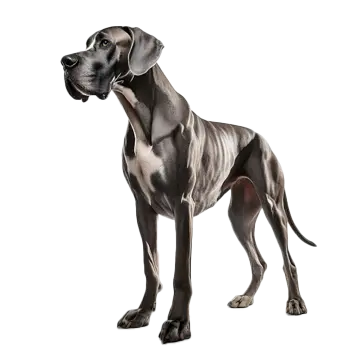
The German Mastiff is one of the tallest dog breeds in existence, and standing next to one for the first time is an experience that photographs simply do not prepare you for. Males routinely stand 32 inches or taller at the shoulder, with some exceptional individuals reaching 36 inches or more. Females are proportionally smaller but still tower over most other breeds. Weight ranges from 110 to 175 pounds depending on sex and build, though some individuals exceed even that upper range. The breed world record for tallest dog has been held by German Mastiffs multiple times, and even average representatives of the breed are dramatically larger than what most people encounter in daily life.

The head is the breed's most distinctive feature when viewed in profile. It is long, narrow, and finely chiseled, with a pronounced stop and parallel planes of skull and muzzle. This refined head shape distinguishes the German Mastiff from the broader, heavier heads of the English Mastiff, Bullmastiff, and other true mastiff breeds. The expression should be alert and intelligent, with medium-sized eyes that are dark in most color varieties. In harlequins and merles, lighter eyes may occur but are not preferred. Ears are set high and may be natural or cropped, with natural ears folding forward close to the cheek in a medium-sized triangular shape.

The neck is long, muscular, and slightly arched, tapering cleanly from the shoulders to the head without excessive dewlap or throatiness. A well-set neck is essential to the breed's elegant profile and should never appear thick or stuffy. The body is powerful and rectangular, with a broad chest that reaches to the elbow and well-sprung ribs that provide ample room for heart and lungs. The deep chest is both a hallmark of the breed and a health consideration, as it contributes to the breed's susceptibility to bloat. The topline is firm and level, rising slightly over the loin. The abdomen tucks up noticeably, giving the breed its characteristic athletic silhouette despite its massive frame.

Legs are straight and strongly boned, with large, round feet and well-arched toes. The forequarters should show good layback of shoulder, allowing for proper reach during movement. The hindquarters are broad and muscular, providing the drive for a surprisingly smooth and ground-covering gait. Movement should be effortless and balanced, with good reach in front and strong push from behind. Any sign of lumber, rolling, or restricted movement is considered a serious fault, and sound movement is a priority for breeders who understand the long-term joint health implications of poor structure.

The coat is short, thick, smooth, and glossy. It lies close to the body and provides moderate protection but is not suited to prolonged exposure in extreme cold. The six recognized color patterns each carry specific requirements that breeders and judges evaluate carefully. Fawn ranges from golden to deep gold with a black mask. Brindle shows a chevron-patterned overlay of black stripes on a fawn base. Blue is a solid steel blue throughout. Black is a glossy pure black. Harlequin features a white base with irregular black torn patches distributed across the body. Mantle shows a black blanket over a white base, resembling a formal cape, with specific requirements for the distribution of white on the collar, chest, and legs.

The tail is long, reaching to the hock, and tapers smoothly from a broad base. It is carried in line with the back or slightly curved upward during movement but should never curl over the back or be carried high like a flag. The overall impression of a well-built German Mastiff is one of power married to elegance, a dog that moves through the world with quiet confidence and unmistakable presence. There is nothing clumsy or lumbering about a properly constructed dog of this breed.

Affectionate With Family
German Mastiffs are deeply devoted to their families. Despite their enormous size, they actively seek physical closeness and are known for leaning against the people they love.
Good With Young Children
Their patience with children is remarkable for a dog this large. Supervision is still important simply because of their size, but the temperament is genuinely gentle.
Good With Other Dogs
Most get along well with other dogs, though some males can be assertive with unfamiliar dogs. Early socialization makes a meaningful difference.
Shedding Level
The short coat sheds moderately year-round. Given the sheer surface area of the dog, that moderate shedding still produces a noticeable amount of hair.
Coat Grooming Frequency
Grooming needs are minimal. A weekly brushing with a rubber curry or bristle brush is typically all that is needed.
Drooling Level
Drooling is a fact of life with this breed. Some individuals drool more than others, but keeping a towel handy is standard practice for most owners.
Coat Type
The coat is short, smooth, and close-fitting. It offers minimal protection in extreme cold, which is worth considering in northern climates.
Openness To Strangers
German Mastiffs are generally friendly and approachable with new people. Their size alone provides a natural deterrent without the dog needing to act aggressive.
Playfulness Level
Playful in a relaxed, good-natured way rather than hyperactive. They enjoy a romp but are equally content to lounge with the family.
Watchdog/Protective Nature
The sheer presence of a German Mastiff is protective in itself. They are alert to unusual activity and will bark to announce visitors or perceived threats.
Adaptability Level
Surprisingly adaptable for their size if given adequate exercise, but they need space to stretch out comfortably. Small apartments are a challenge.
Trainability Level
Responsive and willing to learn when training is consistent and positive. Their sensitive nature means harsh methods backfire quickly.

German Mastiff History & Development

The name German Mastiff tells the breed's story more honestly than Great Dane ever could. The breed originated in Germany, was developed by German breeders, and has been Germany's national dog breed for well over a century. The connection to Denmark that the English name implies simply does not exist in any meaningful historical record.

The confusion appears to trace back to the French naturalist Georges-Louis Leclerc, Comte de Buffon, who encountered a large German hunting dog during travels in Denmark in the 1700s and described it as "Grand Danois" - Great Dane. The name stuck in English and French, despite German breeders consistently calling their dogs Deutsche Dogge. By the time anyone realized the geographic error, the English name was too entrenched to change. German breeders attempted to correct this in 1880 by formally adopting the Deutsche Dogge designation and rejecting all foreign names, but the English-speaking world paid little attention.

The breed's actual ancestors were large hunting dogs used by German nobility to pursue wild boar, deer, and bear. These dogs needed to be powerful enough to hold dangerous game at bay until the hunters arrived, fast enough to keep pace with mounted riders, and brave enough to face animals that could easily kill them. Crosses between English Mastiffs and Irish Wolfhounds are generally credited with producing the foundation stock, blending the mastiff's power with the wolfhound's height and speed. Over generations, German breeders refined this cross into a taller, more elegant dog that retained the strength to work but carried itself with a nobility that appealed to the aristocratic tastes of the era.

In 1876, German breeders formally declared the Deutsche Dogge as Germany's national dog breed and began standardizing the type. The Deutsche Doggen Club was established in 1888, and the first official standard was published shortly thereafter. This standard deliberately moved away from the heavier, coarser mastiff type and toward the more elegant, refined dog we recognize today. The transition was significant enough that the German Mastiff began to look quite different from the English Mastiff, establishing its own identity as a breed that combined size with athletic grace.

The breed's popularity spread rapidly through Europe and into North America in the late 1800s. The AKC recognized the breed in 1887, using the Great Dane name that was already established in English. American fanciers embraced the breed enthusiastically, and the Great Dane Club of America was founded just two years later. The German Mastiff designation continued to appear in literature, show catalogs, and breeding records well into the twentieth century, and it remains the name that most accurately reflects the breed's heritage. Today, the name surfaces most often among breed historians, European enthusiasts, and people who simply want to use the geographically correct title for Germany's most famous dog.

German Mastiff Temperament & Personality

The German Mastiff's temperament is one of the great contrasts in the dog world. Here is an animal that can weigh 175 pounds and stand eye-to-eye with its owner, yet it approaches life with a gentleness and patience that puts many toy breeds to shame. The breed's nickname, the "Gentle Giant," is not marketing - it is an accurate description of how most of these dogs move through daily life.

Bonding with family runs deep. German Mastiffs are not independent dogs that tolerate your company. They actively seek closeness, and the breed's habit of leaning its full weight against the person it loves most is both endearing and something you need to brace yourself for physically. This desire for physical contact extends to sleeping arrangements, and many owners quickly learn that a German Mastiff's idea of personal space does not match the dimensions of a standard dog bed. They will attempt to share the couch, the bed, and your lap despite weighing more than most adult humans.

With children, the breed shows a patience that borders on saintly. They tolerate the noise, unpredictability, and occasional roughness of young kids with a calm steadiness that reflects generations of selection for stable temperament. That said, their sheer size means accidental knockdowns are a real concern with toddlers and small children, and adult supervision is always appropriate. Older children who learn to interact respectfully will find an incredibly loyal and gentle companion who is happy to participate in whatever the family is doing.

Strangers are generally met with friendly curiosity rather than suspicion. German Mastiffs are not naturally aggressive toward people, and their size provides enough deterrent that defensive behavior is rarely necessary. However, they are perceptive dogs that can read situations well, and most will position themselves between their family and a perceived threat without needing to escalate. This natural protective awareness, combined with a deep bark that matches their frame, makes them effective watchdogs without the liability of a genuinely aggressive temperament.

The breed does have a sensitive side that surprises people who expect toughness from such a large dog. Harsh corrections, loud conflict in the household, and chaotic environments can genuinely stress a German Mastiff. They respond best to calm, consistent handling and a home environment that provides emotional stability along with physical comfort. A German Mastiff that lives in a tense household will show it through anxiety, digestive issues, and behavioral changes.

When their social and exercise needs go unmet, German Mastiffs can develop separation anxiety, destructive chewing, and restlessness. A bored dog of this size can do remarkable damage to a home in a short period. The key is consistent daily exercise, regular social interaction, and an owner who understands that this breed needs to feel like part of the family rather than an afterthought confined to the yard.

German Mastiff Family Life & Living Requirements

Living with a German Mastiff requires practical adjustments that go beyond what most breeds demand, starting with the simple reality of space. These dogs need room to move, room to stretch out, and room to turn around without knocking things off tables with their tail. A house with a reasonably sized living area and a fenced yard is the practical minimum. Apartments can work if they are spacious and the dog gets adequate daily exercise, but cramped quarters make life uncomfortable for everyone.

Furniture, vehicles, and doorways all become considerations. Many German Mastiff owners invest in large, supportive orthopedic dog beds to protect joints, SUVs or minivans for transportation, and baby gates that are tall enough to actually contain the dog during initial training. The financial reality is also significant - food costs for a dog that eats four to eight cups of premium food daily, veterinary bills that are scaled to giant breed size, medications dosed by weight, and supplies all add up to a meaningfully higher cost of ownership than most people expect. Giant breed veterinary care including surgery, anesthesia, and medications is consistently more expensive than care for smaller dogs.

With other pets, German Mastiffs are generally easygoing. They tend to coexist peacefully with cats and smaller dogs, especially when raised together. Their prey drive is lower than many breeds, and their energy level is moderate enough that they do not overwhelm smaller housemates with constant chase behavior. Introductions should still be managed carefully, and individual temperament varies, but as a breed they are far more tolerant of multi-pet households than most giant breeds.

The breed's relatively short lifespan is the hardest part of German Mastiff ownership for most people. With an average of seven to ten years, you are making a commitment that is intense but shorter than what most breeds offer. Owners who understand this going in tend to approach each year with intentionality, prioritizing quality time and proactive health care rather than taking the years for granted.

Families who thrive with German Mastiffs are those who genuinely want a dog that is part of daily life, not one that lives separately. These dogs need to be with their people, involved in household routines, and included in family activities. The reward is a companion whose devotion and gentle presence become the emotional center of the household.

German Mastiff Training & Exercise Needs

Training a German Mastiff should start early, while the dog is still small enough to physically manage. A 15-pound puppy that jumps on guests is cute. A 150-pound adolescent that does the same thing is a genuine safety concern. Basic manners, leash walking, and impulse control are the foundation skills that make daily life with a giant breed manageable, and they need to be established before the dog outweighs you.

The breed responds well to positive reinforcement and gentle guidance. German Mastiffs are sensitive dogs, and harsh corrections tend to produce either shut-down behavior or anxiety rather than compliance. Short, upbeat training sessions that end on a positive note work far better than long drills. Socialization is equally important and should expose the puppy to a wide variety of people, places, sounds, and experiences during the critical developmental window between eight and sixteen weeks. A well-socialized German Mastiff puppy grows into a confident adult that handles new situations with composure rather than fear.

Exercise needs are moderate compared to many working breeds, which surprises people given the German Mastiff's size. Adult dogs do well with 30 to 60 minutes of daily exercise, which can include walks, controlled play sessions, and free time in a fenced yard. What matters more than intensity is consistency. A daily routine of moderate activity keeps the dog's weight in check and supports joint health without stressing the skeletal system that is already carrying considerable load.

Growing puppies and adolescents require special attention to exercise limits. The skeletal system of a giant breed takes longer to mature than smaller dogs, and excessive running, jumping, or stair climbing during the growth phase can contribute to joint problems later. Controlled walks on level ground and supervised play with appropriate-sized playmates are better choices than high-impact activities until the dog reaches physical maturity around 18 to 24 months.

Mental engagement matters as well. German Mastiffs enjoy puzzle toys, nose work games, and training sessions that teach new skills. They are not hyperactive dogs that need constant stimulation, but they are intelligent enough to benefit from variety in their routine. A dog that has both physical and mental outlets is a calmer, more contented household companion than one whose days consist of nothing but lounging.

German Mastiff Health Concerns

Health is the area where the German Mastiff asks the most of its owners, both emotionally and financially. The breed's giant size comes with a health profile that requires awareness, preparation, and a strong relationship with a veterinarian who understands the specific needs of giant breeds.

Wobbler syndrome is a neurological condition caused by compression of the spinal cord in the neck, producing an unsteady, swaying gait in the hindquarters. Nutrition during the growth phase plays a role, making proper large-breed puppy diet essential. Treatment options range from medical management with rest and anti-inflammatory medications to surgical intervention in severe cases. Autoimmune thyroiditis, osteosarcoma, and Von Willebrand's disease are additional conditions documented in the breed that warrant awareness and proactive discussion with your veterinarian.

Common Health Issues

  • Gastric dilatation-volvulus - Bloat/GDV, is a life-threatening emergency where the stomach fills with gas and twists, cutting off blood supply. Prophylactic gastropexy surgery can significantly reduce the risk of this condition.
  • Dilated cardiomyopathy - DCM, is a progressive heart disease where the heart muscle weakens and enlarges, eventually failing to pump blood effectively. Annual echocardiograms are the primary screening tool.
  • Hip dysplasia involves improper formation of the hip joint - Causing pain, inflammation, and progressive arthritis. OFA hip evaluation is part of the breed's recommended health testing protocol.
  • Wobbler syndrome - Cervical spondylomyelopathy, causes spinal cord compression in the neck, producing an unsteady gait and coordination problems. Treatment ranges from conservative management to surgery.
  • Osteosarcoma is an aggressive bone cancer that disproportionately affects giant breeds - It typically appears in the long bones of the legs and often requires amputation followed by chemotherapy.
  • Autoimmune thyroiditis results in the immune system attacking the thyroid gland - Reducing hormone production. Regular thyroid blood panels detect the condition, and daily medication manages it effectively.

Preventive Care & Health Monitoring

  • Discuss prophylactic gastropexy with your veterinarian - Ideally performed during spay or neuter surgery. This procedure tacks the stomach to prevent the torsion that makes bloat fatal.
  • Schedule annual cardiac screening by echocardiogram - Not just a stethoscope check. DCM often presents no outward symptoms until the disease is advanced, and echocardiography catches changes early.
  • Complete OFA health testing including hip evaluation - Cardiac exam, eye examination, and thyroid panel. These are the GDCA-recommended screenings registered through the OFA CHIC program.
  • Feed a large-breed-specific puppy food until 18 months of age to moderate growth rate and support proper skeletal development - Avoid all-life-stages diets that do not account for giant breed growth patterns.
  • Maintain lean body condition throughout the dog's life. Excess weight stresses joints - Increases bloat risk, and shortens an already limited lifespan. Your veterinarian should be able to feel the ribs easily under a thin layer of tissue.
  • Avoid vigorous exercise immediately before and after meals to reduce bloat risk - Feed two or three smaller meals per day rather than one large meal.

German Mastiff Grooming & Maintenance

The German Mastiff's short, smooth coat is one of the easier aspects of owning this breed. A weekly brushing with a rubber curry brush or soft bristle brush removes loose hair and keeps the coat looking healthy. During seasonal shedding periods in spring and fall, a daily once-over with a shedding tool helps manage the increased hair loss. Despite the coat being short, the sheer surface area of a dog this size means shedding produces more volume than you might expect from a smooth-coated breed.

Bathing is needed only occasionally, perhaps once a month or when the dog gets into something messy. The coat does not trap odor the way longer or thicker coats do, so frequent bathing is unnecessary and can dry out the skin. Use a mild dog shampoo and make sure to rinse thoroughly, since soap residue on a large dog is easy to miss and can cause irritation. Many owners find that bathing a German Mastiff is easiest in a walk-in shower or outdoors with a hose during warm weather.

Drool management is a daily reality for most German Mastiff owners. Keeping towels positioned near water bowls, food stations, and favorite resting spots saves cleanup time. Some owners carry a small towel during walks for post-drink wipedowns. The amount of drool varies between individuals, but it is a consistent enough feature of the breed that prospective owners should consider their tolerance honestly before committing.

Ear care involves weekly checks and gentle cleaning with a veterinarian-approved solution. Natural ears that fold forward can trap moisture and debris, so paying attention to ear health prevents infections from developing. Nail trimming should happen every two to three weeks, and given the size of the dog, many owners prefer to use a rotary grinding tool rather than traditional clippers. Dental care follows standard recommendations - daily brushing is ideal, supplemented by dental chews and professional cleanings as needed. Giant breeds can be prone to dental issues, so consistent oral hygiene matters more than many owners realize.