Gascon Saintongeois

Gascon Saintongeois

Quick Facts

🐕 Breed Group
Hound Group
📏 Size Category
Large
📏 Height
Males: Grand: 25.5-28 inches | Petit: 22-24 inches, Females: Grand: 24-26 inches | Petit: 21-22 inches
⚖️ Weight
Males: Grand: approximately 77 pounds | Petit: approximately 55 pounds, Females: Grand: approximately 66 pounds | Petit: approximately 48 pounds
⏱️ Life Expectancy
12-14 years
🧣 Coat Type
Short, dense, flat coat
🎨 Coat Colors
White with black patches and black ticking; tan markings on cheeks, inner ears, and legs
😀 Temperament
Calm, Determined, Affectionate, Courageous, Sociable, Vocal
🏃 Exercise Needs
High
🎓 Training Difficulty
Moderate
👶 Good with Children
Good with older children; exuberant size requires supervision with toddlers
🐾 Good with Other Pets
Excellent with other dogs; strong prey drive toward cats and small animals

Other Names & Breed Recognition

The Gascon Saintongeois takes its name from two historic regions of southwest France: Gascony (Gascogne in French) and Saintonge, which is the old name for the area around Saintes in the Charente-Maritime department. The name is both a geographic description and a tribute to the two breed lines that were combined to create it in the 19th century. In French, the breed is sometimes written as the Grand Gascon-Saintongeois or Petit Gascon-Saintongeois, depending on which variety is being referenced, and you will see both hyphenated and unhyphenated spellings in breed club documentation. In everyday French hunting circles, the dogs are often simply called Gascons.

The breed exists in two distinct varieties based on size and the game they were developed to hunt. The Grand Gascon Saintongeois is the larger of the two, developed for pack hunting of large game - wild boar, roe deer, and historically wolf. The Petit Gascon Saintongeois is the smaller variety, developed in the mid-20th century when hunters selected smaller individuals from Grand litters and bred specifically for hare and rabbit hunting, though the Petit retains enough ability to be used on large game as well. The two varieties share the same breed standard with adjustments for size, and in French and international breed documentation they are generally treated as one breed in two sizes rather than as separate breeds.

Recognition by major kennel clubs is limited. The FCI, which governs breed standards for much of the world outside the United States and United Kingdom, formally recognized the Gascon Saintongeois in 1963 under FCI standard number 21. Both the Grand and the Petit are recognized within Group 6, Section 1, among the scenthounds. The FCI standard was updated as recently as August 2023, reflecting the ongoing engagement of French breed clubs with international standards. The United Kennel Club in the United States recognized both varieties in 1993, placing them in the Scenthound Group. The American Kennel Club does not currently recognize the Gascon Saintongeois, and the breed is not part of the AKC Foundation Stock Service. The Kennel Club in the United Kingdom does not recognize the breed either. This limited recognition outside France reflects both the breed's rarity outside its country of origin and its status as primarily a working hunting dog maintained by hunting enthusiasts rather than a general companion breed.

Gascon Saintongeois Organizations & Standards

The Gascon Saintongeois is governed in France by the Club du Chien d'Ordre, which oversees the breed alongside other traditional French pack hounds. The French hunting establishment maintains strong influence over this breed's development because the dog's function as a pack hunting hound is the primary reason it exists. Breed club emphasis is on hunting ability, working conformation, and pack temperament - the qualities that make a dog useful in the field - rather than on exhibition or companion qualities, though the breed has demonstrated that it can be an effective companion when properly exercised.

The FCI breed standard describes both varieties in considerable detail. The standard opens by establishing the breed's character: it calls for an excellent pack dog with a fine nose, wide-ranging scope in the field, and a sonorous voice. That last quality - the voice - is specifically written into the breed standard, which reflects how central a hound's bay is to its function in pack hunting. A hound that does not speak on scent, or that speaks poorly, is of limited value to a pack hunter. The Gascon Saintongeois is expected to have a deep, musical, resonant voice.

Physically, the FCI standard for the Grand calls for males measuring 65 to 72 cm at the withers (approximately 25.5 to 28.3 inches), with females slightly smaller at 62 to 68 cm (approximately 24 to 26.8 inches). The Petit is specified at 52 to 60 cm for males and 50 to 56 cm for females. The Grand weighs approximately 35 kg (77 lbs). Both varieties are described as combining muscular force with elegance - a phrase that captures the breed's characteristic appearance well. The standard emphasizes a harmonious, balanced dog with substance and staying power, not a dog of exaggeration in any direction.

The breed standard also makes an explicit allowance for working scars. The UKC standard notes that scars from field work - cuts and notches on ears, fraying from brush contact - shall not be considered faults and should not be penalized by judges. This provision, which exists in the standards of several traditional European hunting hounds, reflects an honest acknowledgment that a dog used for its intended purpose will bear evidence of that work. It also tells you something about the culture surrounding this breed: it is maintained by hunters who actually use it, not by breeders primarily concerned with cosmetic perfection.

Health testing protocols for the Gascon Saintongeois are not standardized through a formal program equivalent to OFA/CHIC, which applies primarily to AKC-recognized breeds. French breed clubs and the FCI encourage good breeding practices and working evaluations, but the breed's health testing infrastructure is less formalized than for many North American breeds. Hip evaluation and general health assessment by a veterinarian before breeding is considered responsible practice.

Kennel Club Recognition

  • United Kennel Club (UKC): Recognized, Scenthound Group
  • FCI: Recognized, Group 6

Gascon Saintongeois Physical Description

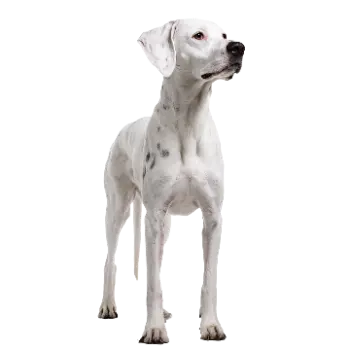
The Gascon Saintongeois presents with immediate presence - a dog of genuine size and substance, combined with a distinctive elegance that prevents any impression of coarseness. The silhouette is that of a classic French scenthound: long in body, leggy, deep-chested, with a level topline and a tail carried in the characteristic sabre curve. This is a dog built for a sustained, ground-covering gallop rather than explosive acceleration, and the proportions reflect that purpose precisely.

The head is elongated and refined - this is not a broad, blocky hound head but a long, lean skull with a slightly convex muzzle of nearly equal length. The stop is only slightly pronounced, giving the skull and muzzle a relatively continuous profile. The lips are moderately pendulous, covering the lower jaw with discreet corners rather than the heavy, exaggerated flews seen in some other hound breeds. The nose is black, well-developed, and wide-nostriled - the tool of the dog's trade, built for maximum scent intake.

The ears are set below eye level, long, thin, and curled - they are pendant and reach well down the neck, giving the dog one of its most visually distinctive features. The ear leather is fine. When a Gascon Saintongeois is on scent, the ears serve a functional purpose: they are thought to help funnel airborne scent particles toward the nose as the dog moves through cover. Whether this is fully supported by physiology or is romantic tradition, the effect of those long ears moving forward as the dog works a trail is unmistakable.

The eyes are oval and dark brown, set obliquely in the skull, and ringed with dark pigment. The expression is attentive and intelligent. Two small, pale tan spots above the eyes - called pips or sourcils in French breed documentation - give the dog a permanently quizzical look that many people find charming. The pips are a consistent feature of the breed and are expected in the standard.

The neck is of moderate length and thickness, slightly arched, with a slight dewlap. It flows into well-inclined shoulders that allow the breed's characteristic reaching trot. The body is long, with a deep, broad chest and slightly rounded ribs. The loin is slightly arched and muscular, and the flanks are fairly long. This combination of long body, deep chest, and well-tucked flank gives the breed a lean, athletic appearance without any appearance of weakness or inadequate substance.

The tail is well-set, elegant, and carried in a sabre fashion - held slightly above back level and gently curved rather than curled or carried flag-high. It is very slender at the tip. The tail carriage is one of the breed's distinctive visual characteristics and is expected to be carried in this sabre position during work and when the dog is alert.

The coat is short, dense, and flat-lying. It provides effective protection against briars and thorns without the maintenance burden of longer coats. The color pattern is one of the breed's most striking features: a white ground with black patches, black ticking distributed through the white, and specific tan markings. Two black patches appear on the sides of the head, covering the ears and the area around the eyes and ending at the cheeks. The cheeks themselves are tan - the standard specifies that this tan should be pale in color. The tan pips above the eyes, the tan on the inner surface of the ears, and tan speckling on the legs complete the pattern. The overall effect is striking: a predominantly white dog with this distinctive tricolor pattern that is immediately recognizable as the breed's hallmark.

The breed is notably dimorphic between the sexes. Males are heavier-boned, broader-headed, and more substantial throughout. Females are lighter and more refined, but should not give any impression of weakness. The UKC standard makes clear that neither heavy coarseness in males nor excessive refinement in females is desirable - both sexes should appear capable of sustained field work.

The movement at the trot is free-reaching and effortless. A correctly built Gascon Saintongeois covers ground with a long, elastic stride that reflects adequate angulation front and rear. The back remains level in motion and the tail maintains its characteristic sabre position. This is a dog that can maintain a working trot for hours across varied terrain - the gait is not flashy or exaggerated, but it is powerful and sustainable. In the field, this breed often works at a gallop when the scent is hot, shifting back to a ground-covering trot between bursts of speed on difficult ground.

Affectionate With Family
Calm and genuinely affectionate with the people it knows well. Not a velcro dog in the sporting-breed sense, but warm, devoted, and keen for human company.
Good With Young Children
Patient and gentle in temperament, but the Grand's considerable size means small children can be knocked over unintentionally. Better suited to families with older children.
Good With Other Dogs
A natural pack dog through centuries of breeding. Gascon Saintongeois thrive with canine company and are reliably easy with other dogs of similar size.
Shedding Level
Light to moderate shedding from the short, dense coat. No seasonal blowout to speak of. Weekly brushing manages it comfortably.
Coat Grooming Frequency
One of the lowest-maintenance coats in any breed. A weekly brush and occasional wipe-down after field work covers routine care.
Drooling Level
Moderate drooling is typical, particularly around food or after water. The pendant lips are not as pendulous as in some other hound breeds, keeping drool at manageable levels.
Coat Type
Short, flat, and dense - a field-practical coat requiring virtually no professional maintenance.
Openness To Strangers
Neither suspicious nor immediately eager. This breed takes a measured approach to unfamiliar people, typically warming up once comfortable with the situation.
Playfulness Level
Playful in the way that pack hounds are - engaged and enthusiastic in the company of other dogs, somewhat more reserved indoors without active stimulation.
Watchdog/Protective Nature
Will alert with the breed's characteristic resonant bay, which is itself an effective deterrent. Not a protective guardian by training or instinct.
Adaptability Level
Best suited to rural or suburban living with space. This is a traditional working hound that thrives with land, exercise, and canine company - not an urban apartment dog.
Trainability Level
Intelligent and willing but independent in the way of scenthounds generally. Nose-driven decision-making and a preference for self-direction require patient, consistent handling.

Gascon Saintongeois History & Development

The Gascon Saintongeois exists because of one of the more dramatic near-extinction events in the history of French hunting hounds. Before the French Revolution, the Saintongeois hound - a large, distinguished pack hound developed in the Saintonge region of western France - was maintained by the French aristocracy as a premier hunting dog for large game. When the Revolution swept away the ruling class that had patronized these dogs, the breed's numbers collapsed almost overnight. By the time the political upheaval had settled, only three individuals of the old Hound of Saintonge type had survived: two males and a female.

This is where Count Joseph de Carayon-Latour enters the story. Working from his chateau at Virelade in the Gironde in the mid-1840s, the Count obtained those three surviving Saintongeois hounds and set about rebuilding a working pack. His solution was to cross them with the Grand Bleu de Gascogne, another historic French scenthound that had survived the Revolution in greater numbers. The offspring that showed the characteristic white coat with black ticking - rather than the Bleu's distinctive blue-ticked coat - were selected and kept. These dogs were given the name Gascon Saintongeois, honoring both parent breed regions.

The reconstructed breed succeeded in the field. The Gascon Saintongeois proved itself on roe deer, wild boar, and large game generally, and attracted enough interest among French hunting families to be sustained through the 19th and early 20th centuries. However, this was always a breed kept by a limited, specialized community of pack hunters with access to large tracts of game country. It never became a broadly popular breed, and numbers outside France remained minimal.

The Petit Gascon Saintongeois was developed in the mid-20th century, when hunters in the southwest of France began selecting the smaller individuals from Grand litters and breeding them specifically for hare and rabbit hunting. The smaller size made these dogs more practical for the type of hunting that had become most common as large game became scarcer and hunting estates contracted. The Petit was informally developed and eventually recognized as a distinct variety of the same breed. It was bred with some infusion of Ariege hound blood to stabilize the smaller size.

FCI formal recognition came in 1963. UKC recognition of both varieties followed in 1993. Today the breed is rare even in France, maintained almost exclusively by hunters and traditional pack hound enthusiasts. It has made almost no impact on companion dog culture in North America or the United Kingdom, and finding a puppy outside France or perhaps Quebec requires significant effort and research. This rarity is simultaneously a health advantage - the breed has not been subjected to mass commercial breeding - and a practical challenge for anyone interested in owning one.

The Gascon Saintongeois stands today as one of the most direct links to the classical French pack hunting tradition. Its survival through the Revolutionary period, its reconstruction by a dedicated individual from a tiny founder population, its selection by practical hunters over more than a century, and its current status as a rare but genuinely functional hunting breed make it one of the more historically interesting dogs in the scenthound group. It is a breed that has earned its place and maintains it through performance rather than fashion.

The Grand and Petit varieties are rarely seen together in the same kennel today outside of their home regions. Those who seek them out typically do so through French hunting breed clubs, occasional imports, or through the small number of breeders in Quebec who maintain the tradition that was established when the breed arrived in Canada. Patience and a willingness to work through breed club contacts are required to find a puppy from health-conscious breeders with documented working history.

Gascon Saintongeois Temperament & Personality

The Gascon Saintongeois is described in French breed documentation as calm, affectionate, and agreeable - and this accurately captures the breed's character in a home environment with sufficient exercise and canine company. This is not a high-strung or anxious hound. At rest, it is dignified and settled. In the field, it is determined, courageous, and committed to the trail. The transition between these two modes is more dramatic than in many sporting breeds, which is part of what makes pack hounds interesting to own.

The breed's social nature is rooted in its history as a pack hunting dog. For centuries, Gascon Saintongeois hounds lived and worked in groups. They read other dogs fluently, manage canine social dynamics with ease, and genuinely prefer canine company to being alone. A single Gascon Saintongeois kept without another dog will be noticeably less settled and content than one living with canine companions. This is not a breed for someone who wants a single-dog household with long daily absences.

With people, the breed is warm and affectionate within its family but not exuberantly demonstrative in the way of many sporting breeds. It will seek contact, appreciate petting, and be clearly content in the company of its people, but it does not have the perpetually tail-wagging, attention-seeking energy of a Golden Retriever or a Labrador. The emotional register is more reserved - engaged, calm, and genuine rather than effusive.

The voice is worth discussing honestly. The Gascon Saintongeois has a deep, resonant, melodious bay that is considered one of the breed's finest qualities among pack hunters. In a rural setting, this voice is music. In a suburban neighborhood, at 3 AM when the dog has detected an interesting scent on the night air, it is a significant noise complaint waiting to happen. This breed will vocalize. It will bay when on scent, when bored, when isolated, and sometimes simply because it feels like it. Prospective owners who live in close proximity to neighbors need to factor this in carefully.

With strangers, the breed is neither suspicious nor immediately eager. It takes a measured, dignified approach - not the immediately friendly bounce of a flat-coated retriever, not the wariness of a livestock guardian. Most Gascon Saintongeois will warm to visitors after a brief assessment, responding well to calm, quiet interaction. Aggression toward people is not a characteristic of the breed.

The prey drive toward small animals is strong and should be taken seriously. Cats, small dogs, and any small furry animal moving through the yard activates centuries of hunting instinct that recall is unlikely to override without exceptional training. Management rather than training is the more reliable strategy for households that include small animals.

This is ultimately a breed for someone who appreciates what a traditional French pack hound is - a dog of dignity, determination in the field, and genuine calm affection at home, with the vocal expression and independence that have always been part of the package. Approached with appropriate expectations and provided with adequate exercise and canine company, the Gascon Saintongeois is a remarkably rewarding and manageable companion. Approached as a large retrieving breed or a family dog that will tolerate whatever comes, it will disappoint.

One practical note on daily life: this breed is quieter than its reputation for bay suggests when its needs are met. A Gascon Saintongeois that is well-exercised, has canine company, and is not being left alone in stimulus-rich outdoor environments does not vocalize continuously. The howling that gives neighbors trouble typically comes from an under-exercised, isolated dog expressing its distress through the only communication tool it has. Provide what this dog needs and the voice is something you appreciate rather than dread.

Gascon Saintongeois Family Life & Living Requirements

The Gascon Saintongeois is fundamentally a country dog. It needs space, outdoor access, and ideally other dogs. The ideal living situation is a rural or semi-rural property with a securely fenced yard - fencing should be at least five to six feet, because a hound on a scent trail will test boundaries that seem adequate until they are not. The breed is not suited to apartment living under any reasonable interpretation of that lifestyle.

Exercise requirements are substantial. Plan on at least an hour of active outdoor exercise daily - free running in a safe area, long walks on trails, or actual hunting. This is a dog built to cover miles at a trot across varied terrain, and a leash walk around a suburban block does not constitute adequate exercise. Dogs that are hunting regularly in season are often the most settled at home, because the field work satisfies drives that other forms of exercise only partially address.

With children, the breed's calm temperament is an asset, but size and energy in motion are a consideration. The Grand Gascon Saintongeois at full size is a big, athletic dog, and young children can be knocked over during enthusiastic greetings or play. Families with children old enough to hold their own generally fare very well. The breed does not tend toward the kind of unmanaged, chaotic energy that makes some sporting breeds problematic around small children - but supervision is sensible regardless.

With other dogs, this is one of the easiest breeds imaginable. Gascon Saintongeois are genuinely pack animals and navigate canine social dynamics naturally and smoothly. Multi-dog households with large dogs are ideal. The situation becomes more complicated with small dogs, because the size differential can lead to unintentional injury during play, and the breed's prey drive may make very small dogs seem like game rather than companions.

Isolation is this breed's primary behavioral risk. A Gascon Saintongeois left alone for long periods without canine company will howl, pace, and potentially develop destructive habits. This is not a behavior problem in the conventional sense - it is a pack animal expressing distress at the absence of its pack. The solution is canine company, adequate exercise, and not leaving this dog alone for extended periods. Prospective owners should be honest with themselves about their daily schedules before committing to a breed with this level of need for social contact.

This breed is not for first-time dog owners. Its independence, its voice, its exercise requirements, its need for canine company, and its prey drive toward small animals all require an owner who has experience with scent hounds or pack breeds and who understands what they are managing. The Gascon Saintongeois rewards experienced, engaged owners with a calm, devoted, elegant companion. It punishes neglect or mismatched expectations with considerable noise and chaos.

Gascon Saintongeois Training & Exercise Needs

Training a Gascon Saintongeois requires an understanding of how scenthound intelligence works. This is not a herding breed that watches its handler constantly, or a retrieving breed that frames its decisions around pleasing a person. It is a nose-driven hunter that was bred to make independent decisions while on scent - decisions that historically had to be made faster than any handler could direct. That independence is a feature in the field. In a training context, it means the dog will choose its own agenda when the owner's instruction conflicts with something interesting in the environment.

This does not make the breed untrainable - it is genuinely intelligent and can learn a substantial command vocabulary and behavioral expectations. What it means is that training requires patience, consistency, and realistic expectations. Food motivation is strong and is your most reliable training tool. Keep sessions short and productive. End on success. Do not attempt to train this breed through harsh corrections or compulsion - the breed's dignified temperament does not respond productively to it, and you will simply create an anxious, avoidant dog rather than a compliant one.

Recall is the primary practical training challenge with this breed. A Gascon Saintongeois that has put its nose down on a scent trail has essentially disengaged from the world above ground level. Coming when called requires that the dog value returning to you more than it values following the trail - and that is a training project that takes consistent work and management, not a behavior that develops naturally. The practical solution for most owners is reliable fencing and leash management rather than off-leash freedom in unsecured areas.

Early socialization is important. Expose puppies to varied people, environments, and sounds from the first weeks of ownership. This breed is not prone to generalized fearfulness, but a hound puppy that grows up in a very limited environment can become reactive to novelty in ways that are inconvenient. Well-socialized Gascon Saintongeois are calm, confident, and easy to manage in varied settings.

Exercise for this breed means distance and sustained movement rather than brief intense bursts. Trail hiking, free-running in secure areas, hunting, and leash walking at a pace that allows for sniffing and exploring all serve the breed well. Mental stimulation through nose work activities - tracking, trailing, hunting-oriented games - satisfies something that pure physical exercise does not fully address. A tired Gascon Saintongeois is a settled Gascon Saintongeois; an under-exercised one is a vocal, restless problem.

For owners interested in formal activities beyond hunting, tracking is the sport most naturally aligned with this breed's instincts. Nose work competitions, tracking tests, and hunting tests through organizations that recognize scent hounds provide structured outlets for the breed's driving ability and give handler and dog a shared goal that builds the relationship. A Gascon Saintongeois that has a job - even a recreational one - is consistently better-behaved and more content at home than one without.

Gascon Saintongeois Health Concerns

The Gascon Saintongeois is among the healthier breeds in its size class, with a documented lifespan of 12 to 14 years - commendable for a large dog. The breed's centuries of selection by practical hunters rather than for cosmetic traits, combined with its relatively limited population maintained by a dedicated specialist community, have helped preserve constitutional soundness that many more popular breeds have lost. There are no breed-specific genetic conditions documented with the same clarity as in some more researched breeds.

As a traditionally kennel-kept pack breed, the Gascon Saintongeois is robust and practically oriented. The health care approach that serves this breed best is straightforward: adequate exercise, appropriate feeding, routine preventive veterinary care, and consistent ear management.

Common Health Issues

  • Ear Infections - Otitis Externa, : The long, pendant ear flaps restrict airflow to the ear canal, creating conditions that favor bacterial and yeast infections when moisture or debris accumulates. Weekly ear checks and prompt cleaning significantly reduce frequency.
  • Hip Dysplasia: A reasonable concern in the Grand variety given its large size. Breed-specific statistics are not available through formal OFA programs - But responsible breeders evaluate breeding stock for hip soundness before pairing.
  • Gastric Dilatation-Volvulus - Bloat, : The Grand Gascon Saintongeois's deep chest places it in the category of breeds at elevated risk for this life-threatening condition in which the stomach fills with gas and rotates, cutting off blood supply.
  • General Musculoskeletal Wear: A breed used for active hunting over rough terrain may experience joint wear - Soft tissue injuries, and the normal physical wear of a working dog's career. Regular veterinary assessment and appropriate weight management help manage this over time.

Preventive Care & Health Monitoring

  • Weekly ear checks with prompt cleaning using a veterinary ear cleaning solution - Dry ears thoroughly after any swimming or hunting in wet conditions to prevent chronic otitis externa.
  • Hip evaluation by a veterinarian for breeding dogs - Ask breeders about the hip soundness of both parents before purchasing a puppy.
  • Feed the Grand variety two measured meals per day rather than a single large meal - And avoid vigorous exercise for an hour before and after feeding to reduce bloat risk. Discuss prophylactic gastropexy with your veterinarian.
  • Regular veterinary examinations including screening for tick-borne diseases - Which are a practical concern for any hunting dog working in tick-endemic environments.

Gascon Saintongeois Grooming & Maintenance

The Gascon Saintongeois has one of the most low-maintenance coats of any large breed. The short, dense, flat-lying coat does not mat, does not require professional trimming, and does not accumulate the field debris that feathered coats collect. A weekly brush with a rubber grooming mitt or a firm bristle brush removes loose hair and keeps the coat clean and healthy-looking. After hunting or heavy outdoor activity, a wipe-down and a brief check for ticks and embedded thorns is the appropriate care. The coat dries very quickly and does not hold moisture close to the skin the way a thicker coat would.

Bathing needs are minimal. Monthly bathing is adequate for most dogs, with more frequent bathing as needed after hunting in particularly dirty conditions. The coat's natural density and tight lay help it shed mud and debris once it dries. This dog was built to work in varied terrain across extended seasons, and the coat reflects that functional requirement.

Ear care is the area of the Gascon Saintongeois's grooming routine that demands the most consistent attention. The long, pendant ears must be checked weekly and cleaned promptly when wax, debris, or moisture is present. Dogs that are hunted in wet conditions or that swim should have their ears dried and checked after each outing. The specific concern is the development of otitis externa - infection of the outer ear canal - which becomes chronic and increasingly difficult to manage if not caught early. Use an appropriate veterinary ear cleaning solution; do not use cotton swabs that can push debris deeper. If the ear smells bad, appears red or inflamed, or if the dog is scratching at its ear or shaking its head, a veterinary visit is warranted promptly.

Nail trimming every three to four weeks is standard. Working dogs that hunt on hard terrain will wear nails naturally; dogs in softer environments will need more consistent attention. Dental care - brushing or equivalent dental hygiene products - is part of overall health maintenance. Routine grooming sessions provide the opportunity to run hands over the dog's body, checking for new lumps, skin issues, or the kind of embedded foxtails or thorns that can create problems if left in place after field work.