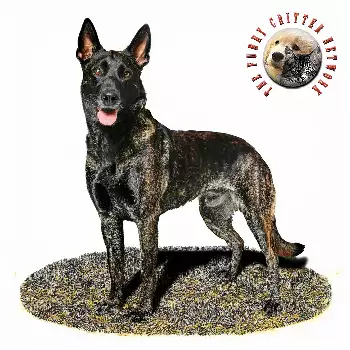
The Dutchie is a medium-sized, well-proportioned working dog that looks exactly like what it is: a dog built to work all day across demanding terrain. Standing 21.5 to 24.5 inches at the withers and weighing 45 to 70 pounds depending on sex and individual build, the Dutch Shepherd sits in the same general size range as the German Shepherd and Belgian Malinois, with which it is most frequently confused by observers who do not know the breed. The brindle coat color is the quickest identifier - no other shepherd breed carries that gold or silver brindle pattern, and experienced observers can identify a Dutchie at distance from that alone.
The head is wedge-shaped with a relatively flat skull, a moderate stop, and a muzzle that is roughly equal in length to the skull. The eyes are almond-shaped, typically brown to gold, and carry an expression that experienced owners describe as alert and intelligent - the look of a dog that is evaluating everything around it. The ears are medium-sized, triangular, and carried erect, adding to the attentive, focused quality of the face.
The neck is well-muscled and slightly arched, flowing smoothly into well-laid-back shoulders. The topline is level and firm. The chest is deep with good rib spring, providing the lung capacity for sustained physical work. The hindquarters are well-angulated with strong, muscular thighs. The overall construction is that of a dog built for endurance - not heavily muscled in a way that would impede speed, but solidly developed in every load-bearing joint and muscle group. The feet are round with well-arched toes and thick, hard pads.
Three coat varieties exist within the breed, all sharing the characteristic brindle coloration. The short-haired variety is the most common and the type most typically seen in working K-9 roles. The coat lies close to the body, is fairly hard in texture, with a dense woolly undercoat, and has visible ruff, breeches, and tail plume. The long-haired variety has a straight, well-fitting coat throughout, harsh to the touch, without curl or wave, with distinct ruff, breeches, and abundant tail coat. The rough-haired variety has a harsh, tousled, dense coat that should not be wiry or curly, covering the entire body with visible ruff, mustache, and beard.
The brindle coloration in all three varieties appears as a base of gold or silver with darker brindle striping that gives the coat a layered, complex appearance. The depth and distribution of brindle varies between individuals. Some dogs show heavy, dramatic striping while others carry a more subtle pattern, but all should be clearly recognizable as brindle. Any color other than gold brindle or silver brindle is considered a fault or disqualification under the breed standard.
In movement, the Dutch Shepherd covers ground efficiently at a trot that can be maintained for extended periods. The gait reflects the breed's herding origin - reaching and driving without excess, maintaining a level topline, and projecting the tireless quality that made this dog valuable to Dutch shepherds and farmers.
The overall impression of a well-built Dutchie is of a dog that is simultaneously athletic and balanced - not overdone in any direction, capable of switching from a sustained trot to explosive acceleration without the structural compromise that often comes from extreme development in either direction. Size and substance should be appropriate to function: a dog that is too heavy lacks the agility the breed needs, while a dog that is too fine in bone lacks the strength for sustained demanding work. The breed should look capable and ready - not glamorous, not extreme in any direction, but genuinely functional in the way that only a breed maintained through working selection over generations tends to produce.
Affectionate With Family
★★★★★
The Dutchie is deeply devoted to its family and forms powerful bonds with the people in its inner circle. This loyalty is one of the most consistently praised traits among Dutch Shepherd owners.
Good With Young Children
★★★★☆
With proper socialization, Dutchies are generally good with children in their family. Their athletic build and high energy mean interactions with very young children should be supervised to prevent accidental knockdowns.
Good With Other Dogs
★★★☆☆
Dutch Shepherds generally coexist well with other dogs they have been raised with or properly introduced to. Their strong working drive can sometimes translate to assertiveness with unfamiliar dogs.
Shedding Level
★★★☆☆
Shedding varies by coat type. Short-coated Dutchies shed seasonally and moderately; long-coated varieties shed more and require more frequent brushing. All three coat types blow their coats in spring.
Coat Grooming Frequency
★★☆☆☆
The short-coated variety is the lowest maintenance of the three coat types, needing only occasional brushing. Long-coated dogs require weekly attention, while rough-coated dogs need seasonal hand-stripping.
Drooling Level
★☆☆☆☆
The Dutchie is not a drooler. A clean, dry-faced dog is the standard for this breed regardless of coat variety.
Coat Type
★★★☆☆
The Dutch Shepherd comes in three coat varieties: short-haired, long-haired, and rough-haired. All share the characteristic gold or silver brindle coloration that distinguishes the breed from its shepherd cousins.
Openness To Strangers
★★☆☆☆
Dutchies are naturally reserved with strangers and tend to assess new people before accepting them. Early and consistent socialization is essential to produce adults that are confident rather than reactive around unfamiliar people.
Playfulness Level
★★★★☆
High-drive and enthusiastic, the Dutchie brings real energy to play and games. Owners who enjoy interactive activities will find this breed an eager and tireless participant.
Watchdog/Protective Nature
★★★★★
The Dutchie is a natural protector. Its alertness, territorial instincts, and loyalty to its family make it an outstanding watchdog, and its working drive has made it a first-choice breed for police and military K-9 applications.
Adaptability Level
★★★☆☆
A Dutchie that receives adequate exercise and mental stimulation can adapt to different living situations, but it is not a breed for passive households. Unmet needs produce a very different dog from the one breed enthusiasts describe.
Trainability Level
★★★★★
Among the most trainable of all breeds, the Dutchie excels in obedience, protection sports, search and rescue, police work, and virtually any structured activity an experienced handler chooses. The drive and intelligence that make this possible also require skilled management.